The Carl Barks Library: Donald Duck: Lost in the Andes: written and illustrated by Carl Barks (1948-49; collected 2011): Writer-artist Carl Barks may be the most-read comic-book creator of all time. It may not even be close.
At its peak, Walt Disney's Comics and Stories -- the comic book in which Barks' tales of Donald Duck and friends appeared -- sold 3 million copies a month upon first publication and millions more in reprints over the decades. That number dwarfs anything the superhero sub-genre in America ever achieved. More importantly, Barks wasn't just popular: he was a tremendous storyteller.
This first volume of the Fantagraphics Carl Barks Library comprises a nice selection of three long stories, several shorter ones, and a few one-page 'gag' strips. Barks wouldn't settle on the final personalities of his versions of the Donald Duck characters for a while, but already they're distinctly different from the one-note cartoons, at least in the three long adventures. Huey, Dewey, and Louie are helpful and curious, and while Donald is frequently exasperated, he still makes for a surprisingly good adventure hero. Only Uncle Scrooge remains undeveloped -- it would be a couple of years before Barks would make him a crusty but loveable participant in the adventures, rather than the Ayn Randist asshat he is here when he briefly appears.
The stories are enjoyable and often enjoyably odd, with the Andes adventure being the stand-out here -- square eggs, square chickens, and an entire Native American civilization dealing with a case of cultural contamination from North Americans that's left them all speaking with parodies of Southern accents (!). The cartooning is clean, the colours vivid, and the incidental action occuring in the background and away from the main action quite witty in a way that would anticipate the more crowded panels of Mad.
All in all, this is a delight, and a testimony to one of America's finest all-ages storytellers in any medium, at any time. Barks was truly "the good Duck artist." Highly recommended.
The Giver by Lois Lowry (1993): This solid little Young-Adult-targeted dystopia has sold a gajillion copies and spawned three more novels set in the same fictional universe. Lowry's dystopic model is far more Brave New World than 1984, though not entirely either.
Neil Postman suggested that dystopias tend to fall between the two poles of pain-based (1984) and pleasure-based (Brave New World) control of the citizenry. Lowry's citizens are taking something a lot like Huxley's Soma, only moreso: they feel nothing strongly, and some things they feel not at all. It's a dystopia of emotional and physical subtraction: no pain, no pleasure, no problem.
The trade-off for the full range of human feelings is a peaceful, well-ordered existence in which even physical pain and accidental death are almost non-existent. But our young protagonist Jonas will soon learn both the secrets of his community and the secrets of himself.
The Giver is a dystopia, not dystopic science fiction: many of the qualities of Jonas's world fall apart when examined too closely. The same can be said of a number of classics of dystopian literature that include Cormac McCarthy's The Road and Orwell's 1984. A dystopia may be an allegory about a condition that already exists and/or of a condition that could exist if things keep on going the way they're going (The Handmaid's Tale satisfies those criteria). It doesn't necessarily hold together as a plausible imagination of a workable society (again, The Handmaid's Tale satisfies that criteria: it really isn't science fiction).
Figuring out what the conditions are that Lowry sees in the here-and-now as deeply disturbing enough to imagine a dystopia around them is part of the enjoyment of reading the novel. It's concise and moving and possessed of appealing characters. Its only real problem is that it ends in a rush. It doesn't overstay its welcome. Recommended.
Silent House: adapted by Laura Lau from the Uruguayan movie of the same name written by Gustavo Hernandez; directed by Chris Kentis and Laura Lau; starring Elizabeth Olsen (Sarah), Adam Trese (John), Eric Sheffer Stevens (Peter), Julia Taylor Ross (Sophia), Adam Barnett (Stalking Man), and haley Murphy (Little Girl) (2012): In the tradition of both Hitchcock's Rope and the Uruguayan horror movie it remakes, Silent House was shot in a series of continuous takes that were then edited so as to look as if there were no edits at all.
The seams don't show as much as in Rope, in which Hitchcock had to have the camera dive into a wall or door every eight minutes to hide the edit. That's because of digital effects and the murkiness of much of this movie, most of which takes place inside a house without electrical power.
Twentysomething Sarah, her father John, and her father's brother Peter are working to clean and repair the family cottage/lakeside house, which has been sold to new owners. Commence the escalating horrors! Is it a ghost story? A slasher movie? Could there be a twist ending?
Elizabeth Olsen, the younger and pronouncedly bustier sister of Mary-Kate and Ashley, does a pretty good job here running the emotional gamut from screaming to trying not to scream to running to hiding. She definitely looks at the handheld camera a couple of times, though, which knocks one a bit out of the film world. But this is a tough acting assignment, as the camera is either on her or looking over her shoulder for the entire movie.
Olsen does a good job overall establishing both viewer sympathy and a growing sense of unease at what she's seeing, though given where the plot goes, a higher-cut, darker-coloured top might have been a good idea. Or not. This is a movie in part about voyeurism and objectification, which means that the amount of time the movie spends centred on Olsen's cleavage can ultimately be read as an attempt to increase the discomfort of the viewer at the pronouncedly anti-erotic climax of the film. Recommended.
The Chronicles of Conan Volume 16: The Eternity War and Others: written by Roy Thomas and J.M. de Matteis; illustrated by John Buscema, Bob McLeod, and Ernie Chan (1980; collected 2008): Workmanlike Dark Horse reprints of Conan adventures originally published by Marvel Comics in the early 1980's. The only item of historical note is that this collection bridges the transition from writer Roy Thomas to other writers on the Conan colour comic book.
Thomas had written the Marvel Conan pretty much by himself since the comic started publication in 1970. But 1979-1980 saw Thomas out at Marvel and in at DC, where he'd soon be writing his self-created sword-and-sorcery book, Arak, Son of Thunder. While two Conan Annuals present some of Thomas' last Conan work for the next ten years or so, a young J.M. de Matteis does nothing to embarass himself here on the included issues of the monthly book: but Marvel's Conan was, like a a lot of other Marvel comics of the time, pretty bland gruel.
Long-time Conan artist John Buscema was only doing breakdowns by this point, leaving it to other inkers to put perhaps too much of a hard edge on the final art (Buscema was apparently chronically dissatisfied with Ernie Chan's work as an inker/finisher which, given the eternal perversity of Marvel Comics, probably explains why Chan finished so much Buscema work). Chan would be a good inker for Buscema if super-heroes were involved but on Conan a lighter hand (or maybe a moodier one like Alfredo Alcala) would have added some sorcery to the cleanly, blandly depicted swordplay.
I'll tell you, though, Buscema really had problems with drawing horses. And don't get me started on the Manotaur, a creature as badly designed as its name was badly chosen. Only recommended for Conan completists.
21 Jump Street: based on the television series created by Stephen J. Cannell and Patrick Hasburgh, written by Michael Bacall and Jonah Hill; directed by Phil Lord and Christopher Miller; starring Jonah Hill (Schmidt), Channing Tatum (Jenko), Brie Larson (Mollie), Dave Franco (Eric), Rob Riggle (Mr. Walters) and Ice Cube (Captain Dickson) (2012): Hilarious comedy reboot of the not-so-good 1980's TV series that introduced Johnny Depp and Richard Grieco to the world. Cops pretend to be teenagers and bust crimes at a high school. What could go wrong?
Almost obsessively filthy-mouthed, the movie makes good use of Jonah Hill's weirdly earnest nebbish personality by setting it off against Channing Tatum's seemingly dumb but well-meaning jock. They weren't friends in high school, but they become so in police academy. And now they're assigned to take down the suppliers of a dangerous new super-drug at a local high school. Will they also purge the demons that have haunted them since senior year?
Ice Cube swears and fulminates as the captain. Dave Franco stirs up echoes of the early, burn-out charm of his older brother James. Actors from the TV series make surprise cameos. Hill again shows his gift for slapstick, but Tatum also demonstrates comic timing and physical prowess. Who knew he was funny? Oh, and a guy gets his dick shot off. Also, Korean Jesus. Recommended.
The Raven: written by Richard Matheson, based on the poem by Edgar Allan Poe; directed by Roger Corman; starring Vincent Price (Craven), Peter Lorre (Bedlo), Boris Karloff (Scarabus), Jack Nicholson (Rexford Bedlo), Hazel Court (Lenore) and Olive Sturgess (Estelle Craven) (1963): Screenwriter Richard Matheson is an American treasure for his short stories, novels, and screenplay work, pretty much all in the thriller, horror, and fantasy genres. You can look him up.
Here, he takes Edgar Allan Poe's poem and turns it into a horror-comedy about dueling wizards (Karloff and Price), a snivelling second banana (Lorre), and a shockingly young Jack NIcholson as a young romantic lead. The wizard's duel is witty and surprisingly good-looking given the technical and budgetary limitations the film faced. Roger Corman's direction is relatively sharp. The acting is pretty much all first-rate, with Karloff uncharcteristically loose and funny as the nefarious Scarabus.
Price is great as he usually was. Holy crap, though, The Raven really highlights his height -- Price, an uncharacteristic-for-Hollywood 6'4" towers over 5'11" Karloff and dwarfs the 5'5" Lorre. Everyone seems to be having a good time, and Matheson even sneaks in a reference to The Day the Earth Stood Still, a movie he had nothing to do with. The only creepy moments involve the really nice make-up design on a couple of corpses. And by 'nice', I mean 'grotesque.' Recommended.
Inspector Morse 1: Last Bus to Woodstock by Colin Dexter (1975): Before Inspector Morse became a beloved PBS franchise that would have its own acclaimed run of episodes and then two spin-off series currently on the air, it was a series of mystery novels by Colin Dexter.
This first installment shows Dexter's early brilliance in combining an American mystery trope (the hard-drinking, tarnished knight of a detective) with the enduring British trope of the detective story per: Agatha Christie or Dorothy Sayers. Detective-Inspector Morse is moody, mercurial, and the highest of all high-functioning alcoholics. He solves crimes in and around the Oxford University area, which apparently has the highest murder rate east of Detroit.
In Last Bus to Woodstock, he teams up with stoic, salt-of-the-Earth Detective-Sergeant Lewis for the first time, a match made in heaven as Lewis remains grounded and methodical even as Morse's investigation wanders all over the map. Morse, erudite and self-pitying, almost blows the case, in part by doing something that would definitely blow the case if he did it and was found out in a contemporary investigation. Lewis puts up with insults and Morse's occasionally bizarre need to keep secrets from his own partner until he's proven right. Like many self-pitying people, Morse has an enormous ego and an attendant fear of appearing to be wrong or misguided.
But Morse is also devastatingly insightful, which explains why he's stayed on the force so long. He's also a lonely bastard throughout this first novel. Dexter's portrayal of both character and British police procedure is top-notch, and the novel never less than engaging.
While it's set in the relatively recent mid-1970's, the novel gives us a mystery that simply couldn't happen today thanks to changes in society and technology. It's a murder that relies to a great extent upon the difficulty of making a truly private telephone call in Oxford circa 1975. Lend it to your kids to show them what telecommunications was like in the Oldey Timey days. Skype would scuttle the entire plot. Highly recommended.
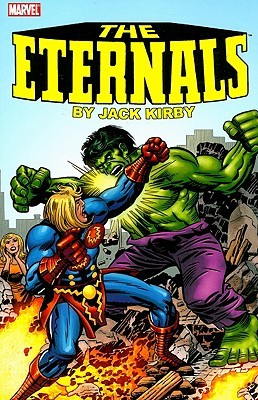
The Eternals Volume 2: written and illustrated by Jack Kirby with Mike Royer (1977; collected 2006): Jack Kirby's loopy, inspired riff on Chariots of the Gods comes to an early end, to be revived approximately every ten years afterwards by other people, including Neil Gaiman and John Romita Jr. on a real dud of a 2006 revival.
While the 2000-foot-tall alien Celestials continue to wander around Earth as part of their 50-year judgment, the Eternals and their foes the Deviants continue to mix it up on a variety of fronts. We follow Eternal Thena and her two Deviant charges, liberated from the Deviant gladiator pits, as they track down a time-travel menace in New York. An unnamed Eternal dubbed The Forgotten One struggles to stop an ill-advised Deviant assault on the Celestial mothership orbiting Earth.
Phew, what else. An ancient mind-controlling menace gets released from its prison below New York, and even the Eternals know fear. A science project designed to look like the Hulk gets animated by cosmic rays and proceeds to destroy New York. Man, New York takes a pounding. Admittedly, as the home of many of Marvel's heroes, it really should be completely depopulated by the late 1970's. How many times can Galactus show up on your streets before you get the message?
Kirby continues to follow different groups on different adventures, often ignoring other protagonists for several issues. It's highly unusual for a Marvel comic book of the time, but it does allow Kirby to develop a large variety of characters. It certainly died too soon. Recommended.