Dark Gods (1985) by T.E.D. Klein, containing the following stories: Children of the Kingdom (1980); Petey (1979); Black Man with a Horn (1980); and Nadelman's God (1985): Despite his relatively small output, especially over the 30 years since this collection appeared, T.E.D. Klein remains one of our greatest living horror writers thanks to the novellas collected in Dark Gods, the early 1970's novella "The Events at Poroth Farm," and the epic 1984 horror novel The Ceremonies. One lives in hope that the second novel announced as being in progress in the mid-1980's will some day appear.
The novellas collected here are meticulous and cosmic, witty and horrifying, closely observed and broad in their ramifications. "Petey" is perhaps the most traditional horror work, a story about something wicked this way coming to a secluded house in the countryside. But it melds that horror with a conversational view of the upper middle class that owes more to writers that include John Updike and John Cheever than to H.P. Lovecraft or Edgar Allan Poe. The monster is coming -- to a house-warming party.
Meanwhile, the house's previous owner gets more and more agitated in his new home at a psychiatric institution as the night goes on. It's a brilliant piece of work that rewards multiple readings (well, all four novellas reward multiple readings). There's something very droll yet grounded in the way that the horror gradually manifests itself, in the back-and-forth of the sometimes envious, often drunken conversations the guests have.
"Black Man with a Horn" is a triumphant piece of meta-Cthulhuiana, narrated by an elderly and somewhat self-pitying horror writer who still chafes at his description in genre circles as a "disciple of H.P. Lovecraft." It's 1980 and H.P. Lovecraft has been dead for 43 years. And then our narrator, mournful and sardonic, stumbles into what he ultimately realizes is a real-world equivalent of an H.P. Lovecraft story. The irony of being trapped in someone else's story doesn't escape him -- indeed, the horror of the situation lies partially in the fact that his literary fate of being subsumed into Lovecraftiana has now been replicated by his actual life's story being similarly removed from his own hands.
"Children of the Kingdom" densely and deftly explores racism and urban decay in the rundown New York of the late 1970's. As with "Black Man with a Horn," this novella riffs on Lovecraft, though in a much more subtle fashion: blink and you'll miss the revelation of just what Lovecraftian race the strange, seldom-glimpsed underground invaders of Manhattan are based on.
Klein's attention to an accumulation of telling, quasi-journalistic information as a means to create horror also owes a debt to Lovecraft (though HPL certainly didn't originate this sort of story-telling in horror circles). Klein, though, is a much better writer of normative characters than Lovecraft was (or intended to be). Here, as in all the novellas, cosmic horror infects the closely observed and described world of the ordinary.
Finally, there's "Nadelman's God." Klein makes brilliant use of the late 1970's and early 1980's media frenzy that hyped fears of Satanic rock bands and backwards-masked Satanic chants hidden on KISS albums. A comfortably numb New York advertising executive (pretty much all Klein's characters live in or near New York) finds himself pulled into the increasingly dire fantasies of a middle-aged heavy-metal fan who believes he can invoke the avatar of the true, malign God that rules the world.
And that invocation lies within a poem written and published by the executive when he was in college, a poem a former friend of the executive handed over to the rock band (Jizzmo!) he manages when they needed a song to finish their recent album (royalties, of course, were paid, though the executive didn't know of the adaptation until after its release). So that avatar the fan constructs out of garbage and broken glass, that's just a pile of garbage. Right?
But the executive, who has aged cynically out of all the things he once believed -- whether Judaism or marital fidelity or writing poetry -- is about to be forcibly reconnected with his past. It's like a tour down Memory Lane if Memory Lane led to Hell and involved a horrifying, ancient, cosmic evil that occasionally got its kicks from calling you on the telephone late at night.
Well, they're all brilliant novellas, aren't they? And it would be nice to have Dark Gods back in print after nearly 30 years, perhaps with "The Events at Poroth Farm" added to the roster. New novellas and novels would also be nice, but even if they never arrive, Klein has already established himself, permanently, in the first ranks of writers of horror. Highly recommended.
Spy: written and directed by Paul Feig; starring Melissa McCarthy (Susan Cooper), Jessica Chaffin (Sharon), Jude Law (Bradley Fine), Miranda Hart (Nancy), Jason Statham (Rick Ford), Bobby Cannavale (Sergio De Luca), Rose Byrne (Rayna Boyanov), Alison Janney (Elaine Crocker), and 50 Cent (Himself) (2015): Hilarious spy spoof takes full advantage of Melissa McCarthy's out-sized comic talents by making her hyper-competent, if occasionally a bit over-matched. The supporting cast is pretty much uniformly well-served as well, whether it's Jason Statham spoofing Jason Statham or 50 Cent supplying a winning cameo. Paul Feig, who did similar writing/directing duties on previous McCarthy movies The Heat and Bridesmaids, has become a gifted comic voice with a particularly appealing manner with women. Highly recommended.

Defending Your Life: written and directed by Albert Brooks; starring Albert Brooks (Daniel Miller), Rip Torn (Bob Diamond), Meryl Streep (Julia), and Lee Grant (Lena Foster) (1991): Albert Brooks writes, headlines, and directs this delightful bit of afterlife satire. I think it's one of the great all-time satiric-romantic film fantasies. The efficient, vaguely sinister bureaucracy of the Afterlife is really a star itself. Brooks is great riffing on that neurotic Albert Brooks archetype. Meryl Streep is unprecedentedly funny and charming. Rip Torn and Lee Grant supply sharp supporting work as dueling attorneys at Brooks' post-death 'trial' that decides whether or not he moves on or gets sent back to be reincarnated again. Highly recommended.

Big Hero 6: adapted by Jordan Roberts, Robert L. Baird, David Gerson, Joseph Mateo, and Paul Briggs from the comic book written by Steven T. Seagle and illustrated by Duncan Rouleau; directed by Don Hall and Chris Williams; starring the voices of Scott Adsit (Baymax), Ryan Potter (Hiro), T.J. Miller (Fred), James Cromwell (Callaghan), and Maya Rudolph (Cass) (2014): Charming Disney adaptation of a little-known comic book is better (and more moral) than most of Disney-Marvel's live-action superhero movies. The writing is sharp enough for adults but soft on hands for children. 'Personal health-care' robot Baymax, voiced by 30 Rock's Scott Adsit, steals every scene. Wait until the end of the credits. This is a Marvel movie, after all, even though it pretends otherwise... except in that post-credits scene. Recommended.

The Boxtrolls: adapted by Irena Brignull, Adam Pava, Anthony Stacchi, Phil Dale, and Vera Brosgol from the novel Here Be Monsters! by Alan Snow; directed by Graham Annable and Anthony Stacchi; starring the voices of Ben Kingsley (Archibald Snatcher), Jared Harris (Lord Portley-Rind), Nick Frost (Mr. Trout), Richard Ayoade (Mr. Pickles), Isaac Hampstead Wright (Eggs), Simon Pegg (Herbert Trubshaw), Dee Bradley Baker (Fish/ Wheels / Bucket), and Elle Fanning (Winnie Portley-Rind) (2014): Very, very English stop-motion animation film from the studio that brought you the weird and excellent Corpse Bride and Coraline. The first 20 minutes are a bit off-putting, but give the film a chance and the design, writing, and voice work ultimately make it well worth watching. A post-modern bit in the end credits is just icing on the cake. Or wheel of cheese. Indeed, The Boxtrolls is almost as obsessed with cheese as Wallace and Gromit. Recommended.
The Killers: adapted by Anthony Veiller, John Huston, and Richard Brooks from the short story by Ernest Hemingway; directed by Robert Siodmak; starring Burt Lancaster (Swede), Ava Gardner (Kitty Collins), and Edmond O'Brien (Jim Reardon) (1946): Burt Lancaster managed to get first billing in his first movie, but it's Edmond O'Brien's investigation of the death of Lancaster's character that drives the plot. And that plot owes more to Citizen Kane than to the Hemingway story that inspired the movie. Capable direction and a sharp script make this a fine early example of film noir. Recommended.

Bullitt: adapted by Alan Trustman and Harry Kleiner from the nove Mute Witness by Robert L. Fish; directed by Peter Yates; starring Steve McQueen (Frank Bullitt), Jacqueline Bissett (Cathy), and Robert Vaughn (Walter Chalmers) (1968): On the plus side, Bullitt has its iconic, 10+ minute car chase and a stoic, macho yet sensitive leading turn by Steve McQueen. On the negative side, the plot is a bit thin, Jacqueline Bissett is wasted in the thankless role of McQueen's girlfriend, and certain aspects of the police work in the movie stagger the imagination. Only three officers total assigned to witness protection? And how the Hell does McQueen get to stay on the case after the literally explosive (and improbably dead-innocent-bystander-free) result of that iconic chase? Oh, well. For those who enjoy film continuity errors, count the number of times Bullitt passes the same slow-moving green car during the car chase. For those who enjoy standard transmission, listen to all the shifting! Recommended.

Night Moves: written by Alan Sharp; directed by Arthur Penn; starring Gene Hackman (Harry Moseby), Jennifer Warren (Paula), Susan Clark (Ellen Moseby), James Woods (Quentin), Kenneth Mars (Nick), and Melanie Griffith (Delly) (1975): Grungy, sun-bleached, almost quintessentially 1970's film noir. Arthur Penn (Bonnie and Clyde) directs in a fast-paced manner that requires quick wits to keep up with at times as he leaps from scene to scene. Gene Hackman is suitably grumpy and world-weary as our private detective whose unusual (for the genre) back-story is that he was an NFL player. Early turns from James Woods and Melanie Griffith and a remarkable amount of casual nudity are some of the highlights. Recommended.

Stranger on the Third Floor: written by Frank Paros and Nathanael West; directed by Boris Ingster; starring John McGuire (Mike), Margaret Tallichet (Jane), and Peter Lorre (The Stranger) (1940): RKO B-movie burned off the last two days of Peter Lorre's contract with the studio -- top-billed, he only has one speaking scene. Instead, the protagonists are reporter John McGuire and plucky girlfriend Margaret Tallichet. There's murder afoot in New York! An extremely expressionistic nightmare sequence made me wonder if director Boris Ingster was yet another German director who had fled Nazi Germany for Hollywood. He wasn't, but the sequence sure suggests such a conclusion. Lightly recommended. Also, only about an hour long.
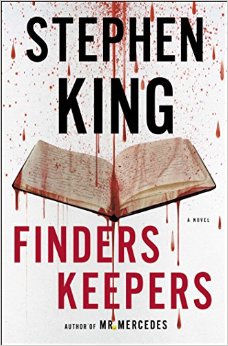
Finders Keepers by Stephen King (2015): The year is 2014 and the mismatched detectives of last year's Mr. Mercedes are back in a new mystery set three years after the conclusion of that novel -- and, as a sub-plot, there's also an odd continuation of the events of the previous novel that seems to be setting up the events of the third novel.
Our protagonist, retired police detective Bill Hodges, continues to run his private detective agency with the help of hyper-intelligent, socially challenged Holly Gibney, with an occasional assist from now-college-student Jerome Robinson. But the scene of carnage that began Mr. Mercedes has helped deliver another case. I'll let you find out how. Suffice it to say that injury and the economic collapse of 2008 will soon put a young man on a collision course with an unusual treasure buried near his house since the late 1970's. And one collision will set off many others.
This is really an odd novel, at least for King. We spend a lot of time with that kid -- Pete Saubers -- and his economically wounded family. And we spend a lot of time learning about that treasure and the terrible man who buried it. But the money in that treasure -- about $30,000 in cash -- is the smallest portion of the booty.
See, back in the late 1970's, a lousy guy in his early 20's was obsessed with a novelist named John Rothstein, who in King's world combines the attributes of John Updike, J.D. Salinger, and Philip Roth. In the 1950's and 1960's, Rothstein wrote a trilogy of novels subsequently dubbed The Runner Trilogy. Those novels featured a protagonist who seems to combine the personality traits of Updike's Rabbit Angstrom and Salinger's Holden Caulfield.
One day in the 1960's, Rothstein stopped publishing and essentially became a hermit overnight on a farm outside a small New England town. Years later, a young reader (and aspiring writer) named Morris Bellamy went looking for Rothstein. He told his two accomplices that they were looking for money. But Bellamy was really looking for Rothstein's unpublished work. And he found it. And, while fleeing from the police, buried it. Arrested and jailed for more than 30 years for a crime unconnected to the Rothstein home invasion, Bellamy finally gets out and goes looking for that unpublished work. But it isn't there -- Pete Saubers dug it up.
Morris Bellamy is one of King's more interesting antagonists, a self-pitying fan who believes he has more right to his favourite author's work than that author. The characterizations of the other characters are all solid, especially of the slowly blossoming Holly Gibney and the intelligent, thoughtful Pete Saubers, whose love of reading is ignited by the contents of that box of treasure. There's not a huge amount of detection in this second Bill Hodges volume, but the material on Rothstein, and on the used book trade (seriously), is highly enjoyable. Recommended, though keep in mind this is a mystery-thriller (mostly) and not a horror novel.
The War of the Worlds: Global Dispatches: edited by Kevin J. Anderson (1996), comprising the following stories:
The Roosevelt Dispatches by Mike Resnick; Canals in the Sand by Kevin J. Anderson; Foreign Devils by Walter Jon Williams; Blue Period by Daniel Marcus; The Martian Invasion Journals of Henry James by Robert Silverberg; The True Tale of the Final Battle of Umslopogaas the Zulu by Janet Berliner; Night of the Cooters by Howard Waldrop; Determinism and the Martian War, with Relativistic Corrections by Doug Beason; Soldier of the Queen by Barbara Hambly; Mars: The Home Front by George Alec Effinger; A Letter from St. Louis by Allen Steele; Resurrection by Mark W. Tiedemann; Paris Conquers All by Gregory Benford and David Brin; To Mars and Providence by Don Webb; Roughing It During the Martian Invasion by Daniel Keys Moran and Jodi Moran; To See the World End by M. Shayne Bell; After a Lean Winter by Dave Wolverton; The Soul Selects Her Own Society: Invasion and Repulsion: A Chronological Reinterpretation of Two of Emily Dickinson's Poems: A Wellsian Perspective by Connie Willis.
About as enjoyable an homage-anthology as I can remember. The War of the Worlds: Global Dispatches gives us the adventures of a wide variety of historical figures during the great Martian invasion chronicled in the novel by H.G. Wells. We visit the invasion on many fronts and on many continents and in many countries, with a side-trip to Mars itself so that Edgar Rice Burroughs can report on what John Carter did to halt the invasion from the Martian end.
The shifts in tone and subject matter from story to story can be a bit jarring, as the stories run the gamut from meditative tragedy to a loopy satire of academia from Connie Willis. But that range is part of the volume's charm: you really don't know what's coming next. Maybe it's Tolstoy and Stalin teaming up to create a refugee camp in late-Tsar-era Russia. Maybe it's a bunch of rootin', tootin', shootin' Texas folk taking on the Martians. Maybe it's an H.P. Lovecraft pastiche pitting Boy Lovecraft against the Martian invaders of Providence like some moody, glum, but plucky Hardy Boy.
The writers tend to gravitate towards writers as protagonists, including Mark Twain, Henry James, Joseph Conrad, and H.G. Wells himself. Highly recommended, and I'd really like to see a full-length novel version of John Carter vs. The Martians by George Alec Effinger.
The Mysterious West by Brad Williams and Choral Pepper (1967): Fun and surprisingly fact-based assortment of weird stories of the American (and, in a cameo, Canadian) West. The essays examine everything from Romans and Phoenicians in places where one wouldn't expect to find them to the odd adventures of various outlaws, miners, ghosts, and lost expeditions. A good time-filler, especially if one follows up on some of the stories to check their truthiness. Recommended.
 Dreadstar Omnibus Volume 1: written by Jim Starlin; illustrated by Jim Starlin, Al Milgrom, and Josef Rubinstein (1983-84/This collection 2014): The Golden Age of long-form science fiction/fantasy came for American comic books in the 1980's with such great series as Grimjack, Nexus, Time Spirits, Aztec Ace, American Flagg, and Dreadstar. Writer-artist Jim Starlin's Dreadstar first appeared in serialized form in Marvel's Epic magazine before getting its own book from Epic Comics once that first storyline had been completed. So while this is the first omnibus reprint, there is a real first volume also available that one should start with unless one is familiar with the story.
There are certain boilerplate elements in Dreadstar's story -- evil galactic empires, heroes with energy swords, masked villains. Starlin manages to transcend them as he goes along. The fight scenes are often quite nicely choreographed. The supporting characters are sympathetic and interesting. Dreadstar himself remains a mournful piece of beefcake throughout the series, but the aforementioned supporting characters keep us from dwelling too much on his limitations. Starlin did much the same thing at Marvel in the 1970's with Warlock, whose supporting characters supplied the characterization while the protagonist supplied the cosmic angst.
One of the better issues included here gives the background to the villain of the piece, the Lord High Papal, leader of the genocidal, church-based empire named the Instrumentality (a nod to the science fiction of Cordwainer Smith). Starlin also shows more of a sense of humour in this series than he generally did, and a lighter hand when it comes to speechifying. His choices in names are still halfway-hilarious sometimes: an evil race named the Zygoteans still cracks me up.
The 12 issues collected here really are enjoyable, certainly moreso than the vast majority of superhero comics from the same era. Beware, though -- the story doesn't really end with the last issue, and the next omnibus isn't due until next year. Though you could always go looking for back issues. Recommended.
The Avengers: The Kang Dynasty: written by Kurt Busiek; illustrated by Alan Davis, Kieron Dwyer, Ivan Reis, Brent Anderson, and others (2001-2002/Collected 2002): Writer Kurt Busiek ended his late 1990's/early oughts run on Marvel's The Avengers with a gigantic bang -- nearly a year-and-a-half arc pitting the Avengers against their time-traveling foe Kang the Conqueror. It's mostly a blast, though a muted one towards the end as the events of 9/11 overtook the events depicted in the story, leading to a final-issue requiem for those fallen to Kang's invasion that reflects the sorrowful poster-boards of post 9/11 Manhattan, with photos of the lost and missing.

Otherwise, Busiek and his rotating band of artists keep an astounding number of characters and situations in the air. The Avengers comic book has always had a luxury the Avengers movies never will have -- the space to develop a long list of characters, rather than a core group of six or seven. You may not like the minor heroes of this Avengers line-up, but Busiek does a fine job of making them important within the epic scope of the story. Whether it's the big-time Thor or the little-known Triathlon, everyone has a part to play in saving the Earth. It's too bad that the saga couldn't have gotten one or at most two artists for its entire length. Nonetheless, Alan Davis, Kieron Dwyer, Ivan Reis, and Brent Anderson do stand-out work on their portions of the saga. Recommended.

Justice League United: The Infinitus Saga: written by Jeff Lemire; illustrated by Neil Edwards, Jay Leisten, and Keith Champagne (2014-2015): Mostly fun six-issue Justice League United arc that brings the 'real' Legion of Super-heroes (LSH) from the 31st century back into action in the DC Universe. Each issue, the head-shots of featured characters surrounding the title page become more and more numerous in what must have been a conscious bit of fun. And it works, among other things.
That Lemire and company make the new DCU's reboot of classically kitschy Silver Age hero Ultra the Multi-Alien into something compelling is amazing enough. That they manage to link him to a re-imagined Infinite Man (an LSH foe originally from the 1970's) is really quite clever. There's maybe about 20% too much fighting, but it's fun to see such oddball-yet-effective LSH members such as Bouncing Boy back again, bouncing for justice. Recommended.
Convergence: written by Jeff King, Scott Lobdell, and Dan Jurgens; illustrated by Ethan Van Sciver, Jason Paz, Carlo Pagulayan, Stephen Segovia, Eduardo Pansica, Aaron Lopresti, Ed Benes, Andy Kubert, and many others (2015): As a standalone miniseries, the weekly, 9-issue Convergence is something of a disaster. It did tie into a seemingly endless group of two-issue miniseries focused on various DC heroes from a wide range of 'abandoned' universes, and some of these two-parters were very good (especially Shazam!). The 9000-page Convergence Omnibus edition should be half-killer, half-filler.
However, Convergence is important for company-wide reasons at DC as it establishes a new/old status quo in its final issue. Unfortunately, while we see the build-up to the important, universe-shattering battle in that final issue, and while we see the aftermath, we do not actually see the battle itself. Either that or my copy of Issue 8 (the series begins with Issue Zero, btw) is missing several dozen pages.
In a way, this makes Convergence the perfect capstone to 30 years of universe-shattering, forest-consuming, million-issue crossover events at DC and Marvel. It's a story so big they couldn't fit the story in. Wait for next year's Convergence: Crisis War Blues Explosion mini-maxi-series, I guess.
And while there are moments of interest interspersed throughout the miniseries (most of them in issue zero, illustrated with snap and verve by Ethan Van Sciver) , a lot of space involves fighting, more fighting, and pointlessly and brutally killing off characters from a Warlord comic-book series that most readers probably weren't born to read when last it breathed life on the comic-book racks. I mean seriously: we spend what seems like half the miniseries in the world of Warlord. And we're mainly there to kill off all the characters in terrible, futile situations. Did Warlord creator and writer-artist Mike Grell poop in somebody's punch bowl over at DC recently?
So while the outcome of Convergence is mostly fine by me, the execution of this miniseries is surprisingly dreadful for long stretches. Pick up the beautifully illustrated Issue Zero and Issue 8 and forget the rest of the minieries. Oh, and track down Convergence: Shazam 1-2. Not recommended in its entirety.