Friday, April 30, 2010


The Batrachian and the Beautiful

Movie:
The Bad and the Beautiful, directed by Vincente Minelli, starring Kirk Douglas, Lana Turner, Gloria Grahame, Dick Powell, Barry Sullivan and Walter Pidgeon (1952): A fairly early Hollywood movie about Hollywood, The Bad and the Beautiful won a number of Academy Awards and has dated remarkably well, all things considering. We follow the career arc of Hollywood producer Jonathan Shields (Douglas) from rags immediately after his bankrupt father's death to riches and back to (almost) rags again within a frame narrative.Three characters (star actress, star director and star writer) who Shields both helped and screwed over on the way up (literally in the case of Turner's actress character) provide a subjective triptych of Shields' career in film. Will they agree to work with him again and help him restart his career? There the movie ends.
The screenplay zips along (and won one of those Oscars), and Lana Turner and Gloria Grahame (another Oscar) give stand-out performances in what is basically a comic melodrama. Cinematic in-jokes abound (one feature is obviously meant to be the original, much-lauded B-movie Cat People; a Germanic director seems to be a carbon copy of Erich Von Stroheim), as does a surprising amount of sexual innuendo, the funniest bit of which is completely wordless (the Latin lover character Gaucho stares appraisingly at a woman's butt as she gets into the backseat of a car. Frankly, I'm surprised the shot got past the Hayes Office). The movie ends up being a paean to the old Hollywood studio system, a system that doesn't exist any more, when placed in the hands of an innovative thinker such as Shields. Recommended.
Book:
The Trail of Cthulhu by August Derleth (1944-1951): Five linked stories form this collection/story cycle following the efforts of a diverse group of individuals attempting to forestall Cthulhu's always-imminent invasion of our universe from his prison on the intermittently sunken island of R'lyeh in the South Pacific. The quest narrative, and Derleth's tendency to literalize pretty much everything about H.P. Lovecraft's Cthulhu Mythos (a name Derleth himself coined after Lovecraft's death in 1937 to describe a loose-knit collection of stories by Lovecraft and others about ancient alien 'gods' who want to return to Earth), tend to dampen the horror elements while highlighting how similar certain aspects of the Mythos are to high-fantasy constructs such as The Lord of the Rings.
Technically, we're dealing with a fellowship (no women allowed) trying to stop a Dark Lord from taking over the planet; the last story here was even published in 1951, the same year as LOTR came out in hardcover in England. In any event, it's an enjoyable romp with some striking scenes (the desert journey to the Nameless City and a brief depiction of the war between the relatively benign 'Elder Gods' and Cthulhu and the rest of the Great Old Ones are particularly nice). Having read a lot of Derleth in a short span, I will say that I'm heartily sick of the evil, sea-dwelling Deep Ones, who Derleth almost reflexively plugs into his stories as the 'infantry' of the Great Old Ones. A little more Tcho-Tcho or Mi-Go would be nice. Heck, I'd even like to find out what a Voola or a Dhole is. Recommended.
Tuesday, April 27, 2010
Bartleby the Giant

Movie:
Big Fan, written and directed by Robert Siegel, starring Patton Oswalt and Kevin Corrigan (2009): Every enterprise that has fans, has fans who are obsessive fringe-dwellers, and that's as true of professional football as it is of Star Trek or comic books. But because sports fandom is much more culturally accepted in the U.S. and Canada, many people would never view the act of, say, painting one's face before going to see a big game in the same light as dressing up as a Klingon to go to a Star Trek convention, even though the two acts are pretty much the same act.
Written and directed by the writer of The Wrestler, Big Fan examines the life of Paul Aufiero, a New York Giants fan who seems to live almost entirely through his football team. He carefully scripts what he'll say on radio call-in shows. His 'real' life is almost entirely non-existent -- only one friend that we see; a dead-end, low-paying job as a parking lot attendant; a family that finds him frustrating and baffling. At 36, Paul still lives at home with his mother. This could have been the most depressing movie about fandom ever.
And yet in a way it isn't, because the movie's quite careful -- and quite empathetic -- in its construction of Paul's love affair with the Giants, and why it is that his entire imaginative life orients around the team. His family members are jerks and, as he points out to his mother at one point, his successful-lawyer brother cheated on his first wife for years with the fake-boob-enhanced secretary who is now his second wife. He holds the far more financially rewarding jobs of his brother and his brother-in-law in barely concealed contempt: his job allows him all the time in the world to indulge in his fannishness, his real life of vicarious thrills, victories, defeats.
Paul doesn't think he lives a life of quiet desperation, though in many ways he does. Patton Oswalt -- a stand-up comedian best-known for being the voice of Ratatouille -- invests Paul with a weirdly jaunty nerdishness in his refusal to be part of the responsible, 'real' world of work. He's like Bartleby the Scrivener had Bartleby cheered up and found a sports team to cheer for. But otherwise, he prefers not to.
And then one day, a series of events leads Paul to be beaten into a three-day coma by his favourite Giants player. The bulk of the film then focuses on how Paul can deal with this fact, especially as the NFL suspends the player, his brother plots a $77 million lawsuit against the player, and he wrestles with the question of just how much he loves the Giants (and hates the rest of his life).
There are clear movie antecedents for this character and this narrative, from Taxi Driver to The King of Comedy to the terrible Observe and Report. The care taken with the small details that define this character and his world makes this a character study worth watching, surprisingly funny and sad at points (generally simultaneously), and with a 'shock' ending that helps define his character once and for all. Highly recommended.
Monday, April 26, 2010
Don't Drink the Water.
Book:
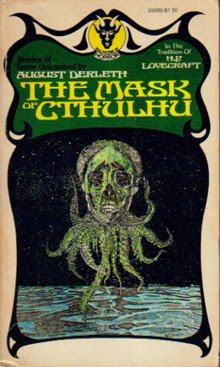
The Mask of Cthulhu by August Derleth (1936-1953): Or, a minor Cthulhu Mythos collection of five stories from Ballantine's paperback horror line of the 1970's. Derleth was inordinately fascinated with Lovecraft's fictional New England seaport of Innsmouth, the subject of Lovecraft's late-period novella "The Shadow Over Innsmouth," in which miscegenation between humans and frog-like Cthulhu-and-Dagon worshippers known as the Deep Ones has led to a certain dangerous wackiness about the inhabitants of Innsmouth. That dangerous wackiness leads to the only U.S. Armed Forces vs. Batrachian Horrors action that I know of in Lovecraft's entire oeuvre, as the U.S. Navy opens up a can of whoop-ass on the Deep Ones, and indeed Innsmouth itself.
Squamous, batrachian horrors living in or under houses with gambrel roofs make appearances in several of the stories collected here, pretty much always up to no good (and by 'no good,' I mean 'plotting the destruction of all of humanity'). Derleth's tendency towards liter-mindedness, lengthy stretches of exposition and a somewhat unLovecraftian bipolarization of the ancient aliens into Good and Evil camps makes his stories less horror than dark, tending-toward-epic fantasy. It actually makes me wish that Derleth had gone all out with 'his' version of the Mythos and come up with some sort of epic, lengthy take on Cthulhu and the other Great Old Ones.
One of the curiosities of Lovecraft's work that gets repeated here is Lovecraft's association of the whippoorwill with evil -- in the Cthulhu Mythos, they seem to operate as sinister psychopomps and harbingers of doom. It's the sort of curious construction that makes me think Lovecraft was kept awake at some point by a particularly vociferous whippoorwill and decided to get his revenge in writing. Recommended.
The Old Gods Waken

Books:
The Lurker at the Threshold by H.P. Lovecraft and August Derleth (1945): I'm not sure how much Lovecraft is really in this novel -- I'd guess Derleth fleshed out some prose fragments and possibly a short plot outline. In any event, it's steeped in the Cthulhu Mythos, following the ill-fated relocation of a retired British man to his ancestral mansion near the fictitious New England city of Arkham. I think this may be Derleth's strongest work as a writer (his status as a publisher who kept the work of Lovecraft and others in print until it came back into style in the 1960's has never been in doubt; Derleth is an incredibly important figure in American fantasy fiction for that reason alone).
The structure is interesting and effective (three narratives, each picking up where the last one leaves off), and Derleth controls his tendency to over-explain everything to do with Lovecraft's fictional mythology-that-isn't-really-a-mythology (because the gods are really aliens and their powers ultimately derive from vague but potentially explicable sources). The result is an enjoyable novel of doomed genealogy and ancient evil, similar in many ways to Lovecraft's short novel The Case of Charles Dexter Ward, only not as intentionally funny.
As the events of the novel take place near fictional Dunwich and involve the always entertaining Great Old One Yog-Sothoth (both the gatekeeper and the gate to the other-dimensional realms where the Great Old Ones were imprisoned by the relatively benevolent aliens traditionally known as the Elder Gods), the novel also works as a companion piece to Lovecraft's "The Dunwich Horror," in which Yog-Sothoth gets up to all sorts of shenanigans in the hills surrounding decayed and inbred Dunwich. I can't say as I was ever scared, but I was entertained. Recommended.
Pork Pie Hat by Peter Straub (1999): Straub's novella gives us the reminiscences of a former graduate student who, on one fateful night, interviewed a great jazz saxophonist named here only as 'Hat' (for his ubiquitous, eponymous hat) just months before that musician's death. The student, looking back twenty years later in the retrospective narrative mode I always think of as Great Expectations Structure, tells us the disturbing story-within-a-story the saxophonist told of one strange Hallowe'en night in Mississippi when the musician was 11.
One of Straub's great narrative gifts has been to make what should be complex and perhaps distancing narrative structures seem instead organic, natural -- 'non-threatening', if you will. His novels and short stories have always been invested with a wide and deep concern with The Matter of Story, how to tell stories, how to create narrative from existential chaos. But Straub does these often-metafictional things without distancing the reader from the characters or the densely described world they inhabit. It's a hell of an accomplishment, one that most postmodern writers never come close to achieving. Pork Pie Hat is an affecting story about stories in which Hat's Hallowe'en story opens a door onto one of Straub's major thematic concerns -- the Sublime, the wonder and terror of existence, and how the Sublime can arise out of the normative and even the most base human actions. Highly recommended.
Friday, April 23, 2010
The World's Worst Bodyguard
Yojimbo (Japanese for "Bodyguard"), directed by Akira Kurosawa, starring Toshiro Mifune (1961): Yojimbo has been remade twice -- once as Sergio Leone's A Fistful of Dollars, starring Clint Eastwood; once as Walter Hill's Last Man Standing, starring Bruce Willis. The original pits a sardonic wandering samurai in 19th century Japan against an entire town of criminals who, through guile and swordplay, the samurai attempts to wipe out. It's interesting how the movie balances slapstick comedy with often portentous drama (wind, rain and fire are occasionally apocalyptic elements) in a way that's peculiar to Kurosawa.
It helps that Mifune's samurai occasionally looks weirdly like Bugs Bunny in a cartoon with a really high bodycount, with a couple of the more comic bad guys filling in for Elmer Fudd. This is pretty much essential viewing, and a much shorter go than Kurosawa's epic masterpiece The Seven Samurai. The translation occasionally slips into hilarity. In response to a dying gangster's "The gates of hell...I'll be waiting for you there!", the samurai exclaims, "What a guy!" I'm not sure why that's so funny, but it really is. Kurosawa's compositional skills amaze throughout, as does his ability to rapidly shift tone from comedy to tragedy. Followed by a sequel, Sanjuro. Highly recommended.
It helps that Mifune's samurai occasionally looks weirdly like Bugs Bunny in a cartoon with a really high bodycount, with a couple of the more comic bad guys filling in for Elmer Fudd. This is pretty much essential viewing, and a much shorter go than Kurosawa's epic masterpiece The Seven Samurai. The translation occasionally slips into hilarity. In response to a dying gangster's "The gates of hell...I'll be waiting for you there!", the samurai exclaims, "What a guy!" I'm not sure why that's so funny, but it really is. Kurosawa's compositional skills amaze throughout, as does his ability to rapidly shift tone from comedy to tragedy. Followed by a sequel, Sanjuro. Highly recommended.
Sunday, April 18, 2010
Rickard's Red
I don't really have anything against Rickard's Red...it's just that the TV ads with the three barflies and the bartender spouting 'clever' lines recommending the brew really beg for new lines...
Rickard's Red...it's what's for dinner.
Rickard's Red...nothing beats the taste sensation when cough syrup collides with Molson Canadian!
Rickard's Red...because you're too cheap to buy Smithwick's.
Rickard's Red...now made with fresh Tang crystals!
Rickard's Red...it's full of flavour. Unfortunately, that flavour is ass.
Rickard's Red...now with 20% more dog!
Rickard's Red...when you're drunk, all beers taste the same anyway.
Rickard's Red...tastes as good coming up as it did going down!
Rickard's Red...the unofficial beer of the Communist Party of Canada.
Rickard's Red...tough on dishes, mild on hands.
Rickard's Red...it's what's for dinner.
Rickard's Red...nothing beats the taste sensation when cough syrup collides with Molson Canadian!
Rickard's Red...because you're too cheap to buy Smithwick's.
Rickard's Red...now made with fresh Tang crystals!
Rickard's Red...it's full of flavour. Unfortunately, that flavour is ass.
Rickard's Red...now with 20% more dog!
Rickard's Red...when you're drunk, all beers taste the same anyway.
Rickard's Red...tastes as good coming up as it did going down!
Rickard's Red...the unofficial beer of the Communist Party of Canada.
Rickard's Red...tough on dishes, mild on hands.
Subscribe to:
Posts (Atom)