Showing posts with label august derleth. Show all posts

Wednesday, July 27, 2016

Arkham - Scouse

Letters to Arkham: The Letters of Ramsey Campbell and August Derleth, 1961-1971 (2014): edited by S.T. Joshi: Essential, informative, and educational reading for any reader of horror, and especially for those who admire both H.P. Lovecraft and Ramsey Campbell.

August Derleth was a fantastically important editor and publisher in the realms of the weird. He kept H.P. Lovecraft in print, in book form, for decades until the rest of the world started catching up with the Cthulhu Mythos. And he also published the first book by Liverpudlian Ramsey Campbell after Campbell started corresponding with Derleth back in 1961.

In 1961, Campbell was 15. His first collection -- The Inhabitant of the Lake -- would come out from Arkham in 1964. And while the precocious Campbell's early works would be Lovecraftian pastiches not-dissimilar to some of Derleth's own work, Campbell's growth curve as a writer was startlingly steep. By the late 1960's, his voice was uniquely his own and he'd helped pioneer a new approach to visionary horror.

Derleth and Campbell carry on a lively, wide-ranging correspondence for ten years, though the last three years are a bit spotty because many letters have gone missing. While thoughts on horror are the main attraction, Letters to Arkham also offers a glimpse into the cottage industry that was Arkham House. We also learn just how prolific Derleth was as a writer. And a lover, though some of that may be taken with a grain of salt.

As Campbell notes in his afterword, he was something of a fan-boy in his early letters. But that element gradually slips away, leaving the reader with a dialogue between two friends who never met in person. Their debates on the merits of everything from Peter Sellers to Samuel Beckett are lively and fascinating. Derleth functions as a mentor figure for Campbell throughout their correspondence when it comes to writing and, more generally, living. 

And we find out that Derleth took to the Wisconsin woods where he lived every May to collect morel mushrooms. Thousands of them, their number dutifully reported each year. Fungi from Wisconsin. How Lovecraftian is that? Highly recommended.

Monday, May 2, 2016

Something in the Dark


Night & Demons (2013) by David Drake, containing the following stories:


  • The Red Leer (1979): Deftly characterized 'werewolf' story with a science-fictional twist.
  • A Land of Romance (2005): Enjoyable, twee nod to one of Drake's favourite writers, L. Sprague de Camp.
  • Smokie Joe (1977): A horror story not for the squeamish.
  • Awakening (1975) 
  • Denkirch (1967): The venerable August Derleth bought this early Drake story for Arkham House. It's a slight but enjoyable pastiche of Derleth and Lovecraft.
  • Dragon, The Book (1999)
  • The False Prophet (1989): The longest story involving Drake's classical Roman times characters Vettius and Dama (V&D), who repeatedly stumble into supernatural situations.
  • Black Iron (1975): V&D
  • The Shortest Way (1974): V&D
  • Lord of the Depths (1971)
  • The Land Toward Sunset [Cormac Mac Art] (1995) : Highly enjoyable novella featuring Robert E. Howard's Celtic hero Cormac Mac Art and a remnant of Atlantis.
  • Children of the Forest (1976): Marvelous 'cryptid' story set in late medieval Europe.
  • The Barrow Troll (1975)
  • Than Curse the Darkness (1980): One of the ten or fifteen greatest Cthulhu Mythos stories not written by H.P. Lovecraft. Drake's attention to the details of history creates a Belgian Congo turned into a house of horrors, not by ancient gods, but by European atrocities committed in the name of the rubber trade.
  • The Song of the Bone (1973)
  • The Master of Demons (1975)
  • The Dancer in the Flames (1982): Viet Nam horror.
  • Codex (2003)
  • Firefight (1976): One of Drake's horror stories informed by his time in Viet Nam.
  • Best of Luck (1978): Short-short resembles the superior "Something Had to Be Done."
  • Arclight (1973): Viet Nam horror.
  • Something Had to Be Done (1975): Brilliant horror story draws on Drake's Viet Nam time to deal with a very old horror trope.
  • The Waiting Bullet (1997): A nod to Drake's friend and mentor Manly Wade Wellman in its rural mountain setting.
  • The Elf House (2004)
  • The Hunting Ground (1976): A great piece of urban horror pits a crippled Viet Nam vet against... something. Reads like a blueprint for elements of the Predator and Alien movies. 
  • The Automatic Rifleman (1980): Drake nods to Fritz Leiber with the title of this science-fiction story, and to Leiber's Changewar series in the story's premise.
  • Blood Debt (1976)
  • Men Like Us (1980): Great piece of post-apocalyptic science fiction that uses some of the most persistent Atomic and Golden Age science-fiction tropes in refreshingly new ways. 
  • A Working Bibliography of David Drake's Writing (2012) by Karen Zimmerman 


* The note "A shorter version of this volume appeared in 2007 as Balefires" is found on this book's copyright page, and was published by Night Shade Books. The added stories are: "Dragon, the Book", "The Land Toward the Sunset", "Codex" and "The Waiting Bullet".


One of the great bargains of all time in its mass-market paperback version. Night & Demons collects a tonne of the prolific, thoughtful Drake's short works from the past 40 years. They fall broadly into the horror and dark fantasy genres, though science fiction also plays a part on its own or in several of the horror stories. Along with the stories comes about a hundred pages of Drake's musings on the genesis of the stories. The recollections are both amusing and informative. Highly recommended.

Saturday, February 28, 2015

The Old Shoe of Cthulhu

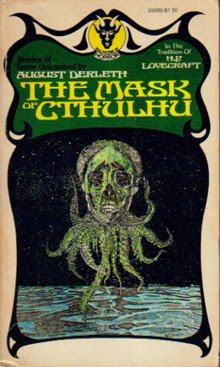
The Mask of Cthulhu (1958) by August Derleth, containing the following stories: "The Return of Hastur" (1939);  "The Whippoorwills in the Hills" (1948); "Something in Wood" (1948);  "The Sandwin Compact" (1940); "The House in the Valley" (1953); and "The Seal of R'lyeh" (1957).

August Derleth's Lovecraftian stories can send some people into a rage. The rage seems to stem from Derleth's attempt to recast the Cthulhu Mythos (a term which he coined, not Lovecraft) as a conflict between Good and Evil. Lovecraft's Cthulhu Mythos stories generally suggested that the ancient aliens/gods that threatened humanity were amoral, not immoral: basically, they just wanted their universe back, and humans were the ants that were getting in the way.

So it goes. A lot of writers have continued in the Derlethian vein of Cthulhu Mythos, though -- among them, Brian Lumley, Lin Carter, and Colin Wilson. It's a subset of Lovecraftian horror, and one that's no more or less legitimate than the far larger school of Lovecraftian horror that ends every story in absolute despair and defeat for humanity. Lovecraft's Cthulhu Mythos stories ended with humanity still hanging in there, somehow, though his protagonists often took it in the chin. Both schools diverge from Lovecraft's vision, then.

But as to this collection of some of Derleth's wanderings in Lovecraft-land. Well, Derleth was superior to Lovecraft in at least one aspect: his depiction of rural life. His small towns and the countryside around them generally seem fairly believable, and his rural dialects aren't absolutely bananas the way that Lovecraft's forays into self-invented rural dialect in stories that include "The Colour out of Space" and "The Dunwich Horror" tend to be.

Beyond that, there's a sort of comforting nature to Derleth's Cthulhu Mythos stories. His monsters aren't particularly scary. Indeed, he goes to the well of the Deep Ones (from Lovecraft's "The Shadow over Innsmouth") so many times in his stories that they lose all capacity to shock. 

So, too, one of Derleth's preferred narratives, in which a person moves into a house or a region and subsequently either gets possessed by ancient, resident evil or at least severely threatened by it. Five of the six stories in this volume follow that pattern; there are an awful lot of the same type of story throughout the rest of Derleth's work as well. It's an interesting psychological obsession: Derleth, working in someone else's milieu, again and again writes about people who end up... working in someone or something else's milieu. Lovecraft himself used this plot on several occasions, though not nearly as many times as Derleth did -- and in Lovecraft's case, the affected parties are related to the ancestors who plague them in the present.

The one story here that doesn't follow this pattern, "Something in Wood," instead has its doomed character gradually possessed by a statue of Cthulhu. I guess we're really six for six in this vein, aren't we? This subset divides into two categories: people who are related to previous occupants of the house and people who aren't. The subset that cuts across these are people who are overwhelmed by the evil in the house and people who defeat it. 

Another thing that happens several times in the collection is a scene in which it's discovered that someone has vanished somehow from inside their clothes, leaving an empty outfit on the floor or on a chair as if they'd been sucked right out of it. It's a nice image when used sparingly. I enjoyed these stories, though they're not frightening and some of the breathless, italicized concluding paragraphs seem almost intentionally self-parodic. Recommended.

Thursday, January 29, 2015

Shiny Happy Lovecraft

The Mind Parasites by Colin Wilson (1967): English writer Colin Wilson started off critical of H.P. Lovecraft. But after being challenged by Arkham House founder August Derleth to try to write a Lovecraftian piece of fiction, Wilson ended up writing at least three Lovecraft-tinged novels and one novella. 

However, what makes The Mind Parasites one bonkers addition to the Mighty Lovecraft Tradition is Wilson's own life philosophy, sometimes described as 'optimistic existentialism' or 'phenomenological existentialism.' Basically, human beings need to be positive. And we can map subjective experiences of the mind as if they were objective and quantifiable phenomena. And...

Well, Wilson pushes these concepts in The Mind Parasites into the realm of super-powers that the right person can attain, basically, by thinking real hard for a few days.

This leads to a lot of philosophical discussion, much of it bat-shit crazy, and all of it in service to a plot in which ancient 'Mind Parasites' have been keeping humanity from reaching its super-powered potential for at least 200 years.

Lovecraft gets name-checked along the way, his stories re-imagined as dream visions of the way the universe operates. Whatever horror there is occurs early in the novel, before people start developing earth-shaking super-powers. It's the early stretches that are most Lovecraftian, as details accumulate and parallels with Lovecraft's "The Call of Cthulhu" are most prominent.

The main events of the novel take place in 1997, 30 years after The Mind Parasites was written. Wilson gets a lot wrong about the then-future. Indeed, it isn't clear until the climax why the novel had to be set in the future. Then we find out. Oh, brother, do we find out!

The basic set-up of the novel -- in which a few plucky, intelligent men In the Know must band together against a massive menace -- recalls some of Lovecraft's works, as well as a lot of other science fiction (Robert Heinlein's Sixth Column, a.k.a. The Day After Tomorrow, much resembles this work, though there the menace is human and the super-powers used to combat it derived from new engineering and scientific discoveries). One also sees the echoes of Eric Frank Russell's Sinister Barrier, in which humanity faces hitherto unseen alien enemies. It's very much a science-fiction trope, and Wilson's heroic cadre of super-thinkers become that old stand-by, The Secret Elite, in order to save humanity.

Wilson's exposition can be heavy-going at times. And while ostensibly inspired by Lovecraft, the novel very quickly moves into the more optimistic Derleth Branch of Lovecraft-inspired fiction: these evils can not only be combated, but utterly annihilated. Brian Lumley's 1970's HPL-homages in his Titus Crow novels would go down this same path, turning Lovecraft's grim cosmos into a backdrop for zippy, pulp-fiction heroics. And while there's a lot more philosophical talk in The Mind Parasites than in Lumley's early work, the last fifty pages or so head straight to Pulp-land, Destination: E.E. "Doc" Smith. Surpassingly odd but lightly recommended.

Tuesday, October 21, 2014

Brief Curtains

Beyond the Curtain of Dark (1967/1972): edited by Peter Haining, containing the following stories:

Lizzie Borden Took an Axe... (1946) by Robert Bloch: Interesting but a bit long and fairly obvious; a sort of thematic companion piece to Bloch's earlier, superior "Yours Truly, Jack the Ripper."
The Snail Watcher (1964) by Patricia Highsmith: Brilliant, gross, and very short from the creator of the talented Tom Ripley.
Chickamauga (1889) by Ambrose Bierce: Haunting and horrible tale of war as observed by a child.
At Last, the True Story of Frankenstein (1965) by Harry Harrison: A mostly funny, EC Comics-like entry in the school of 'that story was actually sorta true!'
Fever Dream (1948) by Ray Bradbury: A creepy tale of infection still resonates with body-fear in the Age of Ebola.
The Other Celia (1957) by Theodore Sturgeon: A fascinating character study of a voyeuristic loner and the strange fellow lodger in a boarding house whose oddities attract his attention.
The Oval Portrait (1842) by Edgar Allan Poe: Short-short from Poe, and not all that rewarding.
The Monster-Maker (1887) by W. C. Morrow: One crazy scientific monster story from the late Victorian Age.
Come and Go Mad by Fredric Brown: Brilliant piece of science-fictional paranoia, and an unusually long story from the often terse Brown, one of the two or three absolute masters of the shock-short.
The Survivor (1954) by H. P. Lovecraft and August Derleth: Derleth expands brief notes from Lovecraft into a story. You will see the ending coming. Fun but derivative.
The Ancestor (1957) by H. P. Lovecraft and August Derleth: Derleth expands brief notes from Lovecraft into another story. You will see the ending coming. Also fun but derivative.
The Mortal Immortal (1833) by Mary Shelley: A melancholy non-Frankensteinian work from Shelley. The ending suggests a possible future team-up between the eponymous protagonist and the Creature.
Dr. Heidegger's Experiment (1837) by Nathaniel Hawthorne: One of Hawthorne's funnier excursions into a bleak assessment of human character.
By These Presents (1953) by Henry Kuttner: Clever deal-with-the-devil story.
Whosits Disease (1962) by Henry Slesar: Brief and disposable.
King Pest (1835) by Edgar Allan Poe: Another of Poe's less-anthologized works is a funny-nightmarish walkabout in a plague-ridden port town. The extreme physical oddities of most of the characters, and the oddly jolly, macabre situation of the story suggest Tim Burton.
Mayaya's Little Green Men (1946) by Harold Lawlor: Very much telegraphed and pointlessly nasty.
For the Blood Is the Life (1905) by F. Marion Crawford: Maybe the prolific Crawford's oddest horror story, with a really striking revelation of a ghost as seen from afar.
The Human Chair (1925/translated from the Japanese 1956) by Edogawa Rampo: Very creepy little tale from a Japanese master of horror.
The Fortunes of Sir Robert Ardagh (1838) by Joseph Sheridan Le Fanu: The great Le Fanu plays with narrative points of view.
Return to the Sabbath (1938) by Robert Bloch: Relatively early Bloch melds Hollywood and the Satanic in an early indication of how Bloch's horror writing would develop.
The Will of Luke Carlowe (1906) by Clive Pemberton: You will see the ending coming.
Eyes Do More Than See (1965) by Isaac Asimov: Nifty and unusual inclusion of a science-fiction story set in a far, far future in which humanity has evolved into immortal energy beings.

Typically eclectic and wide-ranging anthology from the prolific anthologist Peter Haining. Not everything hits hard, but the breadth and occasional rarity of the selections make it a worthwhile read. Recommended.

Wednesday, July 30, 2014

H.P. Lovecraft's Holiday Grab-Bag


The Evil People: edited by Peter Haining (1968) containing the following stories:

The Nocturnal Meeting by William Harrison Ainsworth; The Peabody Heritage by H. P. Lovecraft and August Derleth; The Witch's Vengeance by William B. Seabrook; The Snake by Dennis Wheatley; Prince Borgia's Mass by August Derleth; Secret Worship by Algernon Blackwood; The Devil-Worshipper by Francis C. Prevot; Archives of the Dead by Basil Copper; Mother of Serpents by Robert Bloch; Cerimarie by Arthur J. Burks; The Witch by Shirley Jackson; Homecoming by Ray Bradbury; Never Bet the Devil Your Head by Edgar Allan Poe.

Certainly not one of the prolific anthologist Peter Haining's better efforts in the horror field, but nonetheless interesting and informative from a historical perspective. Many of the stories were little- or uncollected prior to their appearance here. The Evil People offers a survey of witchcraft and voodoo in Anglo-American literature over about a century.

Overt racism figures in several stories. There aren't a lot of scares here, though it's fascinating to see how witchcraft was depicted in some 19th-century stories and excerpts. Poe's story is one of his comic trifles; the Derleth-Lovecraft 'collaboration' is one of those stories written by Derleth from a few notes scrawled by Lovecraft; Basil Copper's story is strong right up to a fizzle of a climax. The Shirley Jackson, Ray Bradbury, and Algernon Blackwood stories are all excellent. Recommended for historical purposes.


Eldritch Tales: A Miscellany of the Macabre by H.P. Lovecraft and others; edited by Stephen Jones (2011), containing the following pieces by H.P. Lovecraft and others where indicated:

A Reminiscence of Dr. Samuel Johnson (1917); Afterword: Lovecraft in Britain by Stephen Jones; Azathoth (1921); Beyond the Wall of Sleep (1919); Celephaïs (1922); Despair (1919); Ex Oblivione (1921); Facts Concerning the Late Arthur Jermyn and His Family(1920); The Festival (1925); Fungi from Yuggoth (1931); Hallowe'en in a Suburb (1926); He (1926); History of the Necronomicon (1938); Hypnos (1922); Ibid (1938); In a Sequester'd Providence Churchyard Where Once Poe Walk'd (1937); Memory (1923); Nathicana (1927); Nyarlathotep (2008); Poetry and the Gods (1920) by H. P. Lovecraft and Anna Helen Crofts; Polaris (1920) by H. P. Lovecraft; Psychopompos: A Tale in Rhyme (1919); Supernatural Horror in Literature (1927); The Alchemist (1916); The Ancient Track; The Beast in the Cave (1918); The Book (1938); The Challenge from Beyond (1935); The Crawling Chaos (1921) by Winifred V. Jackson and H. P. Lovecraft; The Descendant (1926); The Electric Executioner (1930) by H. P. Lovecraft and Adolphe de Castro; The Evil Clergyman (1939); The Festival (1925) by H. P. Lovecraft; The Green Meadow (1918) by Winifred V. Jackson and H. P. Lovecraft; The Horror at Martin's Beach (1923) by H. P. Lovecraft and Sonia Greene; The House(1920); The Last Test (1928) by H. P. Lovecraft and Adolphe de Castro; The Messenger (1938); The Moon-Bog (1926); The Nightmare Lake (1919); The Other Gods (1933); The Picture in the House (1919); The Poe-et's Nightmare (1918); The Quest of Iranon (1935); The Street (1920); The Temple (1925); The Terrible Old Man (1921); The Thing in the Moonlight (1934); The Tomb (1922); The Transition of Juan Romero (1919); The Trap (1932) by H. P. Lovecraft and Henry S. Whitehead; The Tree (1921); The Very Old Folk (1927); The White Ship (1925); The Wood (1929); Two Black Bottles (1927) by H. P. Lovecraft and Wilfred Blanch Talman; and What the Moon Brings (1922).

The second of Gollancz's new line of H.P. Lovecraft collections for the British market covers a lot of ground among Lovecraft's lesser-read works. There's juvenalia, Dream-Cycle stories, collaborations, revisions, poems, and Lovecraft's excellent critical-survey essay, "Supernatural Horror in LIterature."

If the reader has already read Lovecraft's better-known works from his later years as a writer, this book offers a far-ranging sample of his development as a writer. Some of the juvenalia is terrible, but all of it is at the very least interesting. And much of the poetry -- especially the cosmic/comic "The Poe-et's Nightmare" (1918) and the horror-poem cycle of sonnets, Fungi from Yuggoth (1930-31)  -- is surprisingly good. Highly recommended to people who want more H.P. Lovecraft; lightly recommended to people who don't know who H.P. Lovecraft is.

Wednesday, July 9, 2014

Ghoulish Grab-bag

Nameless Places: edited by Gerald W. Page, containing the following stories: Glimpses by A. A. Attanasio; The Night of the Unicorn by Thomas Burnett Swann; The Warlord of Kul Satu by Brian N. Ball; More Things by G. N. Gabbard; The Real Road to the Church by Robert Aickman; The Gods of Earth by Gary Myers; Walls of Yellow Clay by Robert E. Gilbert; Businessman's Lament by Scott Edelstein; Dark Vintage by Joseph F. Pumilia; Simaitha by David A. English; In the Land of Angra Mainyu by Stephen Goldin; Worldsong by Gerald W. Page; What Dark God? by Brian Lumley; The Stuff of Heroes by Bob Maurus; Forringer's Fortune by Joseph Payne Brennan; Before the Event by Denys Val Baker; In 'Ygiroth by Walter C. DeBill, Jr.; The Last Hand by Ramsey Campbell; Out of the Ages by Lin Carter; Awakening by David Drake; In the Vale of Pnath by Lin Carter; Chameleon Town by Carl Jacobi; Botch by Scott Edelstein; Black Iron by David Drake; Selene by E. Hoffmann Price; The Christmas Present by Ramsey Campbell; and Lifeguard by Arthur Byron Cover (1975).

Some of this classic (and never-reprinted) Arkham House anthology from the demon-haunted 1970's consists of stories submitted to Arkham co-founder August Derleth before his death in 1971. Overall, there's no real theme to the anthology, as editor Gerald Page notes in his introduction. It's simply a large collection of often very-short stories of horror, dark fantasy, and the supernatural.

This being an Arkham House release, and Arkham having been originally founded to get the stories of H.P. Lovecraft into permanent hardcover editions, there's more than a soupcon of Lovecraftian shenanigans at work here. Lin Carter and a few others pastiche for all they're worth, both Cthulhu Mythos-era HPL and earlier Dunsanian HPL.  Joseph Payne Brennan refers to Lovecraft in his story, though the style and content of "Forringer's Fortune" remain much in line with Brennan's other work, written in a much more demotic plain style than anything Lovecraft assayed.

It's interesting to me that two horror writers who began as Lovecraft pastiche writers, Brian Lumley and Ramsey Campbell, both give us tales of non-Lovecraftian supernatural horror set on trains. Both tales are effective, though Campbell's "The Last Hand" is the more effective simply because he doesn't try to explain outright the true identities of the three passengers his protagonist must engage in a poker game with.

Several stories herein have been much anthologized, including Campbell's Christmas-short "The Christmas Present." We also get Arthur Byron Cover's poignant story of small-town inertia, a couple of stories from a young David Drake, and an extraordinarily good riff on Lovecraft's Cthulhu Mythos that I've never seen anthologized elsewhere -- A. A. Attanasio's "Glimpses." The quality of the stories is mostly high, and the relatively large number of very short stories means that dissatisfaction with one story may quickly be soothed by another story. Highly recommended.

Tuesday, January 28, 2014

The Wendigo in the Willows

The Ithaqua Cycle: edited by Robert M. Price (1998), containing the following stories:
The Wendigo (1910) by Algernon Blackwood; The Thing from Outside (1923) by George Allan England;; The Thing That Walked on the Wind (1933), The Snow-Thing (1941), and Beyond the Threshold (1941) by August Derleth; Born of the Winds (1975) by Brian Lumley; Spawn of the North (1975) by George C. Diezel, II and Gordon Linzner; They Only Come Out at Night (1975) by Randy Medoff; Footsteps in the Sky (1986) by Pierre Comtois; Jendick's Swamp (1987) by Joseph Payne Brennan; The Wind Has Teeth (1990) by G. Warlock Vance and Scott H. Urban; Stalker of the Wild Wind (1993) by Stephen Mark Rainey; The Country of the Wind (1994) by Pierre Comtois; and Wrath of the Wind-Walker (1999) by James Ambuehl.

In addition to producing The Call of Cthulhu rpg and its offshoots (tendrils?), Chaosium Press also releases mostly reprint volumes of Cthulhu Mythos and Cthulhu-Mythos-adjacent short stories. So kudos to them!

This anthology focuses on one of the more minor Mythos beings, Ithaqua, added to the Mythos by August Derleth and not H.P. Lovecraft himself. It's a wind deity and a spirit of the North. It's also a weird and accidental illustration of how myths -- real myths -- can alter over time, represented in the condensed timeline of 80 years of stories.

Because it all starts with Algernon Blackwood's very European reconfiguration of the myth of the Wendigo, a story with variants among various Native-American peoples of North America's Northcentral and Northeast. As generally constituted in those myths, the Wendigo is both a legendary reinforcer of the taboo against cannibalism and a cautionary fable about the evils of greed and hoarding.

Blackwood, though, reconstitutes the being as instead a sort of embodiment of the dangerous appeal of Going Wild, of surrendering to a sort of Rapture of the Empty Woods and running away from civilization. Blackwood also beefs up the idea of the Wendigo's association with the wind.

And we're off.

Derleth takes some of his cues from Blackwood and further distances his Wendigo (known now also as Ithaqua the Wind-Walker) from its mythological roots. Now it's a malign wind elemental. And that, pretty much, is what the post-Derlethian stories in this anthology work with, to lesser or greater effect.

The stories are all enjoyable, though none are major -- most are pastiches of Lovecraftian style and structure rather than their own unique takes on the Mythos, and that's true of Derleth as much as anyone else. Great post-Lovecraftian stories in the Cthulhu Mythos tend to strike out on their own paths, finding personal approaches. Letting some air in.

Nonetheless, the anthology is quite enjoyable, as noted. The most startling story herein is George Allan England's "The Thing from Outside" -- it's basically a Cthulhu Mythos story before Lovecraft had truly begun the Mythos, a sort of bridge between Blackwood's proto-Lovecraftian "The Wendigo" and "The Willows" and H.P.L.'s "The Call of Cthulhu" and everything after. Recommended.

Sunday, February 24, 2013

Arkham and Manchester

Ghosts Know by Ramsey Campbell (2011): What initially seems to be a horror novel soon turns into a murder mystery, with prickly first-person narrator Graham Wilde both the amateur investigator and the prime suspect. Wilde, the host of a Manchester call-in radio show when the novel opens, soon finds himself drawn into the world of "psychic investigators" and into the mysterious disappearance of a female teenager, Kylie Goodchild, who was ostensibly trying to track down Wilde on the night she disappeared.

Wilde's painful childhood has left him with anger-management issues that flare up verbally at unfortunate times. But he's also rightfully angry at a self-proclaimed psychic who inserts himself into the police investigation -- and then points the finger at Wilde, who's become a vociferous critic of such psychics. Wilde demonstrates on a couple of occasions the tricks people such as John Edward use to "read" an audience. And the psychic here, Frank Jarvis, turns out to be an especially odious charlatan whose tricks, Wilde believes with mounting frustration, should be transparent to all.

Campbell's use of first-person narration is solid here, and periodically leads us to question how much we actually trust Wilde and what he's telling us. Such narration also leads to a slightly different narrative voice for Campbell, whose off-beat descriptions of things have to be tailored to his narrator's relatively straightforward way of observing the world. Wilde is much more verbally inclined than he is to the visual, which makes perfect sense given his job.

The mystery aspect of the novel plays scrupulously fair with the reader. It helps, of course, to realize this is a murder mystery, but once one goes back to the relevant earlier sections of the novel, upon the revelation of the culprit, the whole thing has indeed been laid out fairly. There's a decent helping of humour here, both bleak and not-so-bleak. Wilde's callers sometimes seem to be completely addled, while Wilde, when angered, sometimes verges on Yosemite Sam-level outrage that he can barely contain.

As with many of Campbell's works, this one deals in large part with the scars, physical and psychic, of childhood, and the ways in which they have shaped the adults the children become. And one last twist towards the end of the novel comes like a kick in the stomach. Highly recommended.


The Watchers Out of Time by August Derleth and H.P. Lovecraft (Collected 1974): Besides collecting and keeping in print the stories and letters of H.P. Lovecraft for 30 years at the small press he co-founded, Arkham House, August Derleth also published the work of many other fantasy and horror greats while also maintaining a thriving writing career himself. He's one of fantasy literature's most indispensable figures for Arkham House alone.

Derleth also extrapolated a number of stories from notes, fragments, and sections of letters left by H.P. Lovecraft. This collection actually lists Lovecraft as the primary author (as Derleth himself would have), though there's little here that's actually written by Lovecraft. And I've actually read enough pastiches and homages derived from Lovecraft's Commonplace Book to recognize a couple of examples here.

The bad news is that Derleth's odd love of italics, especially for the concluding paragraph of a story in which terrible things are revealed, is displayed here. Boy, I hate that, and I'm not alone.

The good news is that while Derleth lacks Lovecraft's weird imagination, he can sometimes make up for this with a superior sense of how to depict rural settings and rural residents. Derleth, a regional Wisconsin writer when he wasn't Lovecraft's posthumous Boswell, has a fine eye for natural description. Even a slight story like the first one collected here, "Wentworth's Day", benefits from that studied and accurate creation of an isolated rural world.

Other than a story or two too many about Lovecraft's Innsmouthian hybrid human-amphibians, this is a solid collection. It's also weirdly soothing, which is not something I'd say about Lovecraft's work. The one real debit here is that Derleth's last work, which gives the collection its title, appears here unfinished as it was on Derleth's death in the early 1970's. Given Derleth's own work finishing up Lovecraft, surely someone could have paid Ramsey Campbell or Brian Lumley -- two discoveries of Derleth in the 1960's who are still popular and active writers today -- to complete the story. Preferably without concluding italics and exclamation marks. Recommended.

Saturday, February 16, 2013

Memories of Glaaki

The Inhabitant of the Lake and Other Unwelcome Tenants by Ramsey Campbell (1964; revised edition 2011): Ramsey Campbell's first published book was the Lovecraftian horror collection The Inhabitant of the Lake and Less Welcome Tenants, published by Arkham House in 1964 when Campbell was 18 (!!!). This 2011 anniversary edition from Great Britain's PS Publishing (the anniversary being 50 years since Campbell first put pen to paper on the stories herein) is a terrifically well-produced and generous piece of work.

It's obviously best suited to Campbell completists, but it also offers a great deal of insight into the development of Campbell as a writer and into the methods of H.P. Lovecraft's posthumous Boswell, August Derleth, who co-founded Arkham House to keep HPL's work, and the work of other horror and dark-fantasy writers, alive.

The original cover illustrator actually got the title agreed upon by Campbell and Derleth wrong, as Campbell explains herein. The intended title is restored here. Along with the original contents of the volume, we also get new commentary from Campbell (Derleth died in 1971), the original versions of several of the stories, a story published elsewhere by Arkham House as a 'teaser' for Campbell's collection, and reprints of several of Derleth's letters to Campbell about the stories Campbell had submitted. Oh, and there are extremely apt new illustrations that capture the flavour of such classic Weird Tales illustrators as Lee Brown Coye.

Campbell's still very much a developing writer here, paying homage to the stories of H.P. Lovecraft and other Cthulhu Mythos scribes. But the original and published versions of several of the stories show how quickly Campbell was capable of developing, especially after he took Derleth's career-changing advice and created his own English environment for his Mythos stories.

Campbell's imaginary Cotswolds city of Brichester and its surrounding, demon-haunted towns of Temphill, Goatswood, and Clotton would serve Campbell well as he swiftly moved from pastiche writer to idiosyncratic, unique wordsmith. Campbell's unique narrative viewpoint would develop with great rapidity -- by 1968, he was writing stories that were recognizably 'Campbellian.' But one can see some of that individuality surfacing in this collection; flashes of what's to come.

Campbell's commentary on his own stories depicts a Derleth who was astonishingly generous with his time -- Campbell got Derleth to read several of his stories with a simple letter. It also takes the reader through some of the missteps that remained in the published versions (Campbell notes, for instance, the peculiar ability of a couple of his protagonists to fall asleep in situations during which no normal human would fall asleep, or his peculiar ideas about American regional history that ended up putting a decaying, ancient castle in rural Massachusetts).

But there's a lot that's compelling about these early efforts, especially for anyone interested in the Cthulhu Mythos and/or Ramsey Campbell. And the volume itself from PS Publishing is a handsome piece of work with surprisingly good copy-editing for this day and age. Kudos! Highly recommended.

Sunday, January 15, 2012

Book 'em, Cthulhu

The Book of Cthulhu, edited by Ross E. Lockhart (2011), containing:

Caitlin R. Kiernan - Andromeda among the Stones
Ramsey Campbell - The Tugging
Charles Stross - A Colder War
Bruce Sterling - The Unthinkable
Silvia Moreno-Garcia - Flash Frame
W. H. Pugmire - Some Buried Memory
Molly Tanzer - The Infernal History of the Ivybridge Twins
Michael Shea - Fat Face
Elizabeth Bear - Shoggoths in Bloom
T. E. D. Klein - Black Man With A Horn
David Drake - Than Curse the Darkness
Charles R. Saunders - Jeroboam Henley's Debt
Thomas Ligotti - Nethescurial
Kage Baker - Calamari Curls
Edward Morris - Jihad over Innsmouth
Cherie Priest - Bad Sushi
John Hornor Jacobs - The Dream of the Fisherman's Wife
Brian McNaughton - The Doom that Came to Innsmouth
Ann K. Schwader - Lost Stars
Steve Duffy - The Oram County Whoosit
Joe R. Lansdale - The Crawling Sky
Brian Lumley - The Fairground Horror
Tim Pratt - Cinderlands
Gene Wolfe - Lord of the Land
Joseph S. Pulver, Sr. - To Live and Die in Arkham
John Langan - The Shallows
Laird Barron - The Men from Porlock

An excellent anthology of mostly reprinted Lovecraftian stories, all of them dating from 1976 onwards. The Book of Cthulhu is quite heavy on 21st-century Cthulhuiana, which is fine -- most of the stories are excellent, several are harrowing, and many come from relatively small-press magazines and anthologies I would otherwise not have encountered.

There's some thematic grouping here, noticeable from the titles of what I call the Innsmouth Dining section (starting with "Calamari Curls" and running through "The Doom that Came to Innsmouth"), but also apparent in sections devoted to shoggoths, historical Lovecraft, and invasion from space and other dimensions.

The original-to-this-anthology concluding story, Laird Barron's "The Men from Porlock" (Google the title -- it's a literary reference), is one hell of a capper; standouts from writers other than the old reliables like Ramsey Campbell, David Drake, Joe Lansdale, Caitlin Kiernan, TED Klein, and Michael Shea include "Cinderlands", "Flash Frame", "The Oram County Whoosit", "The Shallows", "Bad Sushi" and "A Colder War." Editor Ross Lockhart does a splendid job of selecting a very broad range of approaches to Lovecraftian themes and variations.

Many stories specifically reference the Cthulhu Mythos not at all, instead building upon what Ramsey Campbell has called the first principles of Lovecraft's approach to horror -- the accumulation of telling, often quasi-documentarian detail in service to an overarching concern with the sublimely horrific. Lovecraft's children include all those 'found footage' horror movies currently dominating the marketplace, and stories like "The Oram County Whoosit" present a similar approach, one that's both contemporary and emergent from similar Lovecraftian constructions like "The Colour Out of Space" or "The Whisperer in Darkness."

But we also get some brilliant new takes on familiar themes and creatures in "Shoggoths in Bloom" and "A Colder War", both of which provide a fascinating blend of the Mythos and a fairly 'hard' science fictional approach. The shoggoths in bloom become surprisingly sympathetic; the shoggoths in Michael Shea's nauseating (in a good way) "Fat Face" really aren't sympathetic at all -- but the humans may be worse. A nice juxtaposition of stories using everybody's favourite freight-train-car-sized slaves of the Great Old Ones.

I could quibble with the selection of the stories from some of the writers (I'd pick Gene Wolfe's "The Tree is my Hat" over the already-reprinted "Lord of the Land", which has a somewhat clunky exposition section towards the end; the Lumley story is too much of an early, Lovecraftian pastiche from a writer who improved remarkably over his long career). I could quibble with the selection of some of the stories, though there's really only one clunker here. I will quibble with the copy editing, which is strangely awful in a handful of stories and perfectly fine in others. Weird!!! Highly recommended.

Friday, April 30, 2010

The Batrachian and the Beautiful


Movie:

The Bad and the Beautiful, directed by Vincente Minelli, starring Kirk Douglas, Lana Turner, Gloria Grahame, Dick Powell, Barry Sullivan and Walter Pidgeon (1952): A fairly early Hollywood movie about Hollywood, The Bad and the Beautiful won a number of Academy Awards and has dated remarkably well, all things considering. We follow the career arc of Hollywood producer Jonathan Shields (Douglas) from rags immediately after his bankrupt father's death to riches and back to (almost) rags again within a frame narrative.Three characters (star actress, star director and star writer) who Shields both helped and screwed over on the way up (literally in the case of Turner's actress character) provide a subjective triptych of Shields' career in film. Will they agree to work with him again and help him restart his career? There the movie ends.

The screenplay zips along (and won one of those Oscars), and Lana Turner and Gloria Grahame (another Oscar) give stand-out performances in what is basically a comic melodrama. Cinematic in-jokes abound (one feature is obviously meant to be the original, much-lauded B-movie Cat People; a Germanic director seems to be a carbon copy of Erich Von Stroheim), as does a surprising amount of sexual innuendo, the funniest bit of which is completely wordless (the Latin lover character Gaucho stares appraisingly at a woman's butt as she gets into the backseat of a car. Frankly, I'm surprised the shot got past the Hayes Office). The movie ends up being a paean to the old Hollywood studio system, a system that doesn't exist any more, when placed in the hands of an innovative thinker such as Shields. Recommended.


Book:


The Trail of Cthulhu by August Derleth (1944-1951): Five linked stories form this collection/story cycle following the efforts of a diverse group of individuals attempting to forestall Cthulhu's always-imminent invasion of our universe from his prison on the intermittently sunken island of R'lyeh in the South Pacific. The quest narrative, and Derleth's tendency to literalize pretty much everything about H.P. Lovecraft's Cthulhu Mythos (a name Derleth himself coined after Lovecraft's death in 1937 to describe a loose-knit collection of stories by Lovecraft and others about ancient alien 'gods' who want to return to Earth), tend to dampen the horror elements while highlighting how similar certain aspects of the Mythos are to high-fantasy constructs such as The Lord of the Rings.

Technically, we're dealing with a fellowship (no women allowed) trying to stop a Dark Lord from taking over the planet; the last story here was even published in 1951, the same year as LOTR came out in hardcover in England. In any event, it's an enjoyable romp with some striking scenes (the desert journey to the Nameless City and a brief depiction of the war between the relatively benign 'Elder Gods' and Cthulhu and the rest of the Great Old Ones are particularly nice). Having read a lot of Derleth in a short span, I will say that I'm heartily sick of the evil, sea-dwelling Deep Ones, who Derleth almost reflexively plugs into his stories as the 'infantry' of the Great Old Ones. A little more Tcho-Tcho or Mi-Go would be nice. Heck, I'd even like to find out what a Voola or a Dhole is. Recommended.

Monday, April 26, 2010

Don't Drink the Water.


Book:

The Mask of Cthulhu by August Derleth (1936-1953): Or, a minor Cthulhu Mythos collection of five stories from Ballantine's paperback horror line of the 1970's. Derleth was inordinately fascinated with Lovecraft's fictional New England seaport of Innsmouth, the subject of Lovecraft's late-period novella "The Shadow Over Innsmouth," in which miscegenation between humans and frog-like Cthulhu-and-Dagon worshippers known as the Deep Ones has led to a certain dangerous wackiness about the inhabitants of Innsmouth. That dangerous wackiness leads to the only U.S. Armed Forces vs. Batrachian Horrors action that I know of in Lovecraft's entire oeuvre, as the U.S. Navy opens up a can of whoop-ass on the Deep Ones, and indeed Innsmouth itself.

Squamous, batrachian horrors living in or under houses with gambrel roofs make appearances in several of the stories collected here, pretty much always up to no good (and by 'no good,' I mean 'plotting the destruction of all of humanity'). Derleth's tendency towards liter-mindedness, lengthy stretches of exposition and a somewhat unLovecraftian bipolarization of the ancient aliens into Good and Evil camps makes his stories less horror than dark, tending-toward-epic fantasy. It actually makes me wish that Derleth had gone all out with 'his' version of the Mythos and come up with some sort of epic, lengthy take on Cthulhu and the other Great Old Ones.

One of the curiosities of Lovecraft's work that gets repeated here is Lovecraft's association of the whippoorwill with evil -- in the Cthulhu Mythos, they seem to operate as sinister psychopomps and harbingers of doom. It's the sort of curious construction that makes me think Lovecraft was kept awake at some point by a particularly vociferous whippoorwill and decided to get his revenge in writing. Recommended.

The Old Gods Waken


Books:

The Lurker at the Threshold by H.P. Lovecraft and August Derleth (1945): I'm not sure how much Lovecraft is really in this novel -- I'd guess Derleth fleshed out some prose fragments and possibly a short plot outline. In any event, it's steeped in the Cthulhu Mythos, following the ill-fated relocation of a retired British man to his ancestral mansion near the fictitious New England city of Arkham. I think this may be Derleth's strongest work as a writer (his status as a publisher who kept the work of Lovecraft and others in print until it came back into style in the 1960's has never been in doubt; Derleth is an incredibly important figure in American fantasy fiction for that reason alone).

The structure is interesting and effective (three narratives, each picking up where the last one leaves off), and Derleth controls his tendency to over-explain everything to do with Lovecraft's fictional mythology-that-isn't-really-a-mythology (because the gods are really aliens and their powers ultimately derive from vague but potentially explicable sources). The result is an enjoyable novel of doomed genealogy and ancient evil, similar in many ways to Lovecraft's short novel The Case of Charles Dexter Ward, only not as intentionally funny.

As the events of the novel take place near fictional Dunwich and involve the always entertaining Great Old One Yog-Sothoth (both the gatekeeper and the gate to the other-dimensional realms where the Great Old Ones were imprisoned by the relatively benevolent aliens traditionally known as the Elder Gods), the novel also works as a companion piece to Lovecraft's "The Dunwich Horror," in which Yog-Sothoth gets up to all sorts of shenanigans in the hills surrounding decayed and inbred Dunwich. I can't say as I was ever scared, but I was entertained. Recommended.


Pork Pie Hat by Peter Straub (1999): Straub's novella gives us the reminiscences of a former graduate student who, on one fateful night, interviewed a great jazz saxophonist named here only as 'Hat' (for his ubiquitous, eponymous hat) just months before that musician's death. The student, looking back twenty years later in the retrospective narrative mode I always think of as Great Expectations Structure, tells us the disturbing story-within-a-story the saxophonist told of one strange Hallowe'en night in Mississippi when the musician was 11.

One of Straub's great narrative gifts has been to make what should be complex and perhaps distancing narrative structures seem instead organic, natural -- 'non-threatening', if you will. His novels and short stories have always been invested with a wide and deep concern with The Matter of Story, how to tell stories, how to create narrative from existential chaos. But Straub does these often-metafictional things without distancing the reader from the characters or the densely described world they inhabit. It's a hell of an accomplishment, one that most postmodern writers never come close to achieving. Pork Pie Hat is an affecting story about stories in which Hat's Hallowe'en story opens a door onto one of Straub's major thematic concerns -- the Sublime, the wonder and terror of existence, and how the Sublime can arise out of the normative and even the most base human actions. Highly recommended.