What If? Classic Volume 7: written by Peter Gillis, Alan Zelenetz, and Mark Gruenwald; illustrated by Butch Guice, Marc Silvestri, Ron Frenz, Sal Buscema, Ron Wilson, Kelley Jones, Dave Simons, Joe Sinnott, Sam Grainger, Mel Candido, Ian Akin, Brian Garvey, Sam de la Rosa, Mark Gruenwald, Jack Abel, and Bill Sienkiewicz (1983-84; Collected 2014): This collection of the final issues of Marvel's first run of What if? is a blast. Peter Gillis writes all but two of the stories included herein, and while he may have been a young writer at the time, he was already a very good one.
What if? spun stories off from (mostly) major events in the Marvel Universe while also serving as a showcase in many issues for up-and-coming artists. Early work from artists Butch Guice, Kelley Jones, Marc Silvestri, and Ron Frenz appears here, and it's generally quite good. Indeed, Guice's work really shines in a sometimes over-rendered way on the first (and best) story in the volume, "What if Doctor Strange never became Master of the Mystic Arts?", written by Gillis. This isn't just a great What if?, it's a great Doctor Strange story.
The other two stand-outs, also written by Gillis, involve Captain America not being thawed out until the (then) present day of the Marvel Universe, and the terrible effects of Sue 'Invisible Woman' Richards dying in childbirth. Both stories are quite grim without slipping into the occasional death-for-death's-sake nihilism that was always the Achilles Heel of the What if? series, as both end on a note of hope and redemption. Unfortunately, an overly complicated set-up for a story about the Hulk "going berserk" leads into just such a work of grim pointlessness, but it's the only real failure in this volume. Recommended.

JLA Deluxe Volume 4 : written by Grant Morrison; illustrated by Howard Porter, John Dell, Mark Pajarillo, Drew Garaci, Frank Quitely, Ed McGuinness, and Dexter Vines 4 (1999-2000, 2004-2005; collected 2010): Grant Morrison's late 1990's run on JLA (Justice League of America) ends in this over-sized volume which also includes Morrison and artist Frank Quitely's terrific JLA: Earth-2 graphic novel from the same time period and a JLA three-parter from 2005 that ties up a couple of loose ends from Morrison's JLA run while also serving as a prologue to his excellent and somewhat wiggy Seven Soldiers of Victory miniseries.
The JLA's final arc is World War Three, the culmination of a plot set in motion in the non-Morrison-penned JLA: Midsummer's Nightmare story that immediately preceded Morrison's relaunch of JLA in the mid-1990's. An ancient super-weapon capable of destroying the galaxy is on its way to Earth, and the super-heroes of Earth are the only people who can stop it. However, the weapon -- Mageddon, a "weapon created to kill gods!" -- sows chaos and war in advance of its arrival. It's also controlling a number of people on Earth who've been charged with destroying the JLA before Mageddon even arrives.
So we fight, on land, in the sea, in the air, and in space. Morrison's greatest contribution to the relaunched JLA was a commitment to epic menaces that only a group composed of Earth's greatest heroes (Superman, Wonder Woman, Martian Manhunter, Flash, Green Lantern, Aquaman, and Batman at the team's core and dozens of other heroes at various times during Morrison's run, from Catwoman to Plastic Man) could possibly defeat.
This time, even all the heroes of Earth may not be enough. But before it's all over Morrison and the pleasingly craggy regular JLA penciller Howard Porter will give readers an epic inversion of the usual 'small elite group of heroes saves poor old defenseless humanity' scene that almost always plays out at the end of any superhero story on the page or in the movies.
Of the other two stories included here, JLA: Earth-2 is a delight. Frank Quitely's weirdly pleasing gallery of gods and grotesques is always fun to look at. Morrison riffs with obvious Silver Agey glee on long-time JLA foes The Crime Syndicate of Amerika, fun-house-mirror versions of the JLA from an alternate, anti-matter universe where Good is Evil and Evil is Good. It's far and away the most satisfying story about the Syndicate since writer Gardner Fox and artist Mike Sekowsky introduced them in Justice League of America back in the mid-1960's. It even spares a melancholy moment for an anti-matter Lex Luthor who is that alternate Earth's only hero as Wonder Woman contemplates his Sisyphean, never-ending failure against the forces of Evil.
Morrison's three-part story from 2005 with artist Ed McGuinness isn't the same sort of success: there's an unpleasantness about the Geoff-Johns-reimagined Gorilla Grodd, now a super-gorilla who actually eats brains rather than telepathically draining them, that pollutes every Grodd appearance since he became a carnivore. Oh Grodd, what have they done to you? Overall, though, highly recommended.
Superman: Red Son: written by Mark Millar; illustrated by Dave Johnson, Kilian Plunkett, Andrew Robinson and Walden Wong (2003): What if Superman's rocket landed in Stalin's USSR in the 1930's? That's the initial changed premise in this Elseworlds 'What if?' story of a Communist Superman and his crusade to keep everyone on the planet safe, all the time, whether they want him to or not.
It's a much-praised story that riffs an awful lot on a classic Silver-Age Superman 'Imaginary Story' in which Superman, concerned by his failures, exposes himself to a barrage of various types of Kryptonite radiation and ends up splitting into two mono-coloured versions of himself, Superman-Red and Superman-Blue. They're both about 100 times smarter than the original, and thus proceed to eliminate all crime, disease, poverty, and want from Earth in about a week. That was presented as a utopia. What's presented here is also a utopia unless one wants a certain level of freedom.
Superman's powers here are actually greater than pretty much any other version of the character in comic books: he actually can protect everyone on the planet from even relatively small-scale dangers such as car accidents. This causes people to start driving recklessly in great numbers (!!!). Once the Soviet Man of Steel takes over from Stalin, the countries of the world join the Communist Bloc with the exception of the United States. Lex Luthor helps keep the U.S. free while trying to figure out how to stop Superman. Some heroes join Superman (Wonder Woman being the prime example) while others are deployed against him (Green Lantern and Batman).
It's all fairly enjoyable, though I'm not entirely sure why this is praised as much as it is: besides Superman-Red/Superman-Blue, there's a Marvel graphic novel from the 1980's, Emperor Doom, which covers pretty much the same territory in about 1/3 the space, while Alan Moore's Marvelman (aka Miracleman) epic also ends in similar territory, only with much better writing.
Time constraints also forced an art change with the last third of the collected book (the third issue of the three issue miniseries in its original printing). Dave Johnson's work is cleaner and more suited to the narrative, making the change a bit jarring when the art switches to Kilian Plunkett. The twist ending is nice, if a bit gimmicky and telegraphed a bit too much in the closing pages. Lightly recommended.
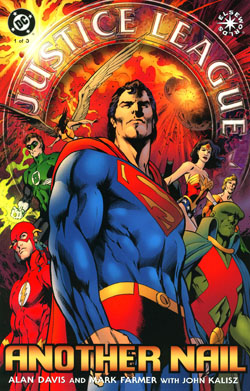
JLA: Another Nail: written and pencilled by Alan Davis, inked by Mark Farmer (2004): Alan Davis's alternate-world Justice League storyline continues here a year after the events of The Nail. Superman is gradually becoming accustomed to life in the outside world, a horribly wounded Green Arrow continues to rail against superheroes in the media, and Something Bad appears to be invading the universe.
Davis' art is great, very much in the tradition of Neal Adams, but with a distinctiveness all his own. And the story is epic without losing sight of small character moments -- it would be the perfect superhero comic book from 1985. Indeed, the basis for the continuity of the book is the 1980's pre-Crisis DC Universe with a few added flourishes.
Davis also comes up with an explanation for the existence of the ridiculously powerful JLA foe Amazo that's so perfect, it should be canonical. DC really needs to package this up with The Nail in a Deluxe edition. It looks terrific, it reads beautifully, and Davis' JLA is a lot more charming and interesting than what we get from the normal title these days. Recommended.