Detectives, Inc. by Don McGregor, Marshall Rogers and Gene Colan (Material from the 1970's and 1980's; this IDW edition 2009): IDW is really winning my heart with its reprints of great comics from the 1980's and 1990's.
This B&W collection of writer McGregor's Detectives, Inc. comic stories comes along with several prose pieces on the genesis of the detective comic, along with a piece on the filming of the Detectives, Inc. movie. My only caveat about the volume is that it's unfortunate that it couldn't be reprinted in a larger format -- the hyper-detailed art of Marshall Rogers on "A Remembrance of Threatening Green" originally appeared in a larger album size, and things do get a little squinty at times.
Still, this is a tremendous achievement both in writing and art. The world of McGregor's private detectives, Rainier and Dennings, gets the hypercrisp, hyper-detailed treatment from Marshall Rogers (best known for his Batman work in the 1970's), and the moodier, more humanistic approach from Gene Colan (best known for Tomb of Dracula and about a dozen other books).
Both art styles work, and both look great in black and white. Indeed, this may be the late Rogers' greatest work. The attention to detail is stunning, and Rogers experiments with some really fascinating one and two-page designs.
Private detectives aren't all that common in comic books unless they wear costumes or have occult powers. Rainier and Dennings remind me a lot of revisionist 70's PIs from the movies -- not so much Jake Gittes in Chinatown, as Rainier and Dennings are less cynical than Robert Towne's PI, but more the characters we see in films like Night Moves (with Gene Hackman on the case) and Cutter's Way (in which non-PI's John Heard and Jeff Bridges try to solve a case). They're battered and bruised sometimes, emotionally as well as physically, but they stay on the case.
McGregor invests his characters with a lot of heart -- he's one of the great comic book writers in terms of creating sympathy and empathy, at creating plausibly flawed and self-doubting protagonists, and at incorporating both sex and romance into a comic book without being prurient or exploitative. Highly recommended.
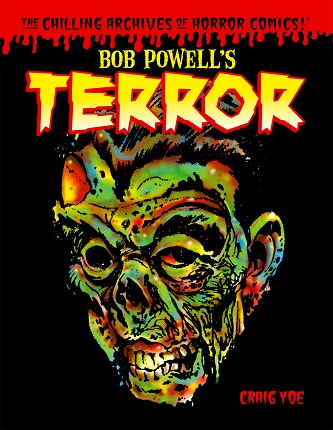
Bob Powell's Terror!: edited by Craig Yoe; illustrated by Bob Powell and others (Collected 2012): Terrific selection of horror-artist-great Bob Powell's 1950's comic-book work, including such bizarre gross-outs as "Wall of Flesh" and "It." Powell was great at depicting gooshy, gushy, blobby monsters and zombies and the busty women who were threatened by them.
All of these stories were published before the Comics Code Authority, so they're plenty violent and often quite grim. In somewhat bizarre fashion, one of the stories anticipates the ending of the Frank Miller/Walt Simonson miniseries Robocop vs. Terminator.
I'd have left out the misogynistic "What Next Then" in favour of something involving a monster and not a serial killer. The introduction gives a nice overview of Powell's career; I would be willing to sacrifice the over-sized tabloid-scale reproduction in favour of more, smaller pages, though. Recommended.
Next Men: Scattered: written and illustrated by John Byrne (2011): 15 years after the last issue of John Byrne's Next Men ended on a cliffhanger, Byrne finally finishes the story, starting here. You'd be well advised to read IDW's two phone-book-sized collections of the original series, and more recently than I did. The first new issue does supply a fairly rapid-fire synopsis of the first run, but even then I was a bit fuzzy on what had come before.
The four issues included here launch the comic into a wild time-travel story that recalls Byrne's brilliant, under-rated OMAC miniseries of the early 1990's in its complexity. It's fascinating and fun and unresolved, partially because some of the story may be a virtual reality fantasy. Other bits may be dreams. And several of the timelines we're shown seem to contradict one another, suggesting that we're looking at multiple timelines created by different alterations in the past occuring at different times. Got all that?
Byrne's art looks sharp, and the writing is solid. Whether or not our genetically engineered superheroes can save the world from the megalomaniacal energy vampire that one of them accidentally empowered through sexual contact remains to be seen. Yes, super-powers are a sexually transmitted disease. Seems reasonable. Recommended for readers of the previous series.