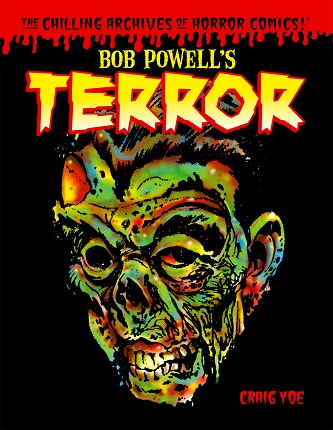
Bob Powell's Terror!: edited by Craig Yoe; illustrated by Bob Powell and others (Collected 2012): Terrific selection of horror-artist-great Bob Powell's 1950's comic-book work, including such bizarre gross-outs as "Wall of Flesh" and "It." Powell was great at depicting gooshy, gushy, blobby monsters and zombies and the busty women who were threatened by them.
All of these stories were published before the Comics Code Authority, so they're plenty violent and often quite grim. In somewhat bizarre fashion, one of the stories anticipates the ending of the Frank Miller/Walt Simonson miniseries Robocop vs. Terminator.
I'd have left out the misogynistic "What Next Then" in favour of something involving a monster and not a serial killer. The introduction gives a nice overview of Powell's career; I would be willing to sacrifice the over-sized tabloid-scale reproduction in favour of more, smaller pages, though. Recommended.
Crime Does Not Pay: Blackjacked and Pistolwhipped: A Crime Does Not Pay Primer: edited by Denis Kitchen, John Lind, and Philip Simon; written by Bob Wood; illustrated by Charles Biro, Jack Alderman, Dan Barry, George Tuska, Carmine Infantino, Dick Briefer, Bob Montana, Fred Guardineer (1943-49; collected 2011): Once upon a time, there were mass-market comic books that featured stories that didn't involve superheroes, and these comic books sold millions of copies a month. That is, each title sold that amount. It was the late 1940's and early 1950's. Superheroes were on their way out after World War Two. Crime, horror, and romance comics were on their way in.
A juvenile delinquency flap in the U.S. and Canada would ultimately do in comic books when they seemed poised on the brink of becoming, as they would in France and Japan, something with a much broader readership base than children. Superheroes would come back. And some of the finest American comic books ever created would die on the vine.
Crime Does Not Pay was the most popular comic book of the late 1940's, selling as many as five million copies a month (for the sake of comparison, the best-selling monthly American comic book now clocks in at around 125,000 copies a month). Its violence and its creepy narrator, Mr. Crime, looked forward to the violent, brilliant EC comics of the 1950's and the creepy narrators of EC's horror books, the Cryptkeeper being the one who remains in the popular consciousness thanks to HBO's Tales from the Crypt series of the 1980's and early 1990's.
These short tales, all 'based on a true story', still pack a kick today. Their graphic violence would get them targetted by censorship groups looking to protect children from violence in the media. And as a terrible bonus, the head writer of the series, Bob Wood, would himself be involved in a lurid murder trial for his killing of his lover with an iron and, once released from jail, would eventually be murdered himself. Wood's downfall occurred after Crime Does Not Pay had been forced off the market.
Anyone who thinks today's kids are exposed to an unprecedentedly violent media universe would do well to read this compilation. Heads are mashed into flames, brains are blown out, babies are killed in their cribs -- and at the end of each story, we're informed that crime doesn't pay because these criminals were finally caught and/or killed. But I don't think most readers were there for the moral uplift at the end. Boy, though. Boy, wow. Highly recommended.
Fighting American, written and illustrated by Joe Simon and Jack Kirby with Jack Oleck, Mort Meskin, John Prentice, George Tuska and others (1954-55, 1966; collected 2011): By the mid-1950's, the American superhero comic book had been reduced to a few 'old' staples (Batman, Superman and Wonder Woman), with the rest of the Golden Age flood cancelled because of low sales. Comics were growing up, with war, horror, romance and crime comics dominating the marketplace, along with the first issues of a little comic book called Mad.
But the industry-self-imposed censorship of the Comics Code Authority, implemented in response to government hearings in both the U.S. and Canada about the contributions of violent comic books to juvenile delinquency, would bring superheroes back as a wholesome substitute for the now-banned excesses and adult situations of crime, horror and war comics. American comic books would descend into a long stretch of second, superhero-dominated childhood, one they've really only been recovering from since the 1970's.
Into the superhero fray would come Fighting American, created by the great Joe Simon and Jack Kirby (who'd created Captain America for Timely/Marvel back in the early 1940's) for Prize Comics. He'd only survive seven issues (as Simon notes in the introduction, that was four better than the revived, Commie-fighting Captain America of the 1950's). But what issues!
The series starts off as a fairly straightforward McCarthy-era superhero book, with super-soldier Fighting American and plucky kid sidekick Speedboy battling Communists and the occasional alien. But McCarthyism was on the way out, and by the third issue, straightforward superhero adventures were as well.
Instead, the comic became more and more comedic and satiric, with our heroes fighting villains that included Hotsky Trotsky, Round Robin, Invisible Irving, Poison Ivan and Rhode Island Red. In what's probably the story closest to being a Mad magazine parody of a superhero comic, a Soviet superman turns out to have powers created by his terrible body odour. He's rendered powerless (and pro-capitalist) by a shower. U.S.A.! U.S.A.! U.S.A.!
Kirby and Simon (who share both art and writing duties) do the lion's share of the artwork here, though some of the material is obviously not from their hands. There's a refreshing lunacy at work here. The comedy doesn't always work, but when it does, it's pretty scathing -- Simon and Kirby were obviously tuned in to the absurdities of the "long underwear" genre (their words, in one of the stories collected here, not mine).
The volume also collects a few stories done for a brief Harvey Comics revival in the late 1960's, though these stories are clearly not drawn by either Simon or Kirby. Fighting American is the grandfather of absurdist Commie-fighting superhero Flaming Carrot and a few others -- the satiric superhero elements and outrageous, occasionally punning names also remind me of Rick Veitch's work. This is great, unusual stuff. In one of the 'straight' stories, the U.S. Air Force bombs Mt. Shasta, where an apocalyptic battle between Commies and Satan-worshipping monsters is taking place. OK, add Hellboy to the list of descendants. Highly recommended.