Showing posts with label horror comics. Show all posts

Saturday, February 14, 2015

Eerie...

Eerie Archives Volume 1 : edited by Archie Goodwin; written by Archie Goodwin and others; illustrated by Wally Wood, Steve Ditko, Reed Crandall, Gene Colan, Johnny Craig, Alex Toth, Angelo Torres, and others (1966-67/collected 2009): Warren Publishing's magazine-sized, black-and-white comics anthologies survived from the 1960's to the early 1980's. Their creative heyday came early, however, when a young Archie Goodwin edited and wrote an awful lot of stories for Creepy, Blazing Combat, and Eerie.

One can see the over-worked Goodwin grow as a writer in this collection of the first five issues of Eerie. However, it's the art that's the star here (and throughout the Warren anthology books, at least during the 1960's). 

Eerie was one of the places Steve Ditko (co-creator of Spider-man and Dr. Strange) landed after he left Marvel in the 1960's. He plays around with washes in his work for Warren, and it's lovely stuff, adding a new dimension to the work of one of the ten finest artists produced by American comic books. 

Veteran artist Reed Crandall also found work at Warren, and his meticulous, fine-lined artwork worked best on period pieces. There's a somewhat silly story about a mummy in Victorian London included here that's elevated by Crandall's artwork to the status of a minor masterpiece. Crandall's work on adaptations of stories by Poe and, perhaps most memorably, Bram Stoker's "The Squaw," is wonderful stuff that merits a Crandall-specific reprint anthology.

Other artists also found ways to express themselves at Warren, free of the choke-hold of super-heroes and lousy colour reproduction. Gene Colan's stories in this collection demonstrate that he was always better when he didn't have to worry about super-heroes but could instead be moody and demotic. Angelo Torres, perhaps unjustly neglected, also did fine work on these short tales of horror.

And as a bonus, Wally Wood produced some one-page bits, while that towering force of paperback covers, Frank Frazetta, produced a number of covers for Eerie. One of the covers in this volume gives away what seems to have been intended to be a surprise in the story it was drawn for. So it goes. 

Eerie and Creepy tried to emulate the great EC horror comics of the 1950's. The writing may not have always been top-notch -- Archie Goodwin and the other writers simply weren't capable of the extraordinary heights of the EC writers, though Goodwin's work on Blazing Combat was far superior to his horror work. The art, though, is terrific. You may not want to pay full list price for this or other Warren horror volumes (I know I didn't), but they're certainly worth a look if you can avoid bankrupting yourself on them. Recommended.

Friday, September 20, 2013

Remember the Monsters?

Four Color Fear - Forgotten Horror Comics of the 1950's: edited by John Benson and Greg Sadowski; written and drawn by Wally Wood, Bob Powell, Joe Kubert, Jack Cole, George Evans, Al Williamson, Basil Wolverton, and others (Collected 2010): The early 1950's were the heyday of the American horror comic book, at least those specializing in five-to-eleven-page stories. EC Comics was the gold standard.

But there were many, many more during this period when the American comic book strove to become mainstream entertainment for adults and children alike, just prior to governmental scrutiny in the U.S. and Canada motivated by the juvenile delinquency scare of the time lobotomized comic books for decades.

This Fantagraphics Books anthology collects non-EC stories from the post-WWII, pre-Comics Code era, that time that was too short a season. The stories range from good to great, and a fair number are extraordinarily disturbing. Basil Wolverton's art could make anything freaky -- he was a true American original of the comic-book grotesque. So, too, was Bob Powell. And many others collected here, ranging in art style from primitive to baroque.

So if you want to sample this lost and truncated time when comic books in the U.S. and Canada almost made the transition into being mass-cultural entertainment as they still are in Japan, buy this book. The historical essays and cover gallery are swell, too.

With stories ranging from the deeply disturbing (Wolverton's "Swamp Monster") to the bizarre and surreal (Powell's "Colorama") to the WTF (a beautifully cartooned entry from Nostrand about an anthropomorphized germ (!)), the range is terrific, the material is terrific, the total package is handsome and scrupulously produced. Highly recommended.

Friday, June 7, 2013

Terror!!!

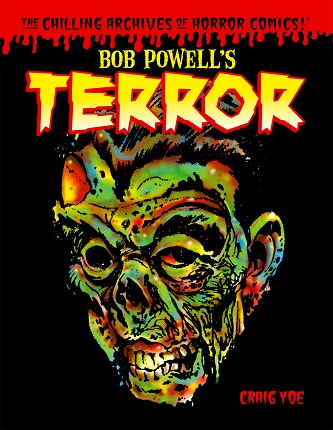
Bob Powell's Terror!: edited by Craig Yoe; illustrated by Bob Powell and others (Collected 2012): Terrific selection of horror-artist-great Bob Powell's 1950's comic-book work, including such bizarre gross-outs as "Wall of Flesh" and "It." Powell was great at depicting gooshy, gushy, blobby monsters and zombies and the busty women who were threatened by them.

All of these stories were published before the Comics Code Authority, so they're plenty violent and often quite grim. In somewhat bizarre fashion, one of the stories anticipates the ending of the Frank Miller/Walt Simonson miniseries Robocop vs. Terminator.

I'd have left out the misogynistic "What Next Then" in favour of something involving a monster and not a serial killer. The introduction gives a nice overview of Powell's career; I would be willing to sacrifice the over-sized tabloid-scale reproduction in favour of more, smaller pages, though. Recommended.

Monday, June 13, 2011

Magical Mystery Tour


John Constantine: Dark Entries, written by Ian Rankin, illustrated by Werther Dell'edera (2009): DC's Vertigo Crime imprint releases black-and-white graphic novels in a normal (for print, not comics) hardcover-sized format. Technically, this isn't really a crime (graphic) novel, and would have made more sense as part of DC's normal Constantine releases. However, author Rankin is best known for his detective series starring Scottish hardcase Inspector Rebus, so I assume that simple fact went into the decision as to the proper format.

Rankin does a solid job here of giving us a standalone story about Vertigo's (and now and again the normal DC Universe's) jaded, working-class English occult detective/magician John Constantine. A British reality-show producer offers Constantine a wad of money to investigate why it is that the contestants on a reality show are being haunted by strange visions and occurrences. Constantine joins the cast, and weirdnesses multiply.

Rankin nails Constantine's bruised and damaged cynical heroism, that of a man who's opposed demons and angels in his day and knows enough to trust neither side. Artist Dell'edera didn't impress me much in colour on the short-lived Loveless Western series, but here black-and-white seems to have freed him up an awful lot -- there are hints of B&W hardboiled master Jose Munoz in the work here -- and the work remains grounded in a grimy reality regardless of how weird things get on the supernatural end. All this and Sawney Beane too. Recommended.

Monday, March 14, 2011

Reduction of the Innocent


The Horror! The Horror!: Comic Books the Government Didn't Want You to Read!, edited and commentary by Jim Trombetta (2010): Once upon a time, in the early 1950's, comic books created the sort of hysteria in the United States now only reserved for violent videogames and sexual innuendo on Gossip Girl. Horror, crime and war comics ruled the newsstands in the early 1950's, with superheroes gradually fading away.

Then, psychologist Frederick Wertham's Seduction of the Innocent came out, with its condemnation of comic books as causing everything from illiteracy to homosexuality to, well, lesbianism and probably more homosexuality. Wertham really had a bee in his bonnet about homosexuality, bondage and the then-popular 'Injury to Eye' motif. A sensational murder case in Dawson involving kids and comic books gradually came into the public eye in the U.S. (it also spawned the "crime comics" section of the Canadian criminal code). Government hearings were held. And American publishers caved, instituting their own censorship body, the Comics Code Authority (blessedly defunct since 2008).


Comics would never be the same again, as their immense post-war, non-superheroic popularity began waning, and continues to wane to this day as anything other than a provider of ideas to Hollywood.The reign of the comic book as the preeminent form of children's entertainment had ended.

Here, Trombetta focuses on the war, crime and horror comic books from 1946 to 1954 that weren't from the illustrious and much-loved EC line, delving instead into comic book stories and covers that in most cases haven't ever been reprinted. Historically, this is valuable; as reading material, this is astonishing. It's not just the violence, implied and otherwise, that amazes -- it's the nightmarish quality of the best of these stories, some of which seem to have come gushing out of some primal, nightmare-filled reservoir of the collective unconscious, some of which are firmly rooted in the terrors of the time.


Trombetta's contextual essays, though occasionally a bit thin in convincingly connecting certain historical events with certain horror tropes, are nonetheless valuable and fascinating overall. His contextualization of the rise of the idea of the menacing zombie horde within certain new and horrifying Chinese combat tactics during the Korean War is quite convincing.

What a dandy, entertaining, enlightening book this is both as a cultural study and as a collection of great covers and stories from a truncated period of comic-book hyperrelevance. Kudos to Trombetta! I want more! Highly recommended.