Sunday, June 6, 2021

Thor and the Eternals

Thor and the Eternals: The Celestials Saga (1979-1980/This collection 2020): written by Roy Thomas, Mark Gruenwald, and Ralph Macchio; illustrated by Keith Pollard, Chic Stone, John Buscema, and Gene Day; adapting portions of Richard Wagner's RING CYCLE (seriously): 

Say what you will about longtime comic-book writer Roy Thomas, but he really likes Norse mythology and Wagner's RING CYCLE. So much so that he shoehorns a really wonky take on the former and an even wonkier shoehorning of the latter into this lengthy attempt to fit Jack Kirby's Eternals into mainstream Marvel continuity.

As it wasn't enough to just figure out how the Eternals could possibly fit into Marvel's already overstuffed pantheons of Norse, Greek, and pretty much every other god on record with the exception of the Christian ones, Roy said, no, I'm also going to offer a new expanded origin for the Norse gods seen in THOR. And I'm going to adapt the RING CYCLE. And the RING CYCLE will explain mysteries of Thor's origins that no one realized were mysteries before. 

And I'll have a sizeable portion of this story narrated by the sentient, giant floating eyeball that Odin sacrificed for knowledge back when the eye was neither sentient nor floating nor giant. The eyeball will tell this story to the titular hero of this saga, Thor, who will be almost as baffled as the readers will be. 

And then Roy left Marvel before the story was over, leaving Mark Gruenwald and Ralph Macchio to figure out how to end the whole thing, though I assume Roy may have left notes or something,

It's far and away the craziest cosmic saga of Marvel's Bronze Age, ably illustrated by John Buscema and the always under-rated Keith Pollard. Roy would go on to retell the Norse Ragnarok with DC's Justice Society of America chipping in to help the Norse gods. Then he and artist Gil Kane would adapt the RING CYCLE in the early 1990's, this time without added superheroes. Because it don't mean a thing if it ain't got that Ring... of the Nibelung! Recommended.


Tuesday, May 4, 2021

The Lost City of Z (2016)

Why am I in this fucking film with Charlie Fucking Hunnam?

The Lost City of Z
(2016): written and directed by James Gray; very loosely based on the non-fiction book by David Grann; starring Charlie Hunnam, Robert Pattinson, Tom Holland, and Sienna Miller:

This film is a shit sandwich if you haven't read the terrific non-fiction book it's based on. If one has read the book, it's about an equal split between boredom and rage. About as dishonest, stereotyped, and miscast adaptation of a non-fiction book as I've ever seen. I mean, Jesus Christ. Charlie Fucking Hunnam. Not recommended.

Tuesday, March 23, 2021

Later (2021) by Stephen King

Later (2021) by Stephen King: Solid coming-of-age horror novel from King, his third from the terrific Hard Case Crime line of reprints and new material, following The Colorado Kid and Joyland. 

King's 22-year-old male narrator gets the comparisons with The Sixth Sense out of the way early, noting that he, like the kid in that movie, sees dead people. And talks to them. And they're compelled to tell the truth after they're dead, though overt references to Wonder Woman's magic lasso are not made in the novel.

It's the truth-telling that drives the major plot elements of the novel. We follow our narrator's life in detail from 6 to 13, all of it in New York, where the dead are abundant. Thankfully, dead people fade away after a few days. But when disaster threatens his single mother's literary agency, our narrator finds himself using his powers to a specific end -- and as the saying goes, no good deed goes unpunished.

King's ability to write in the voice of a young adult remains as solid and convincing as ever. Long-time King readers will note shout-outs to many of King's previous novels that include It and 'Salem's Lot, among others. Ultimately, there are two monsters at the end of this story, and it's hard to decide whether the supernatural one or the very human one is worse. Well, OK, it's the supernatural one. But the human one is pretty close! Highly recommended.

Saturday, February 27, 2021

Uncle Silas (1864) by J. Sheridan Le Fanu

Uncle Silas (1864/This Oxford edition 1989) by J. Sheridan Le Fanu: Irish Protestant Le Fanu was the greatest horror writer of the 19th century after Edgar Allan Poe, producing his work in the middle decades of the Victorian Era. His most famous work is "Carmilla," a terrific and weird novella about a female vampire and her teenaged victim that stands in the background of every lesbian vampire work.

Le Fanu was steadfastly prolific over his 40-year writing career as both a novelist and short-story writer. Much of that output was non-supernatural, but it's his supernatural work that endures and influences. To name one, Bram Stoker's Van Helsing was clearly inspired, right down to his name, by Le Fanu's prototypical supernatural investigator and chronicler Dr. Martin Hesselius. Stories that include "Green Tea," "The Familiar," and "Mr. Justice Harbottle" still retain the power to shock and amaze.

Uncle Silas is probably the only Le Fanu novel still read by choice by readers today. It's not supernatural, though its atmosphere certainly is, and it's weird enough to feel supernatural throughout. It's also steeped in Swedenborgianism, making the introduction and notes in this volume pretty useful for the non-Swedenborgian.

A late-Gothic/Victorian sensationalist novel, Uncle Silas concerns the sinister Uncle Silas, a gambling addict, all-around rogue, and suspected murderer now supposedly reformed in his old age. He stands in line to act as his only niece Maud's guardian until she reaches the age of 21 should her ailing father die. Silas, financially supported by that brother for decades, may have an eye on the enormous fortune Maud would inherit upon reaching maturity.

If Maud dies, he gets the money...

Narrated in the first person by Maud, 18 when the novel begins, Uncle Silas sees Maud's seemingly idyllic, pastoral, though isolated country life invaded and infected from outside and inside, the latter in the form of some tremendously bad decisions and character assessments on the part of her father. 

Uncle Silas is a novel of mirroring, duplicates, and deception. Uncle Silas and Maud's fathers are bad and good father figures, the former with some good qualities and the latter with some bad. Maud's childhood home finds a debased and broken mirror in Silas' estate. But good lurks there, brought out by Maud's own flawed but essential decency when dealing with initially suspicious but redeemable figures that include her cousin Millie. 

But there are also dangerous characters throughout the novel. Uncle Silas sits at the top of that hierarchy, like Moriarty pulling the strands of his spider web. There's also the oafish, creepy but physically imposing cousin Dudley and a French governess who really just has to be experienced rather than described second-hand. Her dialect, along with that of some of the country characters, slides back and forth between the representational and the parodic.

It makes for a long but fun and enduring novel. Le Fanu ratchets the tension up over the past fifty pages or so. If you like protracted endings and epilogues, this novel is not for you. If you want a long novel of manners, morality, and Swedenborgian shenanigans, it probably is. Highly recommended.


Tuesday, February 9, 2021

Otto Graham vs. Tom Brady


One of my criticisms of the NFL is that it generally tries to pretend that the pre-Super Bowl era doesn't count, even as it celebrates a 100 year anniversary last year, 46 years of which were pre-Super Bowl era.

This handsome fellow is Otto Graham. He played ten seasons in the All-American Football Conference and then the NFL once it absorbed the AAFC, all for the Cleveland Browns. The AAFC played football on par with the NFL, as shown by the Browns winning the NFL championship in their first year in the league (1950).

Why is Otto Graham relevant to Tom Brady?


Tom Brady: 10 championship game appearances, 7 wins.

Otto Graham: 10 championship game appearances, 7 wins.


However, Otto Graham retired after ten seasons. So he was in the championship game every year of his career!

In Major League Baseball, with its love of history (maybe TOO MUCH love), Graham's accomplishments would be celebrated when someone else approached them.

In the NFL, Graham is just a footnote.

And I can't help think that it's partially because he played for Cleveland...

Also, Graham did all this while chucking around a football that looked more like a medicine ball.

Friday, January 15, 2021

The Overnight (2004) by Ramsey Campbell


The Overnight
(2004) by Ramsey Campbell: Earth's greatest horror writer takes us into the first English franchise in the Texts big-box bookstore chain. There's friction between the go-get-'em American manager sent to show the English how it's done and the staff, many of whom have issues of their own with one another.

Located between Liverpool and Manchester, Texts and the surrounding strip mall have been constructed on long-unused ground in a place known as Fenny Meadows. Seemingly peaceful grassland while the mall was built, Fenny Meadows has started generating the pervasive fog and rising damp that it's infamous for. These are harbingers of what's to come.

The Overnight pleasingly combines satire with ancient horror and work-place dramedy. Campbell deftly weaves just enough exposition into the narrative to satisfy one's questions about just what is happening, all without having to drop a Basil Exposition-style figure into things. Indeed, the novel brings in what seems to be an Exposition Mouthpiece but then has him refuse to divulge more than a few snippets to one of the characters.

Instead, the most useful exposition both for the reader and for the characters comes from the fact that the Thing plaguing Fenny Meadows apparently enjoys taping over pre-recorded videocassettes. Or something does, perhaps as a warning.

Campbell divvies up The Overnight into third-person-limited chapters focused on one character. This ties into the novel's concerns with human empathy and social ties as the essence of civilization (indeed, being 'civil') -- the Thing of Fenny Meadows seeks to divide to conquer. What wakes in Fenny Meadows is the opposite of civility and fellow feeling  -- and the opposite of language itself as represented in all those doomed texts, and Texts. Winner of Best Novel of 2004 from the International Horror Guild. Highly recommended.


Saturday, November 21, 2020

Solaris, but not the good one

So glowy

Solaris (2002): adapted for the screen from Stanislaw Lem's novel and Andrei Tarkovsky's previous adaptation and directed by Steven Soderbergh; starring George Clooney, Natascha McElhone, Jeremy Davies, and Viola Davis: 


Ostensibly adapted straight from Polish sf writer Stanislaw Lem's 1960's novel, this version of Solaris really seems to have been adapted from Soviet film-maker Andrei Tarkovsky's early 1970's adaptation. Its emphasis on family matters and its changed ending both reflect the film, not Lem's much more coldly rational novel. 


But at least Tarkovsky's Solaris deals with Lem's main focus -- the unknowability of the universe. This movie can't even be bothered to explain the reasons the alien planet Solaris so fascinates and disturbs humanity. We never even see the surface, instead seeing the planet only as a trippy lightshow around which the space station orbits. Of course, in neither the novel nor Tarkovsky's version does the station truly orbit -- it floats inside the atmosphere, above Solaris's mysterious world-covering ocean.


George Clooney does what he can, but the script is far from good and Clooney himself is too ironic a screen star to make the rational, skeptical main character believable. Viola Davis, Jeremy Davies, and Natascha McElhone do what they can, which ultimately isn't much. Soderbergh turns Solaris into a triumphant story about love conquering death, which is not the emphasis of Tarkovsky's ending, and is found nowhere in Lem's original. The mediocre Event Horizon is a better English-language adaptation of Solaris, and that's really saying something.


Soderbergh and company do accomplish something remarkable, though. This Solaris is half the length of Tarkovsky's meditative, glacially paced original. But it feels twice as long. Not recommended.

Sunday, November 1, 2020

The Jugger by Richard Stark

The Jugger (Parker #6) (1965) by Donald Westlake writing as Richard Stark: For once, Parker isn't planning a heist but rather trying to find out why a retired 'jugger' (slang for 'bank robber,' though the character in question is a safe-cracker by trade) has written him asking for help. Parker really, really isn't someone one asks for help. 

But when Parker arrives to find out what's going on -- and whether this retired, occasional partner in crime represents a threat to Parker's hard-won anonymity -- the man in question is already dead. 

The local police chief starts following Parker almost immediately, and another thief is already in town. Why has a safe-cracker who's been retired for five years suddenly the focus of all this attention? Well, there's the novel. 

The Jugger plays more like a mystery than most Parker novels, with Parker as the reluctant detective. The small-town, Midwestern police chief plays a lot like something from a Jim Thompson novel like Pop. 1280, corrupt and scheming. But getting one over on Parker is a very, very difficult thing to do. 

But Parker novels are also lessons in how even the most competent of men may be at least partially undone by unforeseeable circumstance. The trick is knowing when to walk away. Highly recommended.


Saturday, October 31, 2020

Injury to Eye Motif


Justice League: War
(2014): The second animated film in the just-completed DC Animated Movie Universe (the first was The Flashpoint Paradox) reimagines the origin of the Justice League. War mostly adapts the somewhat clunky, post-Flashpoint reboot in the DC Comics universe, though it substitutes Shazam (aka the original Captain Marvel) for Aquaman. It's actually better than its Geoff Johns/Jim Lee source, though it's still burdened with some of Lee's fussy, busy superhero costume re-designs, none worse than on Superman's high-collared, no-red-trunks look.

It's also better than the live-action Justice League movie, which also adapted that Johns/Lee graphic novel/first six issues of the new Justice League. That it also explains both the origins of the heroes who  need one (Cyborg) better than the movie AND deploys Darkseid rather than his lieutenant Steppenwolf in the invasion of Earth -- well, maybe the DC Movie Universe needs to hire more people from the animation wing to work on the live-action movies.

Two somewhat perverse elements may amuse or freak out the casual viewer. For one, Alan Tudyk voices Superman, one of the most baffling voice-casting choices ever (Tudyk voices the Joker in Adult Swim's Harley Quinn series, as a point of comparison). Of course, the voice-casting here, as in the Young Justice series, deliberately establishes this as a different universe than the DC Animated shared universe of Batman: The Animated Series, Superman, Batman Beyond, and Justice League [Unlimited].

The second involves a lengthy climactic battle in which the heroes' goal is to poke out Darkseid's eyes. I shit you not!!!! In any event, recommended.


Wednesday, October 28, 2020

It Follows... Again!

It Follows (2014): One of the ten great horror films of the past decade, It Follows rewards multiple viewings with new observations and revelations. This time around, I wondered if the Creature had problems with water because of Its behaviour during the climax.

As the 'expert' exposition about the Creature's capabilities comes from a very fallible source, one whose knowledge of the Creature is purely anecdotal and personal, his explanation of what the Creature can do must remain suspect. Everyone comes to believe that the Creature only moves at a relatively slow walking pace. 

But while it does indeed so while near its prey, it is intelligent and it isn't a ghost. There's no reason to believe the Creature can't use public transportation, as funny as that seems. Indeed, there's no reason to believe that it's incapable of faster movement when its prey gets too far away. 

Otherwise, from what we see, It is only capable of traveling about 72 miles a day as the crow falls. That doesn't seem to work all that well in terms of its arrival at a cottage about midway through the film. 

Though I did give myself a bit of a laugh when I realized that Its slower return to the suburbs of Detroit from the cottage on the shores of Lake Michigan may be attributed to It not being able to secure a ride. And as it can open doors, It could also hop into the back of someone's car or truck. Unless one has been infected by the Curse, one cannot see it -- though one can hit it, shoot it, or get clobbered by it. Oh well. Highly recommended, as always.


Previous reviews are HERE and HERE...


The Book of the Damned by Charles Fort

The Book of the Damned (1919) by Charles Fort: Charles Fort is an important figure in both paranormal circles and in the science-fiction and horror genres. Financially able to not work, Fort decided to work at compiling strange stories from journals and newspapers and historical accounts during lengthy days spent in New York's public libraries. The result was what sometimes reads like The Book of Lists: Early 20th-Century Paranormal Edition.

Buried under a mountain of metaphysical gobbledygook is a fairly simple thesis: things are not what the experts tell us! The 'Damned' of the title are any 'facts' either excluded from theories of the way things work or explained away as being explicable.

Unfortunately, Fort's writing is often tedious at its best and almost incomprehensible at its worse. The book falls into a fairly consistent tripartite pattern:


1) Metaphysical and philosophical theories that slide rapidly into endlessly repeated Fortean platitudes.

2) Lists of hundreds of items, most of which could profitably be moved to an appendix because once you've read about ten things that were reported as falling from the sky, the list of another 700 things that fell from the sky gets pretty boring.

3) Rinse. Repeat.


What saves the material is Fort's almost throwaway gift for specific science-fictional speculation. These speculations are the stuff that many stories can and have been made of. Do alien spaceships jettison spent fuel into Earth's atmosphere? Is Earth's atmosphere partially covered by a gelatinous dome? Does Earth occasionally pass through the debris fields left by ancient space freighters? See, that's great stuff!

Fort tries to pass himself off as a bold iconoclast. However, while he has oodles of derision reserved for scientists, he seems to accept that stories from newspapers and journals of the 19th century and earlier are for the most part reliable. 

Another problem is that Fort perplexingly begins this, his first of four forays into the paranormal, with perhaps the most boring of topics -- weird stuff that purportedly fell from the sky. About 200 pages of it. This rapidly loses its interest long before the 200 or so pages Fort devotes to it is over. Frogs, fish, red rain, black rain, slag, cannonballs, thunderstones, rocks... on and on and on. You can almost taste the boredom -- and Fort's desire to get all that research he did into the book.

This is an important book when it comes to various genres. But if you read it, you will skim long sections. There's only so many strange rains of the 19th century one can find interesting. Recommended.


Friday, October 23, 2020

Demon Knight !!!!

Tales from the Crypt Presents Demon Knight (1995): written by Ethan Reiff, Cyrus Voris, and Mark Bishop; directed by Ernest Dickerson; starring Billy Zane, William Sadler, Jada Pinkett, CCH Pounder, Gary Farmer, and Thomas Haden Church: 

Based on a  script that had been floating around Hollywood for years, Demon Knight isn't a typical Crypt offering insofar as the main story isn't terminally jokey. It also has a solid cast and good, stylish direction from long-time Spike Lee cinematographer Ernest Dickerson. 

It also seems refreshingly colour-blind in its casting. While protagonist William Sadler and demon antagonist Billy Zane are both white, the remainder of the cast is a very mixed bunch -- and its most heroic members are all African- or Native American.

Demon Knight also takes advantage of Billy Zane's always slightly off presence, slightly off whenever he's played a hero (as in The Phantom or even Twin Peaks). He's much better as a villain than he ever was as a hero.

A young Jada Pinkett Not Yet Smith is spunky, William Sadler is his always good self as a long-lived warrior for good nearing The Final Round-up, and CCH Pounder, John Schuck, Dick Miller, and Gary Farmer all do what they can with a few lines of dialogue and a whole lotta shooting and exploding.

Indeed, if only they'd cut the jokey, punny Cryptkeeper frame story from the film and let it stand on its own, it might find more of an audience even now. It breaks the knee-jerk racism of Hollywood casting just enough to be more interesting and involving than the sum of its parts would suggest. But Jesus, the Cryptkeeper is the worst. Recommended.

Monday, October 19, 2020

Bad Acting Playhouse

Tales from the Crypt Presents Bordello of Blood (1996):  There are a certain number of laughs to be had from the second and last of the features bearing the 'Tales from the Crypt' imprimatur. 

Some come from the fact that neither protagonist Dennis Miller nor antagonist Angie Everhart can act their ways out of a paper bag. Everhart is especially terrible as Vampire Queen Lilith, so much so that Miller looks pretty good when he's acting against her. 

Chris Sarandon can act, but he's strictly here for the paycheck. That means the best performance comes from Erika Eleniak, previously best known for coming topless out of a cake in UNDER SIEGE. Oh, well. 

Despite a frame tale featuring the Crypt-keeper, this very much doesn't resemble the great TALES FROM THE CRYPT comic book of the 1950's, though it does resemble the often slapdash, sophomoric HBO series of the 1990's that it's technically a spin-off of (spun off from?). 

EC Comics'  TALES FROM THE CRYPT was one of three pre-Comics Code horror anthology comics from that company, along with THE VAULT OF HORROR and THE HAUNT OF FEAR. The more you know! Not recommended. 

Now in Smell-o-rama!

Mr. Sardonicus (1961): adapted by Ray Russell from his novella; directed by William Castle: Enjoyable though somewhat low-budget adaptation of one of Ray Russell's terrific nods to the Gothic. Some time just after the invention of the medical hypodermic needle in 1853 (seriously, this is a plot point that allows one to date the narrative), a British expert in the field of curing muscle paralysis is summoned to a Gothicky manor in Eastern Europe by the woman he loved who was forced to marry for money... marry Baron Sardonicus!

Sardonicus wears a life-like mask for reasons he will soon explain to our recently knighted English doctor. The One Who Got Away doesn't love Sardonicus, nor does he love her. Sardonicus' creepy yet sympathetic majordomo, played by the under-rated Oscar Homolka, is found putting leeches all over the face of a maidservant. But it's all for a good cause...

Peasant tales of grave-robbing, corpse-eating ghouls will follow, as will a money-grubbing first wife for Sardonicus, a fantastic lottery win, and the origin of his self-selected baronial name (Sardonicus is descriptive, not inherited). 

The cinematography and staging often tend towards the bland and too-bright but the acting is more than adequate and the make-up and prosthetic work come across nicely, though they will have been shown too much by the end. Oscar Homolka steals the show here. Castle added a hilarious Coda to the film in which the audience voted to choose the ending. There was only one ending to the film, though -- Castle was a great showman, but two-way movies were still a long way in the future. Recommended.


Saturday, October 10, 2020

New Heroes

The Invisible Man (2020): written and directed by Leigh Whannell; starring Elizabeth Moss: Enjoyable though overlong update of H.G. Wells' venerable tale of the dangers of not being seen. 

Having escaped the manipulative clutches of a tech billionaire, Elizabeth Moss' Cecelia soon finds herself stalked by him. But as he's an "optics genius," he's built an invisibility suit! So unlike previous Invisible Men, he doesn't have to run around naked to be invisible. Moss is solid as usual as a wounded woman finding her strength even when no one believes that she's being stalked and framed, you know, an Invisible Man. This may have started life as part of Universal's abortive Dark Universe franchise, especially given the superhero origin story ending. Recommended.


Bloodshot (2020): based on the Valiant Comics character created by Kevin VanHook, Don Perlin, and Bob Layton; directed by Dave Wilson; written by Jeff Wadlow and Eric Heisserer; starring Vin Diesel and Guy Pearce: Perfectly serviceable superhero origin story for Bloodshot, a cyborg hero who first appeared in Valiant Comics books of the early 1990's. 

There's a pretty good twist about 40 minutes into the film that was spoiled by the trailers. And then Covid-19 arrived in force during the first week of the film's North American release, pretty much shutting down the box office. The movie didn't cost much, relatively speaking, so it may yet return as a Vin Diesel vehicle. I suppose one of the ways the movie kept costs down was by having virtually all the action take place in buildings and other enclosed spaces. This may account for what I think is the longest battle on top of an elevator in movie history. Recommended.


Invaders


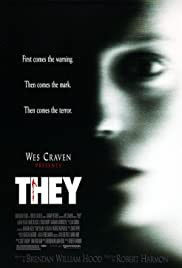
They (2002): written by Brendan Hood; directed by Robert Harmon; starring Laura Regan, Marc Blucas (Buffy's Riley Finn!), and Ethan Embry: 

Underwhelming horror movie with a far-too-passive heroine as played by Laura Regan. Can Regan act? The script doesn't give her much to do other than run around screaming or stand around woodenly denying the supernatural, so who knows? Marc Blucas, Buffy ex Riley Finn, has almost nothing to do. 

Really, no one has much to do -- the shadowy monsters drive the action completely and prove to be unstoppable so early in the movie that one wonders what the point is. They do have an odd array of powers -- not just shutting down electricity but also operating elevators and running subway trains. It sure seems that way, anyway. An interesting film involving Night Terrors hides under the inept writing. Not recommended.


Unidentified Flying Objects: The True Story of Flying Saucers
(1956): written by Francis Martin; directed by Winston Jones: Odd, seminal combination of documentary and docudrama covering the evidence of Flying Saucers Over America! as of 1956. Great for those who love this sort of thing, somewhat tedious for those who don't. The film interpolates actual colour footage of UFO's as captured by reputable civilian photographers -- fleeting, fascinating stuff given extra zing by the fact that the real stuff is in colour and the rest of the film is in black and white. Dry, great stuff. Recommended.


Monday, September 28, 2020

Of Worms and Demons


Mysteries of the Worm: The Cthulhu Mythos Stories of Robert Bloch: edited by Lin Carter: (1935-1958; collected 1982): The first mass-market collection of all of legendary Robert 'Psycho' Bloch's Cthulhu Mythos stories from the early 1930's to the late 1950's. 

Like most writers writing in the Lovecraft vein, Bloch starts as a pastiche artist. Of course, Bloch knew and corresponded with HPL and engaged in a friendly game of killing each other's proxies off in stories (Bloch killing an HPL stand-in in "The Shambler from the Stars" and HPL reciprocating by killing 'Robert Black' in "The Haunter of the Dark.") 

Real-world poignance slips in as Bloch stops writing Lovecraftian fiction for a decade after HPL's death. When Bloch returns, he's much more assured and no longer writing pastiches in the last four stories in the collection. The best from this later quartet is "Notebook Found in a Deserted House" (1951), which is sort of like Huckleberry Finn vs. Cthulhu, if you can dig it. The collection takes its title from Bloch's most famous addition to the fictional books of the Cthulhu Universe, De Vermis Mysteriis. Highly recommended.


The Hollow Ones
[The Blackwood Tapes Volume 1) (2020) by Guillermo del Toro and Chuck Hogan: As with del Toro and Hogan's previous collaboration, The Strain trilogy, The Hollow Ones seems to have an eye to becoming a TV series if it isn't in pre-production already. It's an enjoyable, fast read in the Supernatural Detective genre, pitting a young FBI agent and a mysterious British gentleman against supernatural shenanigans in and around the New York area. Recommended.


Tuesday, September 8, 2020

George Romero's Land of the Dead (2005)


George Romero's Land of the Dead
(2005): written and directed by George Romero; starring Simon Baker (Riley Denbo), John Leguizamo (Cholo DeMora), Dennis Hopper (Kaufman), Asia Argento (Slack), Robert Joy (Charlie), Eugene Clark (Big Daddy) and Joanne Boland (Pretty Boy): 


George Romero's fourth Dead movie gave him a mostly name cast and a decent budget; Romero's own quirky muse caused him to use these things on what wasn't a horror movie at all, or at least not the horror movie the studio thought it would be getting. But George Romero's movies were always about more than just flesh-eating thrills.


Land of the Dead is part-satire, part-social commentary. The zombies aren't really the villains any more: indeed, they don't seem to have any interest in hunting humans until the humans piss them off. And piss them off, they do. 


I don't know that the movie benefited from having known actors in some of the roles, though I am sure that this was necessary to secure funding. Dennis Hopper just seems miscast as a scheming businessman, but Leguizamo, Baker, and Asia Argento are all fine. But the real hero is the massive zombie gas-station owner dubbed Big Daddy. He's the Robinson Crusoe of zombies.


Essential viewing, in part because it now looks like an allegory for America Now. Hint: most of us are the increasingly intelligent zombies, while Donald Trump is played by Dennis Hopper. Fittingly for today's horrorshow world, the leader of the sympathetic zombies is a working-class African-American. Highly recommended. 

Monday, August 24, 2020

From Beyond the Grave (1973)

From Beyond the Grave (1973): Based on stories by R. Chetwynd Hayes; screen play by Robin Clarke and Raymond Christodoulou; directed by Kevin Connor; starring Ian Bannen, Peter Cushing, Diana Dors, Margaret Leighton, Donald Pleasence, David Warner, Lesley-Anne Down, and Angela Pleasence: Highly enjoyable anthology movie adapting four stories by English horror writer R. Chetwynd-Hayes, with Peter Cushing as the frame story's owner of a sinister antiques store (called Temptations, nudge nudge). 


There are some nice moments of horror here, along with some bleak humour very appropriate for any adaptation of the often tongue-in-cheek Chetwynd-Hayes. The climax of the segment starring Donald Pleasence and daughter Angela especially reaches a tone of extremely dark whimsy. In any case, the haunted or possibly cursed items in the stories are a mirror, a Distinguished Service Cross, a snuff box, and an ornately carved wooden door. So avoid such items at all costs.


This isn't a Hammer production but rather an Amicus one, for those who know about such distinctions. Cushing seems to be having quite a bit of fun behind some moderately heavy make-up. The moral of the story seems to be that one shouldn't barter to lower prices at an antique shop, and for God's sake, don't steal anything. Recommended.  

Sunday, August 23, 2020

Happy Colossus Adventure

Colossus: The Forbin Project (1970): Based on the first novel in a trilogy by D.F. Jones, this film somewhat jarringly stars Eric Braeden, now so much identified as Victor Newman on the long-running soap opera The Young and the Restless. 


Dr. Forbin has somehow convinced the U.S. government to hand over all control of its nuclear stockpile to the super-computer he designed, the eponymous Colossus. And it's surrounded by an impenetrable radiation barrier! So of course nothing can go worng...


It makes for an enjoyably sober piece of near-future science fiction. Look for a young Gordon Pinsent as the President of the United States of America! Recommended.


Happy Death Day 2 U (2019): Unnecessary but entertaining sequel to the more enjoyable Happy Death Day. It's sort of the 2010 of sequels, as it spends a lot of time explaining why the time loop happened in the first movie. Jessica Rothe is as charming and spunky as ever in the lead role. Christopher Landon directs again, this time taking over the writer's credit from Scott Lobdell. Affable might be the best way to describe this. Lightly recommended.


Bill and Ted's Excellent Adventure (1989): Amiable comedy without a huge number of laughs. Keanu Reaves and Alex Winter do a lot of heavy lifting because with the exception of George Carlin in a few scenes, this movie has the most undistinguished supporting cast in movie history. Or at least ostensibly big-budget studio movie history. But there is something admirable about a film the climax of which is an oral presentation on history that has to be delivered in an auditorium to one's entire high school. Now that's weird. Lightly recommended.