Tuesday, February 14, 2012

Giant-size Swamp Thing

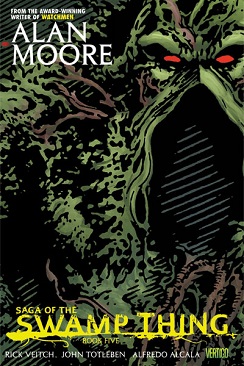
The Saga of the Swamp Thing Volume 5: written by Alan Moore, Steve Bissette, Rick Veitch, and John Totleben; illustrated by Rick Veitch, Steve Bissette, John Totleben, and Alfredo Alcala (1986; collected 2011): The penultimate collection of Alan Moore's career-making run on DC's Saga of the Swamp Thing sees Rick Veitch take over as primary penciller. As previous Swamp Thing penciller (and then-continuing cover artist) Steve Bissette notes in the informative introduction, Veitch's interest in science fiction over horror helped shift the book to a more science-fiction-oriented direction. But first Swamp Thing would travel to Gotham City for a fateful encounter with Batman. Then it was off into space for several issues for an odyssey that would conclude in the next volume.

The double-sized issue featuring Swamp Thing's battle with Batman is a doozy, showcasing as it does longtime Swamp Thing inker John Totleben's second full-art stint on the comic book. It's gorgeous: Totleben's art often looked like he was cutting his fine lines into wood or perhaps copper. It's elegant and old-school without being stiff or anachronistic. This was the time of Frank Miller's Dark Knight Returns, so Batman gets a really, really big Batmobile. However, Moore's Batman is much more sympathetic and fallible than Miller's -- and reasonable, in the end, as he and Swamp Thing ultimately resolve their differences without killing each other.

Subsequent issues further develop the character of Swamp Thing's beloved Abigail Cable, reintroduce two horribly transformed characters from Martin Pasko's early 1980's run on Saga, and bring us Swamp Thing's first foray into space travel. One can see Moore straining at the chains of the endless status quo of the mainstream superhero universe here. Things may return to the baseline at the end of each seemingly world-changing event, but logically they shouldn't.

Even if DC wouldn't soon anger Moore and cause him to leave the mainstream forever, one can't really believe, reading these stories, that he would have been much longer satisfied with 'The More Things Change, The More They Stay The Same.' Highly recommended.


The Saga of the Swamp Thing Volume 6: written by Alan Moore, Steve Bissette, and Rick Veitch; illustrated by Rick Veitch, Steve Bissette, John Totleben, Alfredo Alcala, and Tom Yeates (1986-87; collected 2011): And so Alan Moore's time as writer of DC's Saga of the Swamp Thing comes to an end after four years and nearly 50 issues'-worth of adventures. When he took over with issue 20, Moore was a British comic-book writer making his American debut. When he finished, he was the most praised writer of mainstream comic books in North America.
Swamp Thing's space odyssey continues, as the muck-encrusted Plant Elemental desperately seeks a way back to Earth and the arms of his beloved Abby. Meanwhile, on Earth, Abby believes Swamp Thing to be dead and starts to gradually move on with her life. Yes, they are literally star-crossed lovers.

The move into space brings Swamp Thing into contact (and occasionally conflict) with some of DC's Silver Age space characters, most notably Earth hero Adam Strange and a couple of really jerky Hawkpeople from Hawkman's planet of Thanagar. Swamp Thing also encounters a creepy machine entity in an artistic tour-de-force for Totleben, who illustrates an entire issue in the sort of heavy-duty collage that really does have to be seen to be appreciated, an issue that also allows Moore to cut loose with a long burst of prose-poetry meant to show the alien-ness of the issue's narrator, a world-sized machine intelligence pining for love in the lonely abyss of space.

Swamp Thing also encounters some of Jack Kirby's New Gods in an issue written by Veitch, one that showcases the more satiric, blackly comic and irreverent Swamp Thing that Veitch would be writing a lot more of when he took over from Moore as Saga writer with issue 65. Bissette's first full script sees Abby back on Earth encountering a character from the very beginnings of Swamp Thing back in the early 1970's, when it was written by Len Wein and illustrated by Bernie Wrightson. And there's a Green Lantern to be met before our hero returns home and Moore's stint as writer concludes with the lovely, elegaic "Return of the Good Gumbo." It was one hell of a ride. Highly recommended.

Russian Dressing

Love and Death: written and directed by Woody Allen; starring Woody Allen (Boris) and Diane Keaton (Sonja) (1975): Allen's last pure satire/comedy before Annie Hall moved him into more dramatic film-making, Love and Death sees Allen broadly parody Russian literature and philosophy and movies, along with a healthy dose of Ingmar Bergman references.

The war sequences recall Charlie Chaplin's The Great Dictator in their attention to battlefield slapstick. The peace-time sequences satirize village life, court life, Napoleon, and the philosophical tendencies of 19th-century Russian literature. One doesn't have to be a film buff to find all this funny -- the sequences work on their own level of ridiculousness first. Knowing that a sequence of stills of different stone lions is a nod to Sergei Eisenstein's seminal Battleship Potemkin, or that another sequence plays with Bergman's Persona, only adds to the humour -- it isn't required.

The Allen character's frequent encounters with a robed Death recall both Bergman's The Seventh Seal and the Alastair Sim version of A Christmas Carol. How's that for a mash-up? Unlike the many victims of the plague who engage in the Danse Macabre at the end of The Seventh Seal, though, Allen goes dancing off alone with Death.

Keaton is also very funny as Allen's mostly unrequited love. Allen's only film to be shot at least partially outside the U.S. for 20 years, until 1996's Everybody Says I Love You. Recommended.

A Stretch of the Imagination

Plastic Man Archives Volume 7: written and illustrated by Jack Cole (1946-47; collected 2006): Another jolly, anarchic, cleanly rendered volume of Golden Age Plastic Man adventures, written and illustrated by the stretchable hero's creator Jack Cole and members of Cole's studio. Plastic Man is one of the few Golden Age comic books that holds up today, not just as a historic curiosity, but as an exemplar of the form and of the superhero genre.

Plastic Man's adventures are funny and fun without being weightless (the death count is surprisingly high). Cole's imagination found wings with a hero who could look like pretty much anything, battling crooks who were comic grotesques. While Plas works for the FBI (the first superhero to work for a government agency, so far as I recall), he remains a curiously liminal figure -- a bringer of chaos and anarchy in the cause of law and order.

While Cole would 'cut loose' on the splash pages of Plastic Man's adventures (taking a cue from the Will Eisner studio's Spirit, upon which Cole worked briefly), he primarily worked his narrative magic within a fairly conventional panel layout. It's inside the panels that everything cuts loose, and within which little jokes and sub-stories play out in the background in a manner which anyone who's read the later Mad magazine would recognize, though I think Cole was taking his inspiration from great comic strips that include Bringing Up Father (aka Maggie and Jiggs), Krazy Kat and E.C. Segar's Thimble Theatre (aka Popeye) when it came to the dense shenanigans occurring around and behind the main action of a strip.

The product of a true visionary and artist, Plastic Man is one of those rare Golden-Age comic-book creations who has never been improved upon by writers and artists other than his creator. Lovely, lovely stuff. Highly recommended.

Saturday, February 11, 2012

The Horns of a Dilemma

Horns by Joe Hill (2010): Ignatius "Ig" Perrish wakes up from an alcohol-fueled black-out to discover that horns have sprouted on his head overnight. A year earlier, somebody murdered his longtime girlfriend Merrin, a murder most people believe that Ig committed. So begins Horns, the second novel by Joe Hill (after Heart-Shaped Box).

Ig's horns give him some (mostly) useful powers. People will tell him pretty much anything bad they've ever done, without prompting, and not remember doing so (or seeing Ig, for that matter) afterwards. And when he touches people, he can see every bad thing they've ever done in exhaustive detail. When you're investigating a murder, powers like these seem almost heaven-sent.

Merrin had suddenly broken up with Ig the night of the murder, which was also the night before Ig was set to fly to London, England to work for Amnesty International for six months. She said they should see other people, as they'd been dating steadily for ten years -- since Ig was 15 and Merrin 14.

After an argument in a roadhouse, Ig stormed out, leaving Merrin to find her own way home. And soon thereafter she was dead. There wasn't enough evidence to link Ig to the crime, but pretty much everyone in Ig's small New England town "knows" he did it and got away with it. Everyone except Ig and the murderer.

The early stages of Horns see Hill working in the somewhat familiar territory of Thomas Disch's Minnesota Quartet, four vaguely linked, blackly humourous and satiric supernatural novels from the 1980's and 1990's. Ig's early adventures with his horns lead to terrible revelations set within a storyline dotted with social and political satire directed at the Right and, more generally, the seemingly 'good' pillars of any community. Everyone has secrets: pathetic secrets, awful secrets, blackly comic secrets.

However, Hill is a much softer touch than Disch, and the novel moves into more humanistic territory even as the supernatural grows in importance. Lengthy flashbacks gradually fill us in on what really happened, while all the time Ig's powers -- and resemblance to a traditional Christian devil -- grow. It's an enjoyable ride, chock full of pop culture references and allusions, and possessed of a truly awful, pathetic antagonist. The action gets a bit repetitive towards the end, but it's nonetheless a solid read and a pretty impressive second novel. Recommended.

Best New Horror 2010

The Mammoth Book of Best New Horror 22 (2010), edited by Stephen Jones (2011), containing the following stories:

*What Will Come After by Scott Edelman
Substitutions by Michael Marshall Smith
A Revelation of Cormorants by Mark Valentine
*Out Back by Garry Kilworth
*Fort Clay, Louisiana: A Tragical History by Albert E. Cowdrey
Just Outside Our Windows, Deep Inside Our Walls by Brian Hodge
*Fallen Boys by Mark Morris
The Lemon in the Pool by Simon Kurt Unsworth
The Pier by Thana Niveau
*Featherweight by Robert Shearman
Black Country by Joel Lane
*Lavender and Lychgates by Angela Slatter
*Christmas with the Dead by Joe R. Lansdale
*Losenef Express by Mark Samuels
Oh I Do Like to Be Beside the Seaside by Christopher Fowler
*We All Fall Down by Kirstyn McDermott
*Lesser Demons by Norman Partridge
*Telling by Steve Rasnic Tem
*As Red as Red by Caitlin R. Kiernan
*With the Angels by Ramsey Campbell
Autumn Chill by Richard L. Tierney
City of the Dog by John Langan
*When the Zombies Win by Karina Sumner-Smith

Series editor Stephen Jones gives us 23 stories this year, along with the lengthy annual 'Year in Horror' and encyclopedic 'Necrology' (the latter consisting of obituaries of writers, actors and others with some affiliation to horror, written by British horror expert Kim Newman).

I've starred the stories I think are really exceptional. The writing level is, as always for this series, high. Stories range from nouveau-Cthulhu by way of hardboiled Jim Thompson (Norman Partidge's "Lesser Demons") to the surreal ("Featherweight"), from zombies (three stories) through Lovecraftian ghouls ("City of the Dog") to unwanted, menacing fruits and vegetables ("The Lemon in the Pool"). Ramsey Campbell supplies a story about old family grievances and wounds that may or may not involve the supernatural. Caitlin Kiernan and Albert E. Cowdrey give us fine examples of closely observed historical horror -- or maybe historical-research horror would be a better moniker, as the protagonists dig deeply, too deeply, into the undead past.

Angela Slatter delivers a story that reminds me favourably of some of Tanith Lee's best work. Scott Edelman and Karina Sumner-Smith both deliver elegaic farewells to, well, zombies; Joe Lansdale gives us zombies and Christmas; Mark Samuels delivers a disturbing tale focused upon a character based on deceased horror writing and editing great Karl Edward Wagner. All in all, another good year. Highly recommended.

Wednesday, February 8, 2012

Pale Horrors

Tales from the Darkside: The Movie; written by Michael McDowell and George A. Romero, partially based on stories by Arthur Conan Doyle and Stephen King; directed by John Harrison; starring Deborah Harry (Betty), Christian Slater (Andy), David Johansen (Halston), William Hickey (Drogan), James Remar (Preston), Rae Dawn Chong (Carola), Robert Sedgwick (Lee), Steve Buscemi (Bellingham), Julianne Moore (Susan), and Robert Klein (Wyatt) (1990): The 1983 Stephen King/George Romero movie Creepshow, an anthology of five horror shorts, was once supposed to become a TV series. That fell through, and the Romero-produced Tales from the Darkside series of the 1980's ultimately resulted. A second, lesser Creepshow movie came out in 1987. And then came this film, which horror effects guru Tom Savini called "the real Creepshow 3." Got all that?

Here we get three shorts and a frame story starring Deborah Harry as a suburban housewife with a shocking secret. She's actually a retired pop star! Well, no. Then we get three shorts: "Lot 249", loosely adapted from an Arthur Conan Doyle short story; "The Cat from Hell", based on a Stephen King story; and "Lover's Vow", an original penned by horror novelist Michael McDowell.

The last one is the best, with the first two (and the frame tale) partially submerged by too much campiness and jokeiness. As with Creepshow and Creepshow 2, most of the makers seem to have confused the jokeiness and punniness of the frame narration of the1950's EC horror comics from which these movies draw their inspiration with the content of the actual stories, stories which were generally played straight up and gruesome. It's the frame that's supposed to be jokey, not the tale itself. Thus horror gets repeatedly undercut by that deadly, deadly jolite. Oh, well.

The cast, especially of "Lot 249", is very good -- Julianne Moore and Steve Buscemi would soon be on their way to better things. "Lover's Vow" highlights the fact that Rae Dawn Chong and Jaye Davidson (of The Crying Game) bear a fairly startling resemblance depending on the camera angle. Short, vaguely enjoyable, and occasionally interesting. Lightly recommended.

Sunday, February 5, 2012

Work Sucks

My Work Is Not Yet Done: Three Tales of Corporate Horror by Thomas Ligotti containing "My Work Is Not Yet Done", "I Have a Special Plan for the World", and "The Nightmare Network" (2007): Frank Dominio is a team supervisor at a corporation called New Product. On his own initiative, he comes up with, well, a new product, and briefly presents his idea to his fellow supervisors and their boss, Richard (nicknamed "The Doctor" for initially unknown-to-Frank reasons).

And here Frank's troubles begin in the lengthy titular novella.

Thomas Ligotti gets to be described as a unique voice in horror because he really is a unique voice in horror. He can be approximated by imagining some bizarre mash-up of two or three or four other writers (for the record, I'd go with Franz Kafka, Jorge Luis Borges, Clark Ashton Smith, and Roald Dahl) , but there's no single writer who's truly like him. He's an American original, writer of some of the bleakest, bleakly funniest horror stories of the past thirty years.

His take on corporate horror is singular and tricky. The novella initially seems to exist in the realm of the workplace revenge fantasy, something we've all seen. But the means of Frank's revenge are extraordinarily odd, and become odder as that revenge progresses. This is not Office Space With Ghosts.

People who've read other Ligotti stories may realize around the halfway mark that "My Work Is Not Yet Done" takes place in the same bleak universe as 1999's "The Shadow, The Darkness." One doesn't need to know this to understand what's going on, but it does deepen the experience as we plunge into the Magical Nihilism that is Ligotti's dominant mode of discourse.

But the novella is also horribly funny, as are the two short stories that complete this triptych. Frank Dominio begins the novella with a bleak outlook on humanity in general and his co-workers in particular, and the events of the story show that bleakness to not be enough. The world is much worse than Dominio ever imagined. The revenge scenarios initially carry a certain grotesque zing, but they quickly lose their enjoyability for Frank as he realizes who and what he's up against -- or working for.

Ligotti's fiction can truly unnerve one (as S.T. Joshi has observed), leading one to question the parameters of one's own existence, and the meaning of existence itself. But it's strangely, blackly refreshing because if one rejects the nihilistic cosmos of many of Ligotti's stories, one finds one's own cosmos to be that much more welcoming and benign by comparison. Highest recommendation.