
Showing posts with label s.t. joshi. Show all posts
Showing posts with label s.t. joshi. Show all posts
Wednesday, April 12, 2017


Tuesday, March 15, 2016
The White People and Other Weird Stories by Arthur Machen; edited by S.T. Joshi (2011)
 |
| Pan Sold Separately |
The White People and Other Weird Stories by Arthur Machen; edited by S.T. Joshi (2011), containing the following pieces:
Foreword: The Ecstasy of St. Arthur by Guillermo Del Toro: Nice, brief appreciation of Arthur Machen by the film-maker, whose works often refer directly or indirectly to Machen's work and concepts.
Introduction by S. T. Joshi: A usual excellent historical overview from Joshi.
The Inmost Light (1894): Pseudo-science based horror with ties to the longer, creepier "The Great God Pan.".
Novel of the Black Seal (1895): 'Novel' meaning 'Nouvelle' here and below, and not a matter of length. One of several Machen stories dealing with a survived, malign race of 'Little People.'
Novel of the White Powder (1895): Another piece of pseudo-science based horror. As with the above 'novel,' this was also published as part of the actual 'novel'/short-story cycle The Three Impostors. The 'science' moves into the realm of the occult at the conclusion.
The Red Hand (1895): A fine piece of horror which uses the style and structure of the mystery story.
The White People (1904): A towering achievement in first-person narrative in the horror genre, framed by a somewhat wonky but necessary philosophical discussion of the nature of good and evil. One of the most unnerving stories ever told.
A Fragment of Life (1904) : A slightly weird tale of a young couple chafing at life in a London suburb really grows on one as it builds to a climax reaffirming Machen's love/hate relationship with cities.
The Bowmen (1914): That famous piece of accidental 'journalism' (it's a short story mistaken at the time for being real) that spawned the World War One legend of ghostly bowmen coming to the rescue of British soldiers.
The Soldiers' Rest (1914): Another of Machen's brief newspaper short stories meant to buoy spirits during the early days of the Great War.
The Great Return (1915): A weird tale without horror -- instead, it's a faux-journalistic piece on the Holy Grail in the Welsh countryside.
Out of the Earth (1915): Very minor piece concerns Machen's underground, malign, and apparently foul-mouthed little people.
The Terror (1916): Written in a straightforward journalistic style that's unlike Machen's earlier works of weird fiction that include "The White People" and "The Great God Pan," The Terror is instead the great-grandfather of Max Brooks' World War Z. The Terror depicts its events as real, investigated by the unnamed narrator.
Those events aren't zombie attacks -- they're mysterious deaths breaking out in various locations throughout Great Britain during World War One. Have the Germans landed some sort of hidden force on the British Isles? Is someone using a mysterious 'Z-Ray' to smother people or send them running off cliffs to their deaths? Or is there something wrong with the animal kingdom?
Machen was writing furiously at this time in his life, forced into newspaper work in order to pay the bills. The Terror isn't the imaginative and literary triumph that the aforementioned stories were, but it's still an enjoyable and often weird book. It's also an important permutation in horror's long love affair with the pseudo-documentarian style. Where 'letters' and 'journal entries' once told us that what we were reading was 'real,' now the journalistic voice does.
It's also a mutation of something going back to at least Daniel DeFoe's A Journal of the Plague Year. In that early 18th-century work, DeFoe told a fictional 'you-are-there' story about a real event. Machen embeds The Terror in the real, early events of the Great War and then, like DeFoe, tells everything as a piece of actual reportage. It's a major stylistic leap.
There are many fine moments of horror and pity throughout The Terror, along with some marvelously weird images. Machen captures the way fear can travel through gossip when the official channels are trying to hide the problem. A late-novel tableaux of horror at an isolated farm is especially well-managed through the description of the aftermath and through a dead man's journal describing the mysterious and terrible events that led to that aftermath.
There are a couple of flaws to note. One isn't so much a flaw as a relative lack of closure. Things just sort of stop. This first flaw is exacerbated by the second, which is the narrator's jaw-dropping, climactic theory about why what happened, happened. It's an explanation totally in keeping with Arthur Machen's beliefs about society. But it's a moment of political and social commentary that will leave a sour aftertaste with anyone who doesn't long to live in a medieval fiefdom. I kid you not.
Overall: A selection that includes non-horror pieces makes for an interesting overview of Machen's career. Those interested only in Machen's horror output would be better served by seeking out a collection that includes "The Great God Pan" and "The Shining Pyramid." The end-notes to the stories are extremely useful. The cover is the only oddity, as it seems to have been commissioned for a collection that did include "The Great God Pan." Highly recommended.
Friday, October 10, 2014
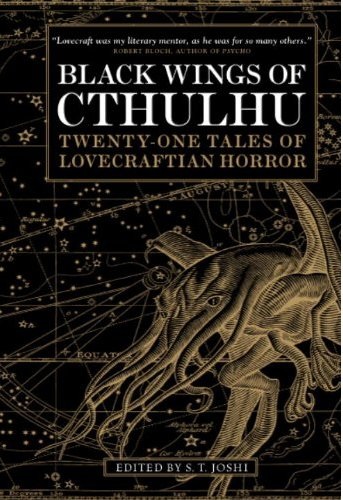
Back to Cthulhu

When it comes to both the general (horror fiction) and the specific (H.P. Lovecraft), S.T. Joshi's credentials are impeccable. His emendations and annotations to Lovecraft's fiction have been a gift to the reading public, as has his other work.
This is certainly a mostly enjoyable anthology with a somewhat misleading title forced upon Joshi by his publishers. The first of these anthologies was simply entitled 'Black Wings' in its original hardcover publication, a quotation from an essay by Lovecraft about horror. 'of Cthulhu' was added to the paperback release to grab the eye of the reader. However, the addition makes the title of the anthology somewhat erroneous. Writers riff here on all of Lovecraft's output, and on the more general aspects of his approach to cosmic horror. This isn't a Cthulhu Mythos theme anthology. So if you want a Cthulhu Mythos theme anthology, look elsewhere. It will probably also have 'Cthulhu' in the title. They're not hard to find.
None of the stories selected by Joshi are bad in the way that Cthulhu Mythos pastiches can be bad (though I'm definitely not alone in my enjoyment of even the most clumsy of attempts to replicate both Lovecraft's style and content). Really, none of them are bad at all. They do fall within a range that also fails to ascend beyond the level of, 'Well, that was enjoyable.'
But wait. Was I frightened by anything here in a cosmic, metaphysical manner? No. Steve and Melanie Tem's stories do disturb on a metaphysical level. John Shirley's piece is a delightful romp, but not a scary one. Jason Brock's "A History of a Letter" does a solid job as an epistolary work of mounting unease, though the jokiness of the footnotes cuts against total investment. Caitlin Kiernan's story does invest totally in its horrific elements, but it's a character study, not an exercise in terror.
Another problem shared by several stories is, well, an absent middle -- "Dead Media" and "The Abject" pretty much jump from detailed introduction to loopy conclusion. And the loopiness of both sudden conclusions works against horror. It doesn't help that "The Abject" has been critically overdetermined, starting with that title, which is actually attached to a large, scary rock in the story. I kept waiting for a Phallic Mother to appear and, you know, it sort of does.
Dire consequences await many of the protagonists of these tales, at a much higher rate of Dire than that found in Lovecraft's whole output. One of the things that you can count on in modern Lovecraft-related fiction is that down endings and cosmic disaster are the norm and not something that may arrive in the near future but does not arrive in the text itself. When the disastrous ending becomes standard, that standard becomes cliche.
It's an interesting development in horror fiction, suggesting that at least when it comes to the fiction they produce, an awful lot of today's writers are far more misanthropic and defeatist than the notoriously misanthropic and "futilitarian" Lovecraft ever was. Some of them make me long for the Derlethian deus ex machina that ended many (but not all) of Derleth's Lovecraft pastiches.
There may be a fairly high level of literary acumen on display here, but the endings too often echo the endings of the last twenty years of horror movies, in which supernatural evil always triumphs. And when evil always triumphs, as T.E.D. Klein noted in a riff on an earlier critic's musings, then I don't see what the point of the point is other than knee-jerk nihilism. Lightly recommended.
Saturday, July 14, 2012
Cthulhu Everlasting
"Pickman’s Other Model (1929)" by Caitlin R. Kiernan
"Desert Dreams" by Donald R. Burleson
"Engravings" by Joseph S. Pulver, Jr.
"Copping Squid" by Michael Shea
"Passing Spirits" by Sam Gafford
"The Broadsword" by Laird Barron
"Usurped" by William Browning Spencer
"Denker’s Book" by David J. Schow
"Inhabitants of Wraithwood" W.H. Pugmire
"The Dome" by Millie L. Burleson
"Rotterdam" by Nicholas Royle
"Tempting Providence" by Jonathan Thomas
"Howling in the Dark" by Darrell Schweitzer
"The Truth about Pickman" by Brian Stableford
"Tunnels" by Philip Haldeman
"The Correspondence of Cameron Thaddeus Nash" annotated by Ramsey Campbell
"Violence, Child of Trust" by Michael Cisco
"Lesser Demons" by Norman Partridge
"An Eldritch Matter" by Adam Niswander
"Substitution" by Michael Marshall Smith
"Susie" by Jason Van Hollander
An excellent anthology of all-new stories inspired by H.P. Lovecraft, edited by Lovecraft expert S.T. Joshi. Joshi wisely didn't limit his writers to the Cthulhu Mythos, or even to explicit references to Lovecraft's work. Instead, there's a more general mandate of the weird and the cosmic (or 'cosmicism') at work here, though the explicitly Cthulhuesque is also welcome.
There really isn't a bad story in the bunch, and there are a number of standouts. Laird Barron's "The Broadsword" works within Barron's own Children of Old Leech mythology of terrible doings behind the walls of our world. Norman Partridge serves up a monstrous invasion within a narrative that works within the hardboiled parameters of the novels of James M. Cain and Jim Thompson. Ramsey Campbell has some fun with Lovecraft's near-obsessive letter-writing, while the protagonist of Jonathan Thomas's "Tempting Providence" seems to meet the ghost of HPL...or is something much more cosmic and sinister going on? Oh, that three-lobed burning eye!
One of the interesting things about the collection is that three stories -- "Pickman’s Other Model (1929)" by Caitlin R. Kiernan, "Inhabitants of Wraithwood" W.H. Pugmire, and "The Truth about Pickman" by Brian Stableford -- all deal with Lovecraft's transitional-phase short story "Pickman's Model" in various ways. It's a story that was adapted in a mediocre fashion for Night Gallery, but it's also probably the Lovecraft story with the most-quoted final line. Hell, Joanna Russ turned that line into the title of a story!
HPL's original story is transitional in the sense that while it looks ahead to the Cthulhu universe in which horror is all around us, waiting to be discovered, it also uses beings -- Lovecraft's version of ghouls, to be specific -- which are treated in a somewhat more whimsical, less horrific fashion in Lovecraft's Dunsanian novel The Dream Quest of Unknown Kadath, in which they actually aid the narrator during his voyage through the Dream Lands. These stories offer radically different takes on the original material: the authors definitely don't think the same way about the stately ghouls of Boston.
In any case, Joshi offers a pip of an anthology here, complete with a useful introduction. At least five of these stories (by my count) have already been anthologized in various 'Best of' and Cthulhu compilation volumes, which is pretty good for a book that's barely a year old. And the cover of the paperback is sweet. Highly recommended.
Sunday, February 5, 2012
Work Sucks
 My Work Is Not Yet Done: Three Tales of Corporate Horror by Thomas Ligotti containing "My Work Is Not Yet Done", "I Have a Special Plan for the World", and "The Nightmare Network" (2007): Frank Dominio is a team supervisor at a corporation called New Product. On his own initiative, he comes up with, well, a new product, and briefly presents his idea to his fellow supervisors and their boss, Richard (nicknamed "The Doctor" for initially unknown-to-Frank reasons).
And here Frank's troubles begin in the lengthy titular novella.
Thomas Ligotti gets to be described as a unique voice in horror because he really is a unique voice in horror. He can be approximated by imagining some bizarre mash-up of two or three or four other writers (for the record, I'd go with Franz Kafka, Jorge Luis Borges, Clark Ashton Smith, and Roald Dahl) , but there's no single writer who's truly like him. He's an American original, writer of some of the bleakest, bleakly funniest horror stories of the past thirty years.
His take on corporate horror is singular and tricky. The novella initially seems to exist in the realm of the workplace revenge fantasy, something we've all seen. But the means of Frank's revenge are extraordinarily odd, and become odder as that revenge progresses. This is not Office Space With Ghosts.
People who've read other Ligotti stories may realize around the halfway mark that "My Work Is Not Yet Done" takes place in the same bleak universe as 1999's "The Shadow, The Darkness." One doesn't need to know this to understand what's going on, but it does deepen the experience as we plunge into the Magical Nihilism that is Ligotti's dominant mode of discourse.
But the novella is also horribly funny, as are the two short stories that complete this triptych. Frank Dominio begins the novella with a bleak outlook on humanity in general and his co-workers in particular, and the events of the story show that bleakness to not be enough. The world is much worse than Dominio ever imagined. The revenge scenarios initially carry a certain grotesque zing, but they quickly lose their enjoyability for Frank as he realizes who and what he's up against -- or working for.
Ligotti's fiction can truly unnerve one (as S.T. Joshi has observed), leading one to question the parameters of one's own existence, and the meaning of existence itself. But it's strangely, blackly refreshing because if one rejects the nihilistic cosmos of many of Ligotti's stories, one finds one's own cosmos to be that much more welcoming and benign by comparison. Highest recommendation.
Sunday, September 4, 2011
50 States of Horror

American Supernatural Tales, edited by S.T. Joshi (2007)
Contents:
"The Adventure of the German Student" by Washington Irving
"Edward Randolph's Portrait" by Nathaniel Hawthorne
"The Fall of the House of Usher" by Edgar Allan Poe
"What Was It?" by Fitz-James O'Brien
"The Death of Halpin Frayser" by Ambrose Bierce
"The Yellow Sign" by Robert W. Chambers
"The Real Right Thing" by Henry James
"Old Garfield's Heart" by Robert E. Howard
"The Call of Cthulhu" by H. P. Lovecraft
"The Vaults of Yoh-Vombis" by Clark Ashton Smith
"Black Bargain" by Robert Bloch
"The Lonesome Place" by August Derleth
"The Girl with the Hungry Eyes" by Fritz Leiber
"The Fog Horn" by Ray Bradbury
"A Visit" by Shirley Jackson
"Long Distance Call" by Richard Matheson
"The Vanishing American" by Charles Beaumont
"The Events at Poroth Farm" by T. E. D. Klein
"Night Surf" by Stephen King
"The Late Shift" by Dennis Etchison
"Vastarien" by Thomas Ligotti
"Endless Night" by Karl Edward Wagner
"The Hollow Man" by Norman Partridge
"Last Call for the Sons of Shock" by David J. Schow
"Demon" by Joyce Carol Oates
"In the Water Works (Birmingham, Alabama 1888)" by Caitlin R. Kiernan
S.T. Joshi has been at the forefront of critical and academic evaluations and re-evaluations of American horror stories for the last 20 years, most notably in the field of Lovecraft studies. American Supernatural Tales has a list of writers it's mostly hard to argue with (OK, I'd argue against the inclusion of August Derleth and for the inclusion of Edith Wharton, whom Joshi dismisses as a Henry James imitator). OK, I'd also leave out Charles Beaumont. And where's Thomas Disch?
The trick with one of these anthologies is to somehow balance the unfamiliar with the familiarly essential, all within the confines of one volume. Virtually all the writers here really are signposts on the road of American horror fiction. Some represent a problem because of the sheer volume of their output; others do not.
"The Yellow Sign" by Robert W. Chambers, for instance, really is pretty much the only story one could choose from this prolific writer of a century ago, introducing as it does the trope of the Forbidden Book into American horror. "The Vaults of Yoh-Vombis" by Clark Ashton Smith is a fine selection from a writer who could supply any one of at least 20 stories for this volume. Henry James's "The Real Right Thing" works as an example of how James used the ghost story for psychological reasons -- and really didn't scare anybody outside of "The Turn of the Screw."
This is a great place to start if one hasn't read much horror fiction, American or otherwise. Modern masters such as Caitlin Kiernan and Thomas Ligotti get fairly representative examples. King's "Night Surf," a dry run for The Stand, seems a bit out-of-place, as does Robert Bloch's frankly goofy "Black Bargain," which has not aged all that well. Still, there's a wealth of supernatural fiction here -- solid stories, names to follow, decent biographical and historical information. Highly recommended.
Subscribe to:
Posts (Atom)