Gorky Park (1983): adapted from the Martin Cruz Smith novel by Dennis Potter; directed by Michael Apted; starring William Hurt (Arkady Renko), Lee Marvin (Jack Osborne), Brian Dennehy (William Kirwill), Joanna Pacula (Irina Asanova), Richard Griffiths (Anton), and Ian Bannen (Iamskoy):
A perfectly respectable, big-budget adaptation of Martin Cruz Smith's first novel featuring morose Soviet detective Arkady Renko. William Hurt is physically miscast as Renko, but he does a good job with the pensive, morose part of the character.
The real problem is that as able a writer as adapter Michael Potter is (he of BBC standouts The Singing Detective and Pennies From Heaven, both made into problematic Hollywood adaptations themselves), he has to either jettison the lengthy descriptions of life in the late-Soviet-era Russia of the novel or use a voice-over. And the film-makers clearly decided against a voice-over. And Gorky Park really needed one. Without it, we're either shown stuff that requires context or told stuff in awkward expository sections.
Stripped of Cruz's detailed, pungent descriptions of life in late-1970's Moscow, Gorky Park becomes a generic detective thriller with an underwhelming MacGuffin. That MacGuffin was interesting in the novel; here it seems almost perfunctory, as does the identity of the killer. Yes, you will guess the identity of the killer quite easily because he's the most obvious suspect and because there really aren't any other suspects. Oh, well.
This certainly isn't a bad movie. And you do get to see a young Joanna Pacula's boobies and William Hurt's naked ass, depending on what sort of nudity spins your dial. And Brian Dennehy is so much fun as an American cop that he seems to have wandered in accidentally from the set of another, juicier movie. Lightly recommended.
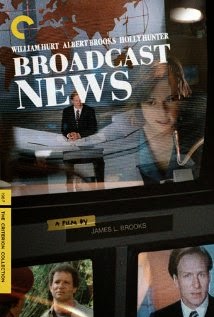
Broadcast News: written and directed by James L. Brooks; starring William Hurt (Tom Grunick), Albert Brooks (Aaron Altman), Holly Hunter (Jane Craig), Robert Prosky (Ernie Merriman), Lois Chiles (Jennifer Mack), Joan Cusack (Blair Litton), and Jack Nicholson (Bill Rorish) (1987): Broadcast News predicts the future better than most science-fiction films, as it shows American broadcast journalism on a collision course with infotainment. Thankfully, the movie is also funny and suitably dramatic, with James L. Brooks making even the intellectual vacuum that is William Hurt's up-and-coming anchorman a sympathetic character.
The major players -- Hurt, Holly Hunter as a Washington TV bureau's assistant producer, and Albert Brooks as a reporter -- are terrific. There is a sort of love triangle going on throughout the movie, but it never completely goes where one expects it to. The triangle is also in service to the movie's concern with the dumbing-down of American news coverage. For Hunter's character, To fall in love with William Hurt is to abandon her most cherished beliefs about what the news can be (as Brooks' character keeps telling her).
In our era of Fox News and 24-hour-Justin-Bieber coverage, Hurt's crowning journalistic sin now seems like very small potatoes. But it isn't. It was, however, a sign of where things were going, and how much further the news had to fall. Highly recommended.
When You Are Engulfed In Flames: Essays by David Sedaris (Collected 2008): Comic essayist and occasional short-story writer David Sedaris seems to have known from the beginning of his late-blooming career that if one wants to mock a wide assortment of people, things, customs, behaviors, and events around one, one must also mock one's self. Otherwise, you're just a judgmental dick. The trials, tribulations, and tics of David Sedaris the character make his judgments of all those things outside himself funnier and, in some cases, at least a little more poignant.
The novella-length essay that finishes this volume, "The Smoking Section," is a marvelous piece about Sedaris' love affair with cigarettes and the reasons for his decision to quit smoking. It's also an often hilarious indictment of a society gone absolutely bonkers on the topic of smoking. Like Orwell, Sedaris doesn't have much time for the "smelly little orthodoxies" of the smug and self-righteous, even when the smug and self-righteous occasionally turns out to be him. Highly recommended.