Showing posts with label raymond chandler. Show all posts

Monday, January 7, 2019

The Knife Slipped (Cool & Lam #2) (1939) by Erle Stanley Gardner

The Knife Slipped (Cool & Lam #2) (1939) by Erle Stanley Gardner writing as 'A.A. Fair': The great Hard Case Crime book line published this 'lost' hard-boiled detective novel from the creator of Perry Mason, Erle Stanley Gardner. It was meant to be the second in Gardner's [Bertha] Cool & [Donald] Lam series but was rejected by Gardner's publisher in 1939 for being too racy and for having Bertha Cool be a little too criminal.

Cool, a Rabelaisian giant of a woman, runs a detective agency in Los Angeles. Donald Lam is one of her newish detectives. A woman and her mother hire Cool's agency to discover what that woman's husband is up to at night. The answer is... plenty! And not all Hanky Panky!

Gardner was certainly no Hammett or Chandler. His prose is workmanlike for the most part, while some of the characters and situations are stereotypical. Nonetheless, this is an enjoyable, pulpy time-waster. Bertha Cool is a memorable comic grotesque. And some of the perils and pitfalls of private detecting are highlighted as Lam makes some (near) rookie mistakes.

And the novel is surprisingly racy. And surprisingly cynical about pretty much everything, with most of that cynicism expressed by Bertha Cool, about as knee-jerk a pragmatist as one could ask for. Gardner's PI's aren't all that interested in the larger ramifications of the case, leading to a conclusion that's pretty much a dramatic fizzle. I won't read another of the Cool & Lam mysteries published between 1938 and 1970, but I am glad I read this one. It's a hoot. Lightly recommended.

Saturday, February 17, 2018

The Big Sleep (1939)

The Big Sleep (1939: Philip Marlowe#1) by Raymond Chandler: Worried that in seeing the great Howard Hawks adaptation of The Big Sleep you've ruined yourself for the novel? Worry not! The novel diverges enough by page 50 or so that it's pretty much a different story than the movie.

Of course, it's also a lot more explicitly bigoted and homophobic than the movie, so there's that too. Get through that stuff and you've got a superior hard-boiled detective novel, one which had a psychological and stylistic depth that would influence hard-boiled fiction ever after.

This is the first novel-length adventure of Chandler's Philip Marlowe, the Los Angeles PI with a heart of gold. Well, gold alloyed with cynicism and pithy, pungent comments on The Way Things Are. Chandler's Marlowe arrives here pretty much entirely formed. He'll stay on a case if he thinks justice needs to be done, regardless of what a client wants. He likes chess, whiskey, and pondering the dusty nature of his office.

The written word in America 1939 had a bit more freedom than Hollywood movies in 1946, so certain portions of the plot are simply a bit more explicit when it comes to the pornography ring that drives part of the action. This also leads to the bigotry and homophobia becoming more explicit -- Bogart couldn't utter the opinion that "a pansy has no iron in his bones" in a movie, but Marlowe sure can, and does, in the novel. Hoo ha!

Nonetheless, the novel still reads with a surprising amount of stylistic freshness. Chandler was not better than all those who would follow him into the hardboiled world he remade, but he certainly was better than most -- and better than Dashiell Hammett, who was the epitome of the hardboiled writer before Chandler. Highly recommended.

Wednesday, January 24, 2018

The Little Sister (1949) by Raymond Chandler

The Little Sister (1949) by Raymond Chandler: The Little Sister is the fifth (of nine) novels featuring Raymond Chandler's Los Angeles PI Philip Marlowe. Marlowe gets involved in the madness that is Hollywood this time around, along with gangsters and tabloids and a particularly nasty killer who enjoys sticking an ice-pick into the base of his victims' skulls. As is often the case, Marlowe doesn't seem to end up being paid for his cynical, dogged, heroic efforts on the parts of all the people who need his help. 

A seemingly naive young woman from rural Middle America hires Marlowe to find her brother, who moved to LA to see the lights and hasn't been heard of in months. As with every Marlowe case, this initially simple proposition blossoms into a labyrinth of corruption, blackmail, and murder in which almost no one is what she or he appears to be.

Chandler's style was so influential that it permeated hardboiled detective fiction, as he added a level of pungent description and social criticism to the prior pinnacle of hard-boiled fiction (and still influential and excellent, then-and-now), Dashiell Hammett and his detective Sam Spade. 

Both characters were played by Humphrey Bogart, appropriately and memorably, in movies: Sam Spade in The Maltese Falcon and Philip Marlowe in The Big Sleep. An odd but enjoyable movie version of The Little Sister was made in the 1960's with James 'Jim Rockford' Garner as Marlowe. 

The Little Sister moves fast and tight, plot-packed without neglecting Chandler's strengths, deployed through first-person narrator Marlowe, at character study and subtly metaphoric descriptions of the California setting. Highly recommended.

Wednesday, December 6, 2017

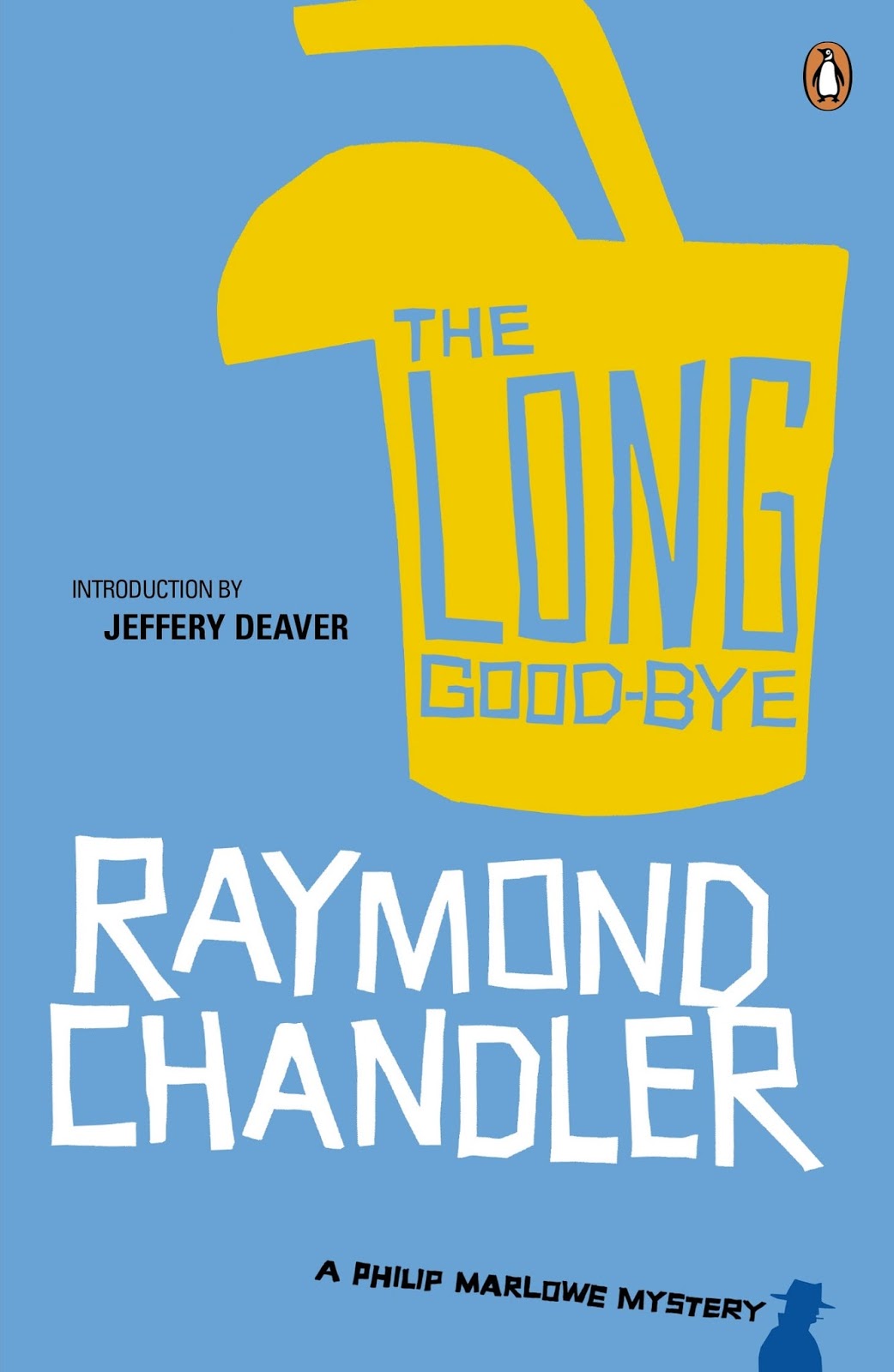
The Long Goodbye by Raymond Chandler

Mmm... big yellow cocktail.
The Long Goodbye [Philip Marlowe #6] (1953) by Raymond Chandler: It's difficult to assess a Raymond Chandler novel when you've read a lot of the novels influenced by Chandler's hard-boiled detective style, much less seen great movie adaptations and great movies influenced by Chandler's transformative work.

The voice of the Chandlerian narrator -- in this case and many others, Los Angeles PI Philip Marlowe -- is that of a cynical, world-weary detective who will nonetheless try to do the right thing. As first-person narration, it's almost infinitely adaptable. 

The narration of the original theatrical release of Blade Runner echoes it. The bleak world of Chinatown subverts it. The triumph of The Big Sleep lies partially in almost perfectly adapting it to the big screen, with help from Chandler himself (and Leigh Brackett, who 30 years later would help write The Empire Strikes Back, the most world-weary Star Wars movie of them all.

Chandler famously railed against the artificiality of most mystery novels in his essay "The Simple Art of Murder." The Long Goodbye seems like the fictional expansion of that essay. Marlowe doesn't so much solve a couple of mysteries as get caught in their undertow before being vomited upon the shore. 

It's a triumph of style and characterization. As a plot, The Long Goodbye makes Murder on the Orient Express look like a true-life case study -- and as the climax recedes once and once again, things get stranger and more complex.

Chandler's depiction of grimy, gaudy Los Angeles rings about as true today as it did then -- or at least as truthy. Philip Marlowe exists not as a possible character, but as the more poetic extrapolation of Dashiell Hammett's earlier Sam Spade. Humphrey Bogart played them both, which somehow makes all the sense in the world. Highly recommended.

Thursday, July 9, 2015

Weird Detective Stories

Solomon Kane: based on the character created by Robert E. Howard and scripted by Michael J. Bassett; directed by Michael J. Bassett; starring James Purefoy (Solomon Kane), Max von Sydow (Josiah Kane), Rachel Hurd-Wood (Meredith), Pete Postlewaite (William), Alice Krige (Katherine), and Jason Flemyng (Malachi) (2009): A second time through, and I again concluded it's a damn shame Solomon Kane didn't get at least a couple of sequels. Writer-director Michael J. Bassett plays a bit fast and loose with Robert E. Howard's quasi-Puritan demon-hunter to give him an origin story with a redemptive arc, but as a whole the movie is fairly true to the character. 

For a fairly low-budget fantasy film, Solomon Kane looks great, is jam-packed with good actors who seem to be invested in their roles, and has a suitably haunted James Purefoy as Kane. In terms of both sword-and-sorcery movies and Robert E. Howard adaptations, I might actually rank this over the original Conan the Barbarian, if only because its lack of pomposity hews much closer to Howard's writing than John Milius's bellicose sturm-und-drang. Highly recommended.


Marlowe: adapted by Stirling Silliphant from the novel The Little Sister by Raymond Chandler; directed by Paul Bogart; starring James Garner (Philip Marlowe), Gayle Hunnicutt (Mavis Wald), Carroll O'Connor (Lt. French), Rita Moreno (Dolores Gonzales), Jackie Coogan (Grant Hicks), Bruce Lee (Winslow Wong), and Sharon Farrell (Orfamay Quest) (1969): Enjoyable, typically twisty Raymond Chandler mystery gets updated by 20 years to late 1960's Los Angeles. James Garner is his typically low-key self as Philip Marlowe -- you could see this as an audition tape for the later Rockford Files. Bruce Lee shows up as a mob enforcer; what happens to him is actually pretty hilarious. Recommended.


The X-Files: Goblins by Charles L. Grant (1994): The first original X-Files novel has its pleasures. Released midway through the second season of the series, Goblins was written by veteran horror scribe Charles L. Grant. As with Grant's own work, Goblins is quiet horror for the most part, implying a lot and showing very little. Unfortunately, the 'monster' in Goblins would barely support an hour-long episode of the series, much less a nearly 300-page novel. Grant does a nice job of capturing the Mulder/Scully dynamic and the paranoid tone of the series. Suffice to say, though, that as in the dreadful movie Hollow Man, 'invisible' apparently means the same as 'invincible.' Lightly recommended.


Department 18: Night Souls by L.H. Maynard and M.P.N. Sims (2010): Night Souls tools along for its first three-quarters as a fairly soapy occult procedural that's light on horror and originality and really long on really short chapters, I assume because it was meant to be read in installments during every trip to the bathroom.

Alas, with about 75 pages to go, it completely craps the bed. Despite the fact that its climax is rushed and sketchy and amazingly satisfaction-light, Night Souls nonetheless finds the space for back-to-back chapters in which major female characters are raped, murdered, and dismembered in graphic detail. Then it throws in the dismemberment of an old homeless guy in a subsequent chapter because the writers seem to have lost all interest in the procedural aspects of their own narrative. As we've already been shown how bad the antagonists can be, these chapters don't tell or show us anything we don't know -- and the later fate of the rapist-murderers comes and goes with so little effect that there's no sense of catharsis or justice or really much of anything.

Oh, and one of the women is raped by a lizard-like monster which we're told on more than one occasion has a foot-long penis with giant barbs on it. Hooray! As the only other horror-novel rape scenes involving monsters with barbed penises that I recall happen in terrible Richard Laymon novels (yes, more than once, barbed-penis-rape-scene fans!), I can only assume this is a grotesque tip of a grotesque hat. There are horror novels that effectively portray rape scenes; Night Souls is not one of them unless you're a rape fetishist or a connoisseur of unusually large barbed penises. Not recommended.

Wednesday, July 1, 2015

Solitary Men

John Wick: directed by Chad Stahelski and David Leitch; written by Derek Kolstad; starring Keanu Reeves (John Wick), Michael Nyqvist (Viggo Tarasov), Alfie Allen (Iosef Tarasov), Willem Dafoe (Marcus), Dean Winters (Avi), Adrianne Palicki (Ms. Perkins), and John Leguizamo (Aurelio) (2014): Fun revenge-action movie directed by a former stunt man/stunt director takes full advantage of Keanu Reeves' low-key charms. 

The action sequences, whether car chases or hand-to-hand combat or lengthy shoot-outs, are all splendidly choreographed. This is in its way as pleasingly low-tech and old-school as Mad Max: Fury Road, and almost as much fun. There's also a refreshing amount of wit in the film's Hotel for Assassins, complete with strict house rules (Rule#1: No business on the premises!). The cast is top-notch, with Alfie Allen (Game of Thrones' Theon Greyjoy) as a suitably puerile and squirmy object of Keanu Reeves' wrath. Highly recommended.


The Lady in the Lake: adapted by Steve Fisher from the novel by Raymond Chandler; directed by Robert Montgomery; starring Robert Montgomery (Philip Marlowe), Audrey Trotter (Adrienne Fromsett), Lloyd Nolan (Lt. DeGarmot), Dick Simmons (Chris Lavery), and Leon Ames (Derace Kingsby) (1947): As an experiment, The Lady in the Lake is interesting in theory: much of the movie is told in the first person (which is to say, with a first-person camera) by Raymond Chandler's Philip Marlowe. Robert Montgomery both plays Marlowe and directs.

Alas, Montgomery simply isn't a good enough director to find ways to make the first-person camera work visually interesting, especially since the technology of the time severely limits the amount and speed of movement a camera was capable of. Montgomery's also woefully miscast as Marlowe, whose greatest portrayer will always be Humphrey Bogart but who has also been memorably played by Robert Mitchum, Eliot Gould, and James Garner, among others.

The four types of shots we see again and again include people talking to Marlowe without moving, Marlowe getting knocked out, Marlowe looking in a mirror, and Marlowe looking at his hands so we can see what he's doing with them. The Lady in the Lake does seem to have been watched by the Coen Brothers: a sequence in which Marlowe is chewed out in a police station by Bay City cops really seems to loom in the background of The Big Lebowski, though Marlowe escapes without taking a coffee mug to the head. Not recommended.


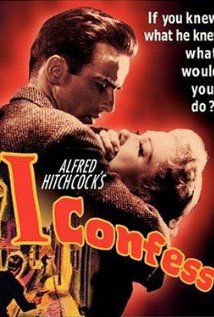
I Confess: adapted by George Tabori and William Archibald from a play by Paul Anthelme; directed by Alfred Hitchcock; starring Montgomery Clift (Father Logan), Anne Baxter (Ruth Grandfort), Karl Malden (Inspector Larrue), Brian Aherne (Willie Robertson), and O.E. Hasse (Otto Keller) (1953): Quebec City co-stars with Montgomery Clift in this moody, expressionistic Hitchcock thriller. Hitchcock's shot selection when it comes to Quebec is perhaps the most impressive thing about this movie, with looming churches, the nigh-cyclopean Chateau Frontenac,  cramped streets, and all the shadows that night can provide. 

Clift is striking and mournful as a Roman Catholic priest accused of a murder he didn't commit. But his Father Logan is royally screwed: not only did he hear the confession of the murderer, thus binding him with the Seal of the Confessional, but the murderer decides to frame Father Logan for that murder. And Logan's pre-priesthood romance with the now-married Anne Baxter has supplied stupid-but-stubborn cop Karl Malden with a motive for Logan to murder. The cinematography and editing make this a movie to study. The ending goes a bit cuckoo and a whole lot abrupt. Recommended.

Friday, January 9, 2015

Strangers on a Train (1951)

Strangers on a Train: adapted by Ben Hecht, Whitfield Cook, Czenzi Ormonde, and Raymond Chandler from the novel by Patricia Highsmith; directed by Alfred Hitchcock; starring Farley Granger (Guy Haines), Robert Walker (Bruno Antony), Ruth Roman (Anne Morton) and Patricia Hitchcock (Barbara Morton) (1951): At the very least, Strangers on a Train is one of Alfred Hitchcock's ten greatest films. And maybe it's top five. It's a terrific thriller that holds up beautifully and which contains an absolutely terrific performance from the tragic Robert Walker, who would die at the age of 32 the same year Strangers on a Train came to theatres.

Farley Granger's Guy Haines is a tennis player with a marital problem. His wife's been unfaithful. He wants to get a divorce so he can marry the daughter of the United States Senator for whom he'll be working full time once his tennis career ends. But his wife, now carrying someone else's child, no longer wants a divorce.

A seemingly random conversation with a stranger Guy meets in the club car of a train rapidly becomes sinister: Robert Walker's Bruno Antony is a superficially charming psychopath who seems to know an awful lot about Guy's marital problems, and indeed his entire personal life.

While spit-balling various theories on how to murder someone and get away with it, Bruno suggests that potential murderers should swap victims so as to eliminate motive. Guy thinks the creepy guy on the train is just indulging in a lurid fantasy (or mentally goofing around the way that the father and the Hume Cronyn character spin out perfect murder theories in Hitchcock's earlier Shadow of a Doubt).  But then Mrs. Haines ends up murdered at an amusement park. And now Bruno wants Guy to hold up his side of a bargain Guy didn't realize he'd made.

Funny, thrilling, and creepy, Strangers on a Train contains a number of shots and sequences that have been discussed in film schools and film criticism for decades. I'll let you experience them for yourself. Farley Granger does solid work as the slightly dense Mr. Haines, as does Hitchcock's daughter Patricia as the smart-aleck sister of Guy's new love interest. But it's Walker who steals the movie with his insinuating, creepy, hyper-intelligent psychopath. It's an absolutely marvelous performance made tragic by the reality of his death. Highly recommended.

Monday, September 8, 2014

Out of the Blue and into the Black

The Blue Dahlia: written by Raymond Chandler; directed by George Marshall; starring Alan Ladd (Johnny Morrison), Veronica Lake (Joyce Harwood), William Bendix (Buzz), Howard Da Silva (Eddie Harwood), Doris Dowling (Helen Morrison), and Hugh Beaumont (George) (1946): A rare case of hardboiled detective great Raymond Chandler writing a new story expressly for the screen, The Blue Dahlia also shares a history with one of the most infamous Hollywood murder cases of all time.

Eight months after the film's release, the mutilated body of an aspiring actress named Elizabeth Short was discovered. Her nickname was 'the Black Dahlia,' and forever after the movie and the still-unsolved case would be mentioned whenever the other was mentioned.

The movie involves the efforts of now-retired bomber pilot Alan Ladd's Johnny Morrison, just home from the Pacific theatre,  to discover the identity of his wife's murderer. And he'd better. He's on the run from the "coppers" because he's the prime suspect.

Ladd looks and acts polished and sharp throughout, though his character can also be stubborn and hot-headed at times. Given that he's returned home to find an unfaithful wife and a son killed as a result of her drunk driving, and within 12 hours she's been murdered...well, that can wear on a man. Especially when he flew 112 successful bombing missions. Screw those lightweights and their 50-mission caps.

The narrative twists and turns, to the extent that even though I'd seen the movie twenty years ago, I couldn't remember who the killer was. Veronica Lake is beautiful and cool, as is Ladd, and William Bendix is believable as a wounded, shell-shocked comrade of Morrison's who really hates big-band music and flowers. Apparently, Veterans' Affairs wasn't any better after WWII at looking after the wounded than it is now.

Some casual gunplay in somewhat unlikely locations will probably raise a laugh or two, as may Morrison's amazingly hard head. He's the Bruce Campbell of 1946. The direction is workmanlike, the script sparkling with tough/sentimental dialogue and weird little bits, including a scene involving a hood with a broken leg that seems like the Ur-Moment for all those scenes of talkative criminals in Quentin Tarantino movies. Recommended.

Tuesday, July 1, 2014

Adaptations and Lamentations

The Blues Brothers: written by Dan Aykroyd and John Landis; directed by John Landis; starring John Belushi (Jake Blues), Dan Aykroyd (Elwood Blues), and a cast of thousands including Aretha Franklin, Cab Calloway, James Brown, Ray Charles, John Lee Hooker, Carrie Fisher, Twiggy, Steven Spielberg, Frank Oz, Joe Walsh, Mr. T. and Paul Ruebens (1980): It's hard to imagine a vanity project this counter-intuitive being made today. The Blues Brothers is a musical in which the titular heroes (first performed by Aykroyd and Belushi on Saturday Night Live)  stand to the side and bounce around every ten minutes while a legend of rhythm and blues performs. And Cab Calloway. Even in 1980, Cab Calloway must have seemed like a reach.

But it all works surprisingly well, maybe better now that we've endured 34 years of much less agile-afoot action-comedies, none of which feature Aretha Franklin singing in a diner or a performance of the theme from Rawhide at a Country-and-Western bucket of blood. John Landis wasn't a stylistically sophisticated director -- the action scenes are funny or not depending on how much crap he throws into the frame. And boy, does he throw a lot of expensive crap into the frame.

The widespread destruction of property (and especially police cars) becomes funnier as we go along and the level of destruction increases. Belushi and Aykroyd hold it all together with performances as twin, deadpan Bugs Bunny types, nigh-indestructible and apparently completely unaware of that indestructibility. They're loveable because they don't try to be loveable. And they know when to get off stage. Highly recommended.
 

22 Jump Street: based on the TV series 21 Jump Street created by Stephen J. Cannell and Patrick Hasburgh; written by Michael Bacall, Jonah Hill, Oren Uziel, and Rodney Rothman; directed by Phil Lord and Christopher Miller; starring Jonah Hill (Schmidt), Channing Tatum (Jenko), Peter Stormare (The Ghost), Wyatt Russell (Zook), Amber Stevens (Maya), Jillian Bell (Mercedes), and Ice Cube (Captain Dickson) (2014): So metafictional, self-mocking, and self-referential that it feels like the longest SNL skit ever. 22 Jump Street is a hoot, though a little of the meta goes a long way.

Jonah Hill and Channing Tatum charm again as off-beat cops Schmidt and Jenko. Peter Stormare doesn't have a lot to do as the main villain, but Jillian Bell steals pretty much every scene she's in as a snarky college room-mate who keeps commenting on Schmidt's incongruous age whenever she sees him. A little draggy in the middle; a lot hilarious during the sequel-happy end credits. Recommended.


Winchester '73: written by Robert L. Richards, Borden Chase, and Stuart N. Lake; directed by Anthony Mann; starring James Stewart (Lin), Shelley Winters (Lola), Dan Duryea (Waco Johnny Dean), Stephen McNally (Dutch Henry Brown) and Millard Mitchell (High Spade) (1950): Hugely successful at the box office, Winchester '73 revitalized the movie Western for several more years, and Jimmy Stewart's Western career with it. To call the movie episodic is to state the obvious -- it almost plays like six short episodes of a TV series strung together. And it really feels like the sole sponsor of that TV series was the Winchester rifle company.

Solid location work and direction adds to the charms of Stewart, the young and pretty Shelley Winters, and a Who's Who of solid character actors. Oh, and Tony Curtis plays a Cavalry officer with about two lines. More weirdly, a young Rock Hudson plays a Native American. Recommended.


Murder, My Sweet: adapted by John Paxton from the novel Farewell, My Lovely by Raymond Chandler; directed by Edward Dmytryk; starring Dick Powell (Philip Marlowe), Claire Trevor (Helen Grayle), Anne Shirley (Ann Grayle), Otto Kruger (Jules Amthor) and Mike Mazurki (Moose Malloy) (1944): Poor casting hamstrings a mediocre adaptation of Raymond Chandler's Farewell, My Lovely from the get-go. The title was changed from Farewell, My Lovely after release because audiences stayed away in droves, believing it was another musical starring Powell rather than his first dramatic leading role. The movie might not have been great with Humphrey Bogart and Lauren Bacall, but it would have been better.

As is, Dick Powell is bland and serviceable as P.I. Philip Marlowe (whom Bogie would play two years later in The Big Sleep to universal and enduring acclaim). Claire Trevor, so good as the prostitute with a heart of gold in 1939's Stagecoach, is completely baffled by her role. A somewhat surreal dream sequence seems to nod knowingly at Hitchcock's forays into similar sequences. An adequate time-waster, but nothing more. Lightly recommended.


Ender's Game: based on the novel by Orson Scott Card, written and directed by Gavin Hood; starring Asa Butterfield (Andrew 'Ender' Wiggin), Harrison Ford (Colonel Graff), Hailee Steinfeld (Petra Arkanian), Abagail Breslin (Valentine Wiggin), Ben Kingsley (Mazer Rackham) and Viola Davis (Major Anderson) (2013): Not so much a bad movie as a peculiarly undercooked one, with a need for more character development before the apocalyptic climax. Asa Butterfield is fine as tween-aged Messiah Andrew 'Ender' Wiggin, whose strategic skills may be the only hope humanity has against an alien race known as the Formics. Harrison Ford and Ben Kingsley glower and growl quite effectively as the military geniuses who see in Ender humanity's last hope, and the rest of the cast is mostly fine.

That child-messiah thing that permeates science fiction and fantasy at least comes with some reservations on the part of Ender in this version of Orson Scott Card's popular novel. And the battle sequences are fine, though we're never given the equivalent of an establishing shot for the Earth fleet (or, for that matter, much idea of the scale of the ships), two mistakes that cut against any feeling of the epic. Lightly recommended.

Saturday, February 23, 2013

Up from the Past

Rec 3: Genesis: written by Luiso Berdejo, David Gallart and Paco Plaza; directed by Paco Plaza; starring Leticia Dolera (Clara) and Diego Martin (Koldo) (2012): Enjoyable fake-found-footage Spanish horror movies Rec and Rec2 become a less enjoyable horror movie combining found footage and traditional narrative elements.

There are nice gory and goopy bits scattered throughout, but an awful lot of this is just rote zombie action set at a wedding. The interesting religious reveal at the end of the first Rec has become here a shovel hitting us in the face over and over again. Lightly recommended for people who have seen the first two and will see the fourth (and ostensibly final) installment.


The Big Sleep: adapted by William Faulkner, Leigh Brackett, and Jules Furthman from the novel of the same name by Raymond Chandler; directed by Howard Hawks; starring Humphrey Bogart (Philip Marlowe), Lauren Bacall (Vivian Rutledge), John Ridgely (Eddie Mars), Martha Vickers (Carmen Sternwood), Louis Heydt (Joe Brody), and Charles Waldron (General Sternwood) (1946): Perhaps the most indispensable hard-boiled detective film of all time -- only Chinatown rivals it, though The Maltese Falcon too has its champions.

Screenwriters Leigh Brackett (who would thirty years later work on the screenplay for The Empire Strikes Back) and Jules Furthman and Chandler's original novel supply most of the verbal fireworks, William Faulkner having wandered back to Oxford, Mississippi in the middle of screen-writing to drink, hang out with his wheelbarrow, and inspire Barton Fink. Virtually all the dialogue crackles with wit and substance; the plot is twisty but ultimately perfectly logical (though depending on which version you see, the mystery of the chaffeur's murder may or may not be fully explained).

The performances are stellar throughout, with lengthy reshoots a year after the original completion of filming to beef up the badinage between Bogart and Bacall. Hawks directs with his trademark rapid-fire dialogue, and the black-and-white cinematography is beautifully deployed by Syd Hickox. If for no other reason, one needs to see The Big Sleep to fully appreciate the Coen Brothers' gonzo homage/parody, The Big Lebowski, with its warped parallel characters and situations (and use of the word 'shamus'). Highest recommendation.


Poltergeist: written by Steven Spielberg, Michael Grais, and Mark Victor; directed by Tobe Hooper; starring Craig T. Nelson (Steve Freeling), JoBeth Williams (Diane Freeling), Beatrice Straight (Dr. Lesh), Dominque Dunne (Dana Freeling), Oliver Robins (Robbie Freeling), Heather O'Rourke (Carol Anne Freeling) and Zelda Rubinstein (Tangina) (1982): Stephen Spielberg essentially co-directed Poltergeist and controlled its post-production, and it shows: this is very much a mirror image of E.T., released within a week of Poltergeist in 1982.

Much of the early material with the family soon to be beset by vengeful spirits works pretty well; we're in Spielberg suburbia, where the Dad is distant (figuratively here; literally in other Spielberg films) and the Mother is the spiritual head of the family. The supernatural starts with what seems to be a furniture-moving poltergeist ("Noisy ghost") but soon moves into high-tech pyrotechnics, rubbery models, stop-motion trees, and large accumulations of skeletons rocketing up from the muddy ground.

I can't say the Spielberg kitchen-sink approach works all that well in horror -- indeed, many of the later effects here would be spoofed to a certain extent by Evil Dead 2. There are brief moments of wonder, but the Spielbergian need to underline every effect and every emotional sequence with music, flashing lights, and endless close-ups of people looking awestruck quickly dissipates that wonder.

One of the elements of the main plot -- the disappearance of the little girl from her own house into an alternate dimension, with only her voice being able to be heard in our dimension -- is lifted pretty much wholesale from the Richard Matheson short story and, later, 1962 Twilight Zone episode "Little Girl Lost." Besides being afraid of old Twilight Zone episodes, original story-writer Spielberg was also apparently scared of trees, his face melting, clowns, and really large faces. And getting trapped in a crowd of skeletons. It's amazing how many of the horror tropes here previously showed up in Spielberg's Raiders of the Lost Ark. Lightly recommended.