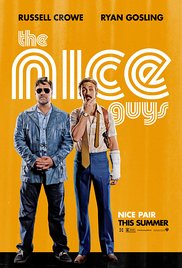
The Nice Guys (2016): written by Shane Black and Anthony Bagarozzi; directed by Shane Black; starring Russell Crowe (Jackson), Ryan Gosling (Holland), Angourie Rice (Holly), Matt Bomer (John Boy), Margaret Qualley (Amelia Kuttner), and Kim Basinger (Judith Kuttner): Writer (Lethal Weapon) and occasional director (Iron Man 3) Shane Black really loves buddy movies. And movies set in Los Angeles. Russell Crowe and Ryan Gosling are the unlikely duo here as hired muscle and private eye, teaming up to solve a missing persons case tied somehow into the American auto industry. Did I mention it's 1977? It's 1977.
Black gives Gosling's character a much less foul-mouthed version of Bruce Willis' daughter in The Last Boy Scout and a much less gay partner than Kiss Kiss Bang Bang's Val Kilmer in Russell Crowe. Crowe, unshaven and lumpy, looks like he's auditioning to be a young John Goodman. And he's great! The movie is violent, quippy fun, a throwback to buddy movies that were actually violent, quippy fun. Recommended.
Kiss Kiss Bang Bang (2005): written by Brett Halliday and Shane Black; directed by Shane Black; starring Robert Downey Jr. (Harry), Val Kilmer (Perry), Michelle Monaghan (Harmony), and Corbin Bernsen (Dexter): Violent, quippy, twisty fun from Shane 'Iron Man 3' Black. Val Kilmer is surprisingly light and funny as the LA Private Eye everyone calls 'Gay Perry.' Robert Downey, Jr. is also light and funny as a thief who stumbles into a case involving suicide, murder, and missing persons. And Michelle Monaghan makes for a great gal pal who may also be a femme fatale. The movie's 'chapters' all use the titles of works by Raymond Chandler, first famous chronicler of LA PI's. Like most great PI stories, it's narrated (by Downey's character). Unlike most of them, people keep correcting the narrator's grammar. Terrific cult fun. Highly recommended.

The Hateful Eight (2015): written and directed by Quentin Tarantino; starring Samuel L. Jackson (Major Warren), Kurt Russell (John Ruth), Jennifer Jason Leigh (Daisy Domergue), Walton Goggins (Chris Mannix), Tim Roth (Oswaldo Mobray), Michael Madsen (Joe Gage), Channing Tatum (Jody), and Bruce Dern (General Smithers): I'm glad I didn't see the Director's Cut 'Roadhouse' version of The Hateful Eight because this version is already too long and that one is 25 minutes longer.
On the bright side, there's a great 95-minute movie buried inside The Hateful Eight's repetitive bloat. On the dark side, The Hateful Eight's repetitive bloat. Tarantino's homage to John Carpenter's The Thing is very much in love with Tarantino's dialogue because, well, it's written and directed and at points narrated by Quentin Tarantino. If nothing else, it suggests that the on-screen love affair between Tarantino and the 'N' word that first bloomed in Reservoir Dogs has only grown more impassioned over the intervening two decades and change.
The actors are all fine. The action, when it comes, has the power to shock with both surprise and grue. The landscape is white and menacing. The characters never shut up. And a recurring bit with a door that won't close may have seemed funny on paper, but it surely does wear out its welcome quick. I'd have liked more from Bruce Dern and Michael Madsen and a whole lot less from Walton Goggins, an actor I like but not particularly in this part. Tarantino's threat to stop making movies after this one... yeah, I'm fine with that. Because no one's ever going to edit down a Tarantino movie to a length that works. It's a lot more likely that his next project would be a four-hour remake of The Car entitled N*gger Car. Not recommended.

Hidden Figures (2016): adapted by Allison Schroeder and Theodore Melfi from the non-fiction book by Margot Lee Shetterly; directed by Theodore Melfi; starring Taraji P. Henson (Katherine Johnson/Goble), Octavia Spencer (Dorothy Vaughan), Janelle Monae (Mary Jackson), Kevin Costner (Al Harrison), Kirsten Dunst (Vivian Mitchell), Jim Parsons (Paul Stafford), and Glen Powell (John Glenn): How does Taraji P. Henson not get a nomination for this? Oscar noms for Best Picture, Best Supporting Actress (Octavia Spencer) and Best Adapted Screenplay have been given to this fine docudrama. Does it play fast and loose with the facts, especially in compressing 15 years worth of events into two years? Well, yeah. So, too, so many other docudramas and biopics.
But Hidden Figures presents the Space Race as a thrilling exercise in math, engineering, and race relations. How great is that? The acting is superb, from Kevin Costner's (composite character) team leader of NASA Langley's mathematicians striving to put an American in space and in orbit to the aforementioned Henson as pioneering NASA mathematician Katherine Johnson, the African-American mathematician who helped put Americans into orbit and on the Moon. Octavia Spencer and Janelle Monae also do terrific work as an African-American computer-team leader and engineer, respectively. It's a movie about the thrill of intelligence and lofty aspirations, dominated by women. Highly recommended.
The Seven-Per-Cent Solution (1976): written by Nicholas Meyer and based on the novel by Nicholas Meyer and characters created by Arthur Conan Doyle; directed by Herbert Ross; starring Alan Arkin (Sigmund Freud), Vanessa Redgrave (Lola Deveraux), Robert Duvall (Dr. Watson), Nicol Williamson (Sherlock Holmes), Laurence Olivier (Professor James Moriarty), Joel Grey (Lowenstein), and Jeremy Kemp (Baron von Leinsdorf): Adapted by Nicholas 'Wrath of Khan' Meyer from his own revisionist Sherlock Holmes novel, The Seven-Per-Cent Solution is a barrel of fun with one minor problem: Robert Duvall's horrible English accent.
How Duvall got cast as Dr. Watson is a good question. My best guess would be that the producers wanted another American in the major cast. This was an expensive production after all.
One can't say much about The Seven-Per-Cent Solution without giving away major plot points. Suffice to say that the movie looks great, is wittily written, and has a concluding action sequence that riffs on Buster Keaton's The General (and all without the benefit of CGI). Nicol Williamson pretty much plays Nicol Williamson, which is fine for Meyer's manic version of the great detective. Alan Arkin also delights as Sigmund Freud. Easily one of the ten best Sherlock Holmes movies ever made. Highly recommended.
The Neon Demon (2016): written by Nicolas Winding Refn, Mary Laws, and Polly Stenham; directed by Nicolas Winding Refn; starring Elle Fanning (Jesse), Karl Glusman (Dean), Jena Malone (Ruby), Bella Heathcote (Gigi), Abbey Lee (Sarah), and Keanu Reeves (Hank): Writer-director Nicolas Winding Refn works in the lurid pulp mode of Only God Forgives here, and not in the cooler style of his break-out film, Drive.
The carefully composed, static shots and cool synth score suggest late-career Stanley Kubrick directing a very special episode of Melrose Place. The plot manages to surprise. The characters are barely characters, but as this is a horror movie centered on the cosmic terror of the modelling industry, one expects a keen devotion to surface. And a horror movie it is, not so much slowly building as suddenly exploding in the last half hour.
The men are peripheral to the action, while the women take center stage. Elle Fanning performs beautifully as the enigmatic new model at the heart of the story, while Jena Malone and Abbey Lee embody different, dark aspects of the modelling industry. Not for the squeamish. Recommended.
From Dusk Till Dawn (1996): written by Robert Rodriguez and Quentin Tarantino; directed by Robert Rodriguez; starring George Clooney (Seth Gecko), Quentin Tarantino (Richard Gecko), Harvey Keitel (Jacob Fuller), Juliette Lewis (Kate Fuller), Ernest Liu (Scott Fuller), and Cheech Marin (Three characters): From Dusk Till Dawn still seems like two movies bolted together in the middle. The first movie is a gritty, amoral Tarantino crime drama about the bank-robbing Gecko brothers (George Clooney and Quentin Tarantino as Superego and Id, respectively). The second movie is a gore-soaked horror-comedy in the vein of Evil Dead 2.
They're both good movies, but I'll be damned if I know how they got stuck together like this. Robert Rodriguez directs with a lot of gusto, and Tarantino's script is solid, pulpy fun in the second half. There's some poorly modulated sexual violence towards women in the first half, a problem magnified by the jokey, one-note performance by Tarantino as the sexually predatious Gecko brother whom Clooney's more upright criminal is stuck with. Jesus, Tarantino was (and is) a terrible actor.
The second half goes on about ten minutes too long and bafflingly loses its antagonist about five minutes in. I enjoyed the movie, but I also felt a bit dirty afterwards. Harvey Keitel, George Clooney, and Juliette Lewis seem to be acting in (and reacting to) a completely different movie than anyone else. Their naturalistic performances accentuate the artificial grue and spew of the second half. Recommended.
Maximum Overdrive (1986): adapted by Stephen King from his short story "Trucks"; directed by Stephen King; starring Emilio Estevez (Bill), Pat Hingle (Hendershot), Laura Harrington (Brett), and Yeardley Smith (Connie): Revisiting the infamous Maximum Overdrive after 30 years, I was struck by how generally not-awful it was. This may just be a product of 30 more years of bad horror movies. I don't know.
Stephen King's one-and-done directorial effort is intermittently clumsy, poorly shot, and uneven in tone. But there are moments of startling gore and grue. And Emilio Estevez sells the shit out of his character: this might actually be his best performance. The movie's premise suffers a bit from King's expansion of the, ahem, possession of things from Just Trucks in his short story to Pretty Much Whatever the Plot Demands in the movie. Watch for a young Giancarlo Esposito's brief turn. And yes, that's the voice of Bart Simpson as the world's most annoying newlywed. Lightly recommended.
Cyrus: written and directed by Jay and Mark Duplass; starring John C. Reilly (John), Jonah Hill (Cyrus), Marisa Tomei (Molly), and Catherine Keener (Jamie) (2010): Sad-sack John starts dating sad-sack Molly, only to encounter problems with her 22-year-old live-at-home son Cyrus. An enjoyable mumblecore comedy-drama got pitched for its brief theatrical run as a wacky comedy, which it assuredly is not. Indeed, the rhythms of many of the scenes featuring a fish-eyed Jonah Hill are those of horror and not comedy. Marisa Tomei is a lot more striking now that she's aged out of cuteness -- she projects an occasional tiredness of adulthood that's extremely affecting. John C. Reilly is also good as a guy with his own dependency issues, while Jonah Hill exudes menace and hostility hidden behind platitudes and false bonhomie right up to the final scenes. Recommended.

Kill Bill 1 and 2: written by Quentin Tarantino and Uma Thurman; directed by Quentin Tarantino; starring Uma Thurman (The Bride), David Carradine (Bill), Vivica Fox (Vernita Green), Lucy Liu (O-Ren Ishii), Michael Madsen (Budd), Daryl Hannah (Elle Driver), Sonny Chiba (Hattori Hanzo), and Gordon Liu (Johnny/ Pai Mei) (2003-2004): Quentin Tarantino was forced by Miramax to split Kill Bill into two movies, primarily because it was impossible to sell a 4-hour movie of any genre to theatre chains. This looked for a time like it would be Tarantino's Heaven's Gate -- filming went on forever, the budget kept rising, and Tarantino was forced because of budget issues to come up with a different final confrontation between the Bride and Bill than he originally intended. But the two movies ended up making a lot of money.
It's a fascinating movie (s). It's a triumph of synthetic style over substance; so many different film styles, so many different homages, so little substance. It's a piece of film entertainment that's ultimately about nothing but the indiscriminate love of movies and the cool things that happen in them, the cool way they can look and move. The cast is almost uniformly perfect, with Uma Thurman as the vengeful Bride (we only learn her real name towards the end of Volume 2) and David Carradine as the malign, soft-voiced Bill the stand-outs. It's a love letter to Kung Fu movies, spaghetti Westerns, different film stocks, and pulp of all types from a half-dozen countries. Highly recommended.

Earth Vs. The Flying Saucers: inspired by the non-fiction book by Donald Keyhoe and written for the screen by Curt Siodmak, George Worthing Yates, and Bernard Gordon; directed by Fred F. Sears; starring Hugh Marlowe (Dr. Marvin) and Joan Taylor (Carol Marvin) (1956): The looming inspiration for Tim Burton's Mars Attacks in both UFO design and anti-UFO weaponry (sound waves, albeit not those generated by the golden throat of Mr. Slim Whitman). The writing, direction and acting are competent, but the star is stop-motion guru Ray Harryhausen, whose UFOs look great and are generally very well integrated into the rest of the footage. Joan Taylor gets a much larger than normal role for a woman in this sort of movie. Recommended.

Trading Places: written by Timothy Harris and Herschel Weingrod; directed by John Landis; starring Eddie Murphy (Billy Ray Valentine), Dan Aykroyd (Louis Winthorpe III), Denholm Elliott (Coleman), Ralph Bellamy (Randolph Duke), Don Ameche (Mortimer Duke), Jamie Lee Curtis (Ophelia), Paul Gleason (Clarence Beeks), and Jim Belushi (Harvey) (1983): Eddie Murphy's second movie was a comedy hit in 1983. It still shines today, though certain routines will make a person cringe. Originally intended to be a Gene Wilder/Richard Pryor vehicle, Trading Places is the only comedy I can think of that hinges on the commodities trading of frozen orange juice concentrate on the floor of the Stock Exchange. Murphy is young, thin, hilarious, and charismatic. Aykroyd is very good as an upper-class twit. The supporting cast is also good and fairly well-served. Jamie Lee Curtis, trying to change her image as the virginal good girl in slasher movies, does a couple of brief topless scenes. They appear to be real, and they're spectacular. Recommended.