Showing posts with label laird barron. Show all posts

Monday, January 18, 2016

Imago Cubed

The Imago Sequence and Other Stories by Laird Barron (Collected 2007) containing the following stories: Old Virginia (2003); Shiva, Open Your Eye (2001); Procession of the Black Sloth (2007); Bulldozer (2004); Proboscis (2005); Hallucigenia (2006); Parallax (2005); The Royal Zoo is Closed (2006); and The Imago Sequence (2005): 

Not the first, not the second, but the third time I've read this collection in the last four years. So I guess I like it. I'll add only that the third reading allowed the connections among the stories to stand out more in my mind. 

And Barron's generally-doomed tough-guy protagonists sometimes bring to mind some of Jim Thompson's characters along the same lines, though Thompson's characters didn't have to deal with screamingly awful occult menaces. I sort of wish Barron would write a story in which one of his tough, morally dubious protagonists beats a Shoggoth to death with a shovel. That would be awesome. Highly recommended.

Tuesday, January 6, 2015

Year's Best Weird Fiction Volume 1 (2013/Published 2014): edited by Laird Barron and Michael Kelly

Year's Best Weird Fiction Volume 1 (2013/Published 2014): edited by Laird Barron and Michael Kelly, containing the following stories:


  • The Nineteenth Step by Simon Strantzas: Not so much a story as an opening that's missing a middle and an end. 
  • Swim Wants to Know If It's as Bad as Swim Thinks by Paul G. Tremblay: Sharp and nasty character study suddenly turns into a vaguely observed (and possibly completely subjective) invasion of Lovecraftian horrors.
  • Dr. Blood and the Ultra Fabulous Glitter Squadron by A. C. Wise: Well, it's sort of funny, and it sort of feels like something that was written in about 1970 for the magazine Weird Heroes, given that the genre tropes it spoofs are all very, very, very old. 
  • The Year of the Rat by Chen Qiufan: Nice dystopian satire in translation from the Chinese would be pretty much at home in an issue of Galaxy magazine from 1955.
  • Olimpia's Ghost by Sofia Samatar: Something to do with Sigmund Freud but I never really cared what or why.
  • Furnace by Livia Llewellyn: Solid bit of weird horror reminds me a lot of late-career Thomas Ligotti...which makes a lot of sense when you realize that it's from a Ligotti tribute anthology.
  • Shall I Whisper to You of Moonlight, of Sorrow, of Pieces of Us? by Damien Walters Grintalis: The pomposity of the title has literally erased the story from my memory. Honestly, it's like an episode title from Season 3 of Gene Roddenberry's Andromeda.
  • Bor Urus by John Langan: Typically solid Langan piece with a really spooky, disturbingly dream-like climax.
  • A Quest of Dream by W. H. Pugmire: A tip of the hat to H.P. Lovecraft's Dream-Cycle stories. There's really only one W.H. Pugmire story, a sort of Swinburne-meets-early-Lovecraft fragment, and this is another one of those. Enjoyable, rotted twee.
  • The Krakatoan by Maria Dahvana Headley: Promising start, completely goofy weird ending.
  • The Girl in the Blue Coat by Anna Taborska: Solidly written and observed ghost story of the Holocaust.
  • (he) Dreams of Lovecraftian Horror... by Joseph S. Pulver, Sr.: No memory of this.
  • In Limbo by Jeffrey Thomas: Twilight Zone-like set-up for a keenly observed character study. Very reminiscent of a lot of stories that appeared in Charles Grant's Shadows anthologies in the 1970's and 1980's.
  • A Cavern of Redbrick by Richard Gavin: Very nice weird tale with a disturbing either/or conclusion that offers closure without a definitive answer to what just happened.
  • Eyes Exchange Bank by Scott Nicolay: Really the 900-pound gorilla of this anthology super-collides splatterpunk and kitchen-sink horror with some great riffs on Poe and the Decadents.
  • Fox Into Lady by Anne-Sylvie Salzman: Mostly unpleasant, amorphous, mythy.
  • Like Feather, Like Bone by Kristi DeMeester: Story fragment about some gross stuff.
  • A Terror by Jeffrey Ford: Excellent period piece depicts Emily Dickinson's first meeting with Death.
  • Success by Michael Blumlein: I could imagine this story as having been written by someone like Robert Sheckley or Cyril Kornbluth and published in a 1957 issue of Galaxy magazine, only at about one-third the length. As is, it's almost monstrously attenuated.
  • Moonstruck by Karin Tidbeck: A sort of inert bit of dark fantasy shading into a postmodern folk story.
  • The Key to Your Heart is Made of Brass by John R. Fultz: This one, enjoyable as it is, would be more enjoyable if it were the script to a Heavy Metal/Metal Hurlant comic-book story from 1979, preferably illustrated by some very baroque and murky European comics artist of the time.
  • No Breather in the World But Thee by Jeff VanderMeer: The usually subtle and understated VanderMeer cuts loose, to increasingly dire and unengaging effect. It may be a satire of weird-fiction tropes the writer has grown tired of. It's sort of a rubbery, pointless, "shocking" mess.


Barron casts the net so wide for his definition of the Weird in his introduction that the term becomes almost meaningless. And the extraordinarily broad reach of the contents bear this out. It seems less like an attempt to come up with a new genre and more like a land grab. Nonetheless, there's a lot of good stuff here. In all: recommended, a little lightly

Saturday, October 18, 2014

Tales to Admonish

The Best Horror of the Year Volume 4 (2011): edited by Ellen Datlow, containing the following stories: The Little Green God of Agony by Stephen King; Stay by Leah Bobet; The Moraine by Simon Bestwick; Blackwood's Baby by Laird Barron; Looker by David Nickle; The Show by Priya Sharma; Mulberry Boys by Margo Lanagan; Roots And All by Brian Hodge; Final Girl Theory by A. C. Wise; Omphalos by Livia Llewellyn; Dermot by Simon Bestwick; Black Feathers by Alison Littlewood; The Final Verse by Chet Williamson; In the Absence of Murdock by Terry Lamsley; You Become the Neighborhood by Glen Hirshberg; In Paris, in the Mouth of Kronos by John Langan; Little Pig by Anna Taborska; and The Ballad of Ballard and Sandrine by Peter Straub (all stories 2011):

Ellen Datlow's Best Horror anthologies tend towards an area of the horror axis in which weirdness and relationship problems are the highest values. It's not my favourite area of horror, but if it's yours, you may find Datlow's anthologies more rewarding than I do.

Certainly nothing here is badly written. The entries from Glen Hirshberg and Laird Barron are typically excellent. I like how Hirschberg lays out the long-term psychological effects of a brush with the supernatural, while Barron's world of muscular protagonists faced with an enormity of perverse, hidden horrors always gives me a kick. "Blackwood's Baby" seems like the sort of fever dream Hemingway might have had after getting punched in the mouth by Cthulhu.

The John Langan story is also good, though the ending is telegraphed all the way back to the title. Stephen King's story seems to be included solely to get King's name on the cover -- it's a curiously limp affair in which one can call all the plot points several pages before they occur and be right every time.

Peter Straub's story disappoints in a much different way. It's weird and creepy for awhile, but the eponymous couple's peculiar sexual fetish, once revealed, acts to distance one from any investment in the narrative's outcome. The ending comes several paragraphs too late, as a third-party explanation of what we've just read blunts whatever horror remained in what we'd previously read. Chet Williamson's otherwise excellent "The Final Verse" also has a problematic ending, as it veers into a sort of jokey, EC-Comics nihilism that doesn't fit the rest of the story.

Stylistically, the stories are well-written. Would I like more stories that are actually scary? Oh, yeah. I do like that Datlow includes a list of stories as 'Honourable Mentions' at the end of the volume. There's something weird and off-putting about it.  I could also probably go to the end of my days without reading another Bradburyesque story with the plot-engine removed, or another Weird Incest Tale. Weird Incest Tales: the worst fantasy magazine ever. Lightly recommended.

Saturday, January 4, 2014

Horrors by the Dozens

Occultation and Other Stories by Laird Barron, containing the following stories: The Forest; Occultation; The Lagerstatte; Mysterium Tremendum; Catch Hell; Strappado; The Broadsword; --30--; and Six Six Six (2010): Laird Barron's second collection of short stories shows a writer unafraid to broaden his reach and his grasp. He's a fine horror writer committed to his craft.

For example, this time around we get three female protagonists, two stories with gay protagonists, and one gay narrator. All are handled sympathetically, all ring true to my ears. Of course, even Barron's least likeable protagonists can be made sympathetic when juxtaposed with the horrific entities and situations they are set against. Barron's fictional cosmos is a cruel abattoir shot through with brief flashes of hope and defiance -- to quote Michael Ondaatje, very faint, very human.

Which stories sing the loudest? "The Lagerstatte" deals with mourning and depression subtly, though there's some nebulous form of cosmic horror amplifying the human loss in the story. "Mysterium Tremendum" grants the reader a greater understanding of the Necronomicon of Barron's fictional universe, The Black Guide. That The Black Guide is a malevolent guide to tourist sites that tends to be found in homey country stores is deeply hilarious and practical at the same time.

Really, all the stories are tremendous, whether dealing with mysterious insect intelligences ("The Forest"), rundown hotels formerly of glorious aspect ("The Broadsword"), or monsters wearing human disguises with detachable heads (a Barron staple, and an attribute of the horrible Children of Old Leech, about whom I will only add AIM FOR THE CENTRE OF BODY MASS!!!). "The Broadsword" may be the most weighted with tragedy, along with "The Lagerstatte," but both are tragedies of the loss of self, and whether or not one can stop that loss before greater horror sets in.

To quote a doom-fraught line from another Barron work, "They enter as slaves and emerge as kin." It's not just that characters in Barron's universe have to make decisions about remaining human or becoming monster -- it's that sometimes even that decision is stripped from them. Their transformations will be terrible. But what price has the reader paid to become what he or she is? Highly recommended.


Cults of Horror, edited by Charles G. Waugh and Martin H. Greenberg, containing the following stories: The Feast of St. Dionysus (1973) by Robert Silverberg; Devils in the Dust (1935) by Arthur J. Burks; The Questing Tycoon (1954) by Leslie Charteris; The Peacemaker (1983) by Gardner Dozois; The Legend of Gray Mountain (1979) by Emily Katharine Harris; Sword for a Sinner (1959) by Edward D. Hoch; The Shaker Revival (1970) by Gerald Jonas; The Red One (1918) by Jack London; The House of Eld (1895) by Robert Louis Stevenson; Sticks (1974) by Karl Edward Wagner; Overkill (1990) by Edward Wellen; In the Abyss (1896) by H. G. Wells; and Fear Is a Business (1956) by Theodore Sturgeon (Collected 1990):

Fun and typically wide-ranging anthology from master anthologists Waugh and Greenberg. Boy, is it wide-ranging both in time and genre! There's an excellent novella by Robert Silverberg from Silverberg's artistic peak of the early 1970's. There's an adventure of Leslie Charteris's Saint. There's a story by science-fiction pioneer H.G. Wells. There's a weird bit of extraordinarily racism and misogynism from Jack London. There's Karl Edward Wagner's legendary "Sticks." And there's a piece from the 1930's by Arthur J. Burks about the Dust Bowl that reads like one of Robert E. Howard's fever dreams (if he had such things). Well worth picking up should you see it in a used bookstore. Recommended.


Just Behind You by Ramsey Campbell, containing the following stories: Fear the Dead; Digging Deep; Double Room; The Place of Revelation; The Winner; One Copy Only; Laid Down; Unblinking; Breaking Up; Respects; Feeling Remains; Direct Line; Skeleton Woods; The Unbeheld; The Announcement; Dragged Down; Raised by the Moon; Just Behind You; and Safe Words (Collected 2009):

Strong collection of Campbell's early 21st-century short stories with the usual generous and explanatory afterword by Campbell. Cellphones become instruments of horror, though perhaps in "Digging Deep" there's as much bleak humour to the proceedings as anything. Homages to M.R. James (the title story) and Arthur Machen ("The Place of Revelation") work marvellously while maintaining that slightly hallucinatory Campbellian diction. "Safe Words" plays as non-supernatural comedy of embarrassment, as its narrator's life goes off the rails thanks to a few mistaken assumptions about a fellow teacher.

"Skeleton Woods" is also a marvel of narration, as it uses first-person present-tense in a way that amplifies the horror of the last few paragraphs. Teen-aged fears and social class help form the horrors of "Dragged Down," while "Fear the Dead" gives us a little boy with some very unnerving problems involving bullies, squabbling parents, and a grandmother who doesn't seem to want to stay dead. In all, another strong outing from Campbell. Recommended.

Sunday, December 8, 2013

They Eat Babies, Don't They?

The Beautiful Thing That Awaits Us All and Other Stories by Laird Barron (Collected 2013) containing the following stories: Blackwood's Baby (2011); The Redfield Girls (2010); Hand of Glory (2012); The Carrion Gods in Their Heaven (2011); The Siphon (2011); Jaws of Saturn (2012); Vastation (2010); The Men from Porlock (2011); and More Dark (2012):

As his fictional cosmos becomes denser and more awful with each new story, Laird Barron's sense of humour has become more apparent. One of the jokes is in the collection's title. Look at the contents. "The Beautiful Thing That Awaits Us All" is mentioned in the collection's final, blackly satiric "More Dark", but it's a work by a thinly veiled parody of horror writer Thomas Ligotti. Hunh?

Barron certainly hasn't transmogrified into a laugh-riot, but nonetheless assays one semi-parodic roman a clef ("More Dark") and one warp-speed, semi-comic, ultra-cosmic cruise through the Cthulhu Mythos ("Vastation") in this new collection. Lurking somewhere in each story is at least the shadow of Barron's space-born, Earth-afflicting creation, the Children of Old Leech. As always, their sense of humour only amuses themselves.

He's still the reigning champion of stories about tough, competent men faced with overwhelming, horrific evil. "The Men from Porlock" is a modern classic about a hunting expedition gone tragically wrong; it bears comparison to that foundational giant in the 'Bad Camping Trip' sub-genre of horror, Algernon Blackwood's "The Willows."

I love this story. It's brutal and elegaic and startling. And its characters even manage to land a few punches on the snouts of those awful cosmic cancers, the Children of Old Leech, albeit at one remove. The day's coming when somebody's going to kill one of the Children of Old Leech in a Barron story, and that moment is going to be goddammed Christmas and New Year's all rolled into one.

Barron also continues to explore new voices and new approaches: all-female casts of protagonists in "The Redfield Girls" and "The Carrion Gods in Their Heaven"; an extraordinarily unpleasant gangland stooge in "Jaws of Saturn"; a suicidal writer in "More Dark"; quite possibly the most disturbing vampires ever in "The Siphon." Along the way, we revisit old haunts, most prominently the demon-haunted forests of Washington state and the demon-haunted rooms of Olympia, Washington's Broadsword Hotel.

Well, really, the whole world is demon-haunted. But most of Barron's protagonists keep plugging along, heads down, trying to move forward against the blood torrent. There's a metaphysical lack of hope herein, but not complete hopelessness. Highly recommended.

Broken-minded

The Croning by Laird Barron (2012): On second reading, Laird Barron's The Croning yields up more frights and more depth, along with a greater understanding of the interconnectedness of all of his fiction. What a frightful universe Barron conjures up, one in which the existential terror of his particular form of cosmic horror manifests itself in the simplest of human emotions and actions.

This terrific first novel touches upon almost everything Barron had written to this point, and on many things he hadn't written yet, but the novel doesn't require knowledge of those other works -- though knowing of The Black Guide or the events of "The Men of Porlock" certainly deepens one's understanding of the events related here.

There's tragedy here in the story of Don Miller, who in the present day lives in a rambling old house in small-town Washington state, is 80-something and still devoted to his curiously youthful wife, Michelle Mock, and their adult children, fraternal twins Holly and Kurt. But Miller has become almost paralyzed by fear of the dark, especially when Michelle is away on one of her curious, frequent anthropological expeditions. The very house Miller lives in is a source of recurring terrors, the cellar most of all. But they must be the nightmares of an aging man with the attendant mental-health problems of old age. Right?

Barron's concern with identity is a career-long one, and Miller represents a study in the limits of the continuity of human character. Don's memory is failing, possibly the result of incipient dementia or Alzheimer's. But it's been failing almost as long as Miller can remember. When he remembers. There are holes in his mind almost too many to count, and Don gets through the day by avoiding the most basic questions about his own past.

But memories sometimes flare up, in nightmares forgotten upon waking. And the absence of memories must also be dealt with or ignored. How, Don wonders at one point, can a person forget not only an entire language (Spanish, in this case), but that he ever knew that language at all?

Well, he's going to find out. And as we travel back and forth across the history of Don and the history of these strange, powerful monsters known collectively as the Children of Old Leech, we find out too. Barron's prose is brutal and beautiful. He links the cosmic and the personal and the visceral in fascinating and rewarding ways, in this tragedy of the losing and finding and losing of memory.

Besides the terror, there's sorrow for humanity here, as a whole and in its constituent parts. Don's a fascinating character, mentally wounded but pushing onwards towards knowledge that he knows at every step he probably doesn't want to possess. And the various manifestations of evil, human and otherwise, ring true. The humans who collaborate with the Children of Old Leech do so for power and money and immortality. The cost of these things is exceedingly high, but as in our world, people can do the most frightful things for the most basic of reasons. Highly recommended.

Thursday, November 28, 2013

Imago, Imago, Imago

The Imago Sequence and Other Stories by Laird Barron (Collected 2007) containing the following stories: Old Virginia (2003); Shiva, Open Your Eye (2001); Procession of the Black Sloth (2007); Bulldozer (2004); Proboscis (2005); Hallucigenia (2006); Parallax (2005); The Royal Zoo is Closed (2006); and The Imago Sequence (2005): Barron's fictional cosmos, in which most and possibly all of these early stories take place, exudes dread. Barron himself is a marvelous writer who seemed to arrive fully formed in 2000, as good or better than all of his contemporaries, and then proceeded to get better over the following decade.

As with H.P. Lovecraft's Cthulhu Mythos, Barron's fictional cosmos deploys many of the trappings of supernatural fiction in service to what is really science-fictional horror. What seems to be supernatural is really the result of beings and sciences too far beyond humanity to be fully fathomed by Barron's protagonists. None of the seemingly supernatural beings we encounter is remotely benign.

Humanity isn't so much cattle to many of these beings, per Charles Fort's classic construction, as it is game. Modern, 21st-century game animals, hopelessly doomed by the firepower of the modern hunter, still striving to escape while terrible things laugh at their impotency in the face of torture, death, dismemberment, or worst of all, transformation at the hands and tentacles and proboscises of their tormenters.

What helps set Barron apart from the majority of those who have followed in Lovecraft's squamous, gambrel, rugose footsteps is the nature of many of his protagonists. Most tend to be the hardest of hard-cases: professional killers, enforcers, former soldiers, Pinkerton men. When they come face to face with the ravenous, cloachal, aggressively sadistic god-monsters that populate the dark place of the Earth, they find themselves punching way, way above their weight class. But by God, many of them keep punching. A man can be destroyed but not defeated.

Barron's keen eye for both psychological and physical description is a joy to behold, regardless of the awfulness of what it is he's beholding. Even the worst protagonists seem benign compared to what they're facing.

There's a real sense of pathos in "Hallucigenia," to cite one example, in which a millionaire real-estate developer whose business practices are mostly loathsome but legal -- he specializes in displacing the poor in places such as Viet Nam so as to build factories -- comes up against...something. Something in an abandoned barn in the Pacific Northwest, where many of Barron's stories are set. Is he being punished? Well, no, I don't think so: Barron's universe, like Hemingway's, doesn't discriminate morally in terms of who it kills. Or eats. Or tortures. Or transforms.

There are awful wonders here, and marvelous images, and a measured approach to the accumulation of psychological detail. There are oddities I can't recall reading in any other horror writers. And there's a tremendous amount of re-readability, both to catch all the things you missed the first time, and to make the connections among the stories collected here and elsewhere. The stories can all stand alone, but the various intersections of characters, names, and locations often add extra levels of dread and delight. Highly recommended.

Thursday, August 23, 2012

Abyss Gazes Also

Occultation and Other Stories by Laird Barron (2010) containing the following: "Introduction" by Michael Shea; "The Forest", "Occultation", "The Lagerstatte", "Mysterium Tremendum", "Catch Hell", "Strappado", "The Broadsword", "-30-", "Six Six Six.": Barron really is a relatively new wonder in the horror world, an American writer who's been greeted with the sort of astonished critical praise I last remember being attached to a young John Varley in science fiction in the 1970's.

Barron works in the tradition of H.P. Lovecraft and Arthur Machen, but he brings to the cosmic tradition of horror his own muscular, cloachal, sadomasochistic vision of evil. Many of his stories take place on an Earth much like ours, only behind the walls lurk the horrifying emissaries and representatives of the Children of Old Leech.

There's much that's Cthulhian about Old Leech, a world-ravaging god-monster whose followers have a pronounced fondness for torturing and eating children. But many of Barron's stories center around the horror of metamorphosis -- the Children want some humans to become them and share in their terrible ecstasies. There aren't many heroes in Barron's stories, but there are a lot of victims, and a lot of normal people doing the best they can when faced with evil of sublime and abyssal gravity.

Barron also makes some truly bizarre forays into more traditional supernatural tropes here, but they're as distinctive as the tales set in the world of Old Leech. He's got the fearlessness and the distinctiveness of a truly great writer, and his horrors aren't quite like anything I've read before. And trust me, I've read a lot of horror. Highly recommended.

Tuesday, July 24, 2012

The Worms Crawl In

The Croning by Laird Barron (2012): Laird Barron has fairly quickly made a name for himself in horror fiction with a unique blend of cosmic horror, graphic depictions of horrific violence, and a constant concern with masculinity and its discontents, satisfactions, and challenges when faced by maggot-like, child-eating horrors from beyond the rim of conventional space-time. Some of Barron's male protagonists (sort of) break even in their confrontations with gibbering, capering, nigh-omnipotent horrors, though generally only through escape or death. Most of them are either destroyed or subverted.

Many of Barron's stories share the same mythology, in which a race of cosmic horrors collectively known as the Children of Old Leech lurk in the lost places of the Earth, spiritually and physically feasting on humans while occasionally offering a small handful of people the "honour" of joining them. Technically speaking, the Leech are both endo- and exocolonists: they conquer from without and within, all in preparation for the day Old Leech itself wakes up hungry and devours the populations of whole planets. Which is what happened to the dinosaurs, among other lost Earth populations.

Yes, he's the feel-good writer of 2012!

The Croning is Barron's first novel, and it's a doozy. For the most part, the narrative follows hapless geologist Don Miller who, in the present day, is in his 80's and plagued by gaps in his memory that, when encountered, his mind scrambles to either explain or forget that such a discovery ever happened (he's even forgotten that he ever knew Spanish well enough to translate Spanish documents).

Don's uncannily young-looking wife of more than 50 years, Michelle Mock, has always pursued the anthropology and archaeology of "lost" tribes, periodically leaving Don for weeks or even months at a time. And as the narrative swings back and forth in time and space, we begin to see why Don's mind is so screwed up -- and why, despite his great love for Michelle, he also occasionally fears her.

The horrors here are indeed horrible, the worst coming from the failures of human morality when confronted by terrible tests. Barron weaves history and mythology and legend (including a crackerjack origin for the story of Rumplestiltskin) into this backwards-and-forwards-looking opus, presents the horrors of the flesh and the soul, and gives us scant light in the face of world-annihilating darkness. It's a brilliant debut, but not for the physically or philosophically squeamish. Highly recommended.

Wednesday, July 18, 2012

Best Spoken Underwater

New Cthulhu: The Recent Weird: edited by Paula Guran (2012) containing the following stories:

"The Crevasse", Dale Bailey & Nathan Ballingrud; "Old Virginia", Laird Barron; "Shoggoths in Bloom", Elizabeth Bear; "Mongoose", Elizabeth Bear & Sarah Monette; "The Oram County Whoosit", Steve Duffy; "A Study in Emerald", Neil Gaiman; "Grinding Rock", Cody Goodfellow; "Pickman’s Other Model (1929)", Caitlin Kiernan; "The Disciple", David Barr Kirtley; "The Vicar of R'lyeh", Marc Laidlaw; "Mr. Gaunt", John Langan; "Take Me to the River", Paul McAuley; "The Dude Who Collected Lovecraft", Nick Mamatas & Tim Pratt; "Details", China Mieville; "Bringing Helena Back", Sarah Monette; "Another Fish Story", Kim Newman; "Lesser Demons", Norm Partridge; "Cold Water Survival", Holly Phillips; "Head Music", Lon Prater; "Bad Sushi", Cherie Priest; "The Fungal Stain", W.H. Pugmire; "Tsathoggua", Michael Shea; "Buried in the Sky", John Shirley; "Fair Exchange", Michael Marshall Smith; "The Essayist in the Wilderness", William Browning Spencer; "A Colder War", Charles Stross; "The Great White Bed", Don Webb.

Editor Paula Guran's mandate here is focused -- the best Lovecraftian stories of the first 11 years or so of the new millennium. If there's a disappointment here, it lies in something that's only going to be immediately apparent to a reader who buys a lot of Lovecraft-influenced anthologies and collections.

However, as I imagine a high percentage of people who read this sort of thing do just that, I'll note the disappointment: too many stories taken from the same original anthologies (eight of the stories herein appear in just three other original anthologies) and a fairly significant overlap (four stories) with the 2011 anthology The Book of Cthulhu, the mandate of which was to collect Lovecraft-influenced stories from the last thirty years or so.

In a pinch, I'd suggest going with The Book of Cthulhu. Its overall quality is higher, though that's obviously a factor of a longer span of time to choose from. Furthermore, choosing a lot of stories from other anthologies strikes me as somewhat problematic -- I've got several of these stories in three anthologies already, a pretty heavy load for a story published in, say, 2008 to be carrying. This may indicate taste rather than laziness, but it feels like laziness. And a couple of the multiple stories from other anthologies really sort of stink. Others are a stretch for the anthology, especially for one with a big picture of Cthulhu on the cover.

Nonetheless, there are some corkers here, both too often repeated ("The Oram County Whoosit" is a terrific tale -- so terrific I've now seen it in three different anthologies) and relatively new to this anthology (the offerings from old pros Michael Shea and John Shirley are especially gratifying). Shirley's almost reads like a Cthulhu Mythos story semi-sarcastically supercollided with a Young Adult novel. Shea's story about Clark Ashton Smith's blobby toad-god addition to the Lovecraft pantheon (subsequently described by HPL in At the Mountains of Madness) is squishy and, thankfully, not the over-anthologized, excellent "Fat Face".

Neil Gaiman impresses with a Sherlock Holmes/Cthulhu Mythos crossover, but not only was it in a fairly high print-run anthology, the story also appeared on Gaiman's website free of charge for several years. China Mieville's terrific "Details" also appeared in an anthology that, ten years later, remains in print.

There's a problem of overfishing the same ponds over and over again. Ponds filled with the Deep Ones. What is it with all the stories about people who identify with Lovecraft's Deep Ones? Yeuch. Alan Moore was on to something with Neonomicon. Lightly recommended.

Saturday, July 14, 2012

Cthulhu Everlasting

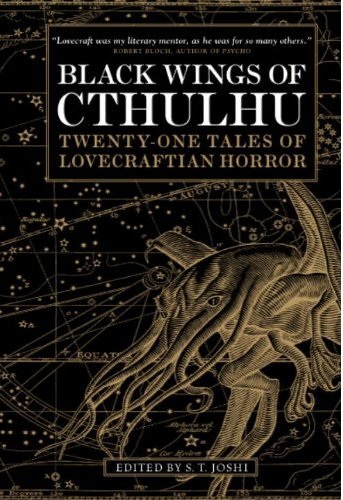
Black Wings of Cthulhu: 21 Tales of Lovecraftian Horror: edited by S.T. Joshi (2011) containing:

"Pickman’s Other Model (1929)" by Caitlin R. Kiernan
"Desert Dreams" by Donald R. Burleson
"Engravings" by Joseph S. Pulver, Jr.
"Copping Squid" by Michael Shea
"Passing Spirits" by Sam Gafford
"The Broadsword" by Laird Barron
"Usurped" by William Browning Spencer
"Denker’s Book" by David J. Schow
"Inhabitants of Wraithwood" W.H. Pugmire
"The Dome" by Millie L. Burleson
"Rotterdam" by Nicholas Royle
"Tempting Providence" by Jonathan Thomas
"Howling in the Dark" by Darrell Schweitzer
"The Truth about Pickman" by Brian Stableford
"Tunnels" by Philip Haldeman
"The Correspondence of Cameron Thaddeus Nash" annotated by Ramsey Campbell
"Violence, Child of Trust" by Michael Cisco
"Lesser Demons" by Norman Partridge
"An Eldritch Matter" by Adam Niswander
"Substitution" by Michael Marshall Smith
"Susie" by Jason Van Hollander

An excellent anthology of all-new stories inspired by H.P. Lovecraft, edited by Lovecraft expert S.T. Joshi. Joshi wisely didn't limit his writers to the Cthulhu Mythos, or even to explicit references to Lovecraft's work. Instead, there's a more general mandate of the weird and the cosmic (or 'cosmicism') at work here, though the explicitly Cthulhuesque is also welcome.

There really isn't a bad story in the bunch, and there are a number of standouts. Laird Barron's "The Broadsword" works within Barron's own Children of Old Leech mythology of terrible doings behind the walls of our world. Norman Partridge serves up a monstrous invasion within a narrative that works within the hardboiled parameters of the novels of James M. Cain and Jim Thompson. Ramsey Campbell has some fun with Lovecraft's near-obsessive letter-writing, while the protagonist of Jonathan Thomas's "Tempting Providence" seems to meet the ghost of HPL...or is something much more cosmic and sinister going on? Oh, that three-lobed burning eye!

One of the interesting things about the collection is that three stories -- "Pickman’s Other Model (1929)" by Caitlin R. Kiernan, "Inhabitants of Wraithwood" W.H. Pugmire, and "The Truth about Pickman" by Brian Stableford -- all deal with Lovecraft's transitional-phase short story "Pickman's Model" in various ways. It's a story that was adapted in a mediocre fashion for Night Gallery, but it's also probably the Lovecraft story with the most-quoted final line. Hell, Joanna Russ turned that line into the title of a story!

HPL's original story is transitional in the sense that while it looks ahead to the Cthulhu universe in which horror is all around us, waiting to be discovered, it also uses beings -- Lovecraft's version of ghouls, to be specific -- which are treated in a somewhat more whimsical, less horrific fashion in Lovecraft's Dunsanian novel The Dream Quest of Unknown Kadath, in which they actually aid the narrator during his voyage through the Dream Lands. These stories offer radically different takes on the original material: the authors definitely don't think the same way about the stately ghouls of Boston.

In any case, Joshi offers a pip of an anthology here, complete with a useful introduction. At least five of these stories (by my count) have already been anthologized in various 'Best of' and Cthulhu compilation volumes, which is pretty good for a book that's barely a year old. And the cover of the paperback is sweet. Highly recommended.

Friday, February 3, 2012

The 2009 Horror

The Best Horror of the Year Volume 2 (2009) edited by Ellen Datlow (2010) containing

*Lowland Sea by Suzy McKee Charnas
The End of Everything by Steve Eller
Mrs Midnight by Reggie Oliver
*each thing i show you is a piece of my death by Gemma Files and Stephen J. Barringer
*The Nimble Men by Glen Hirshberg
*What Happens When You Wake Up in the Night by Michael Marshall Smith
Wendigo by Micaela Morrissette
*In the Porches of My Ears by Norman Prentiss
Lonegan's Luck by Stephen Graham Jones
*The Crevasse by Nathan Ballingrud and Dale Bailey
The Lion's Den by Steve Duffy
Lotophagi by Edward Morris
The Gaze Dogs of Nine Waterfall by Kaaron Warren
Dead Loss by Carole Johnstone
*Strappado by Laird Barron
*The Lammas Worm by Nina Allan
*Technicolor by John Langan

Big, big improvement on the first volume of this series, with a lot more excellent stories and fewer boring ones. I've starred the high points, which run the gamut from near-future apocalypse ("Lowland Sea" by Suzy McKee Charnas) through a bad night at the movies ("In the Porches of My Ears" by Norman Prentiss) to, well, a bad night ("What Happens When You Wake Up in the Night" by Michael Marshall Smith).

The Toronto-set Gemma Files/Stephen J. Barringer story does a lovely job of combining both the structure and the content of new media with one of the oldest structures for a horror story (the epistolary format), while John Langan's story presents us with a mountingly dread-filled college classroom lecture on Poe. Recommended.

Friday, January 27, 2012

Men Vs. Chaos

The Imago Sequence and Other Stories by Laird Barron (Collected 2007):

Either The Imago Sequence and Other Stories or something I ate gave me a screaming-to-awake nightmare, so that's a recommendation. I even fell out of bed. If I were blurbing this, I'd write "The Imago Sequence and Other Stories made me fall out of bed with horror!!!"

Barron collides at least two things -- the wounded, jaded, unheroic, macho American tough guy from Hemingway or Cormac McCarthy with a Lovecraftian secret history -- that haven't been collided much before to my knowledge.

There's a certain sameness in the overall conception of several of the stories (first-person-narrating tough guy encounters horribly, horrifyingly awry cosmos, gets stripped of his manhood by cackling representative of chaos), but the imagery and the characterization really carry the day. Also, there's a lot of violence towards men. It's like he's trying to balance the scales. Cracks appear in reality. Cracks appear in traditional constructions of masculinity.

It's hard to summarize any of the stories without giving away the surprising horrors that await. Several appear to occur in pretty much the same universe, one that's Lovecraftian without explicitly name-checking Lovecraft's alien pantheon. Much of the action occurs in Washington State and other West Coast areas (Alaska and Northern California both figure), where real-world oddities (the Mima mounds) jostle up against assorted incursions into everyday reality by some truly awful things. Barron's characters are generally doomed, beset by forces that can't be stopped, incapable of action until it's far too late.

One thing done well here is making characters sympathetic whose backgrounds are anything but (a ruthless real-estate tycoon, a leg-breaker, an aging CIA operative, a right bastard of a Pinkerton detective) -- thus, the stories don't reduce down to EC-Comics-style revenge horror, in which the supernatural takes vengeance where the natural has failed. And yet that's the basic concept that Barron uses in some of these stories. But what's coming is so awful that no man deserves it. Or maybe he does. I'll be damned if I know. Tough and poetic and occasionally very funny, Barron really is already one of horror's brightest talents. Highly recommended.

Monday, January 23, 2012

Sleepy, Hollow

The Best Horror of the Year Volume One (2008), edited by Ellen Datlow (2009) containing:

Cargo by E. Michael Lewis
If Angels Fight by Richard Bowes
The Clay Party by Steve Duffy
*Penguins of the Apocalypse by William Browning Spencer
*Esmeralda: The First Book Depository Story by Glen Hirshberg
The Hodag by Trent Hergenrader
Very Low-Flying Aircraft by Nicholas Royle
When the Gentlemen Go By by Margaret Ronald
*The Lagerstätte by Laird Barron
Harry and the Monkey by Euan Harvey
Dress Circle by Miranda Siemienowicz
The Rising River by Daniel Kaysen
Sweeney Among the Straight Razors by JoSelle Vanderhooft
Loup-garou by R. B. Russell
Girl in Pieces by Graham Edwards
It Washed Up by Joe R. Lansdale
The Thirteenth Hell by Mike Allen
The Goosle by Margo Lanagan
Beach Head by Daniel LeMoal
The Man from the Peak by Adam Golaski
The Narrows by Simon Bestwick

Being the most subjective of genres, horror lends itself to argument when 'best of' selections are made. What scares one person may make another person chortle. Based on my encounters with multiple-award-winner Ellen Datlow's horror and dark-fantasy editing, the two of us don't have particularly complementary tastes. The first volume of this 'Year's Best Horror' anthology series from Night Shade Books seems to me to be an awfully scattershot assortment of stories, with only three stories I'd pick myself for such an anthology (I've starred them, if you're interested).

On the bright side, the technical side of horror writing seems in good shape -- there's nothing badly written here. Some of the stories are dark fantasy stories that aren't particularly horrific; others use tired tropes to unnoteworthy effect; a few offer nothing in the way of endings or even adequate set-up, instead falling into the nouveau-tired school of artsy fragments possessed of a few startling images but nothing in the way of character, plot, or cumulative horrific effect. These last examples remind me of Henry James's 100+ years-old-advice to ghost-story writers: "Write a dream, lose a reader."

The inclusion of two poems doesn't really help things either, while "Beach Head" gets the Ramsey Campbell "In the Bag" award for mislabelling a horrific story with a jokey title. I note this while also noting that Campbell himself flagged himself for the "In the Bag" mistake in the introduction of one of his short-story collections.

One story -- "The Narrows" by Simon Bestwick -- is especially frustrating because it's basically two good stories smashed together to make one frustrating one, as Lovecraftian shenanigans and nuclear holocaust work together in a way that never coheres. The standout here is William Browning Spencer's "The Penguins of the Apocalypse", which uses an old (and unlikely) monster to startling, quirky effect. Spencer's horror novels and short stories generally show a mind attuned to absurdity as well as horror -- he's the closest thing the genre currently has to Philip K. Dick, and God bless him for it. Not recommended.