Still Mine: written and directed by Michael McGowan; starring James Cromwell (Craig Morrison), Genevieve Bujold (Irene Morrison), Campbell Scott (Gary Fulton), and George R. Robertson (Chester) (2012): Based on a true story of frustrating governmental bureaucracy in New Brunswick (Canada), Still Mine follows octogenarian James Cromwell's attempts to build a new, one-story home on his own property so as to make caring for his Alzheimer's-stricken wife (Genevieve Bujold) workable. If some of the bureaucratic stuff seems fictional, take note that the real-life struggle was actually more arduous.
Cromwell, a veteran character actor probably best known as the farmer in Babe and Zefrem Cochrane in Star Trek: First Contact, does marvelous work here. In an American movie with a big enough name director, it's the sort of acting that gets an Oscar nomination. Bujold is also excellent, underplaying her descent into greater and greater silence and confusion. In her case, she's not showy enough for an Oscar nomination.
The movie could have devoted a few more minutes to the specifics of the bureaucratic hoops Cromwell keeps getting forced to jump through -- this is a relatively rare case in which exposition would help the dramatic elements. Nonetheless, the film is beautifully shot in both its long looks at landscapes and beaches and the passing of the seasons, and in recurring extreme close-ups of things one doesn't generally see in Hollywood movies -- which is to say, old faces and old bodies.
The supporting cast, mostly unknown with the exception of Campbell Scott, is excellent, low-key, and real-looking. One doesn't realize how unreal the casts of even the most serious of American dramas look until one sees people who look real, whether in independent movies or even in Hollywood movies made prior to the 1990's, when our genetically engineered overlords seized control of most mass-market movies and TV shows. Highly recommended.
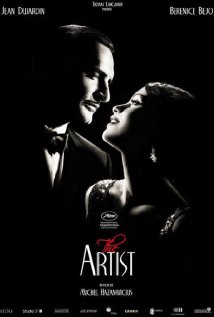
The Artist: written and directed by Michel Hazanavicius: starring Jean Dujardin (George Valentin), Berenice Bejo (Peppy Miller), John Goodman (Al Zimmer), and James Cromwell (Clifton) (2011): Hollywood tends to like its metanarratives peppy and upbeat when it's going to reward them with Oscars, and on the surface last year's Best Picture winner is just that. There's an underlying thread of despair, though, reminiscent of the sort of thing one sometimes found in Charlie Chaplin movies. Thankfully, the abyss is kept at bay with slapstick, dancing, and some awfully good scenes involving a dog.
This mostly silent movie (there's a score and sound effects and voices at key moments), shot in colour but presented entirely in period-appropriate black and white (and in a period-appropriate 1:1.33 aspect ratio) is a delight about the last days of silent motion pictures and the first few years of sound in Hollywood. Box-office king George Valentin, loosely based on Douglas Fairbanks, Jr., finds himself a relic of the past. The ingenue he discovered, Peppy White, finds herself becoming a big star.
The plot bears some similarity to the oft-filmed chestnut A Star is Born. Shot and staged like a late-silent-era movie, we get a certain amount of approriate mugging, a heroic dog with several killer scenes (one in which he fetches a police officer is a lovely bit of business worthy of a Chaplin or a Keaton), and a host of actors who look pretty much absolutely right for the time period and the way films looked back then. The French stars look great, while the Hollywood supporting actors -- most notably John Goodman and James Cromwell -- have the sort of faces that work perfectly in this milieu.
While there are also parallels between the plot of The Artist and Singing in the Rain, the number of allusions and references is broader than that. One will see shades of some of F.W. Murnau's films, Sunset Boulevard, Citizen Kane, City Lights, a musical quote from Vertigo, and a number of Guy Maddin films that play in the same sandbox. But you don't need a background in film to enjoy these references and salutes: The Artist is a delight on its own, and a delight from beginning to end. Highly recommended.
'Salem's Lot: adapted by Peter Filardi from the novel by Stephen King; directed by Mikael Salomon; starring Rob Lowe (Ben Mears), Andre Braugher (Matt Burke), Donald Sutherland (Straker), Samantha Mathis (Susan Norton), Robert Mammone (Dr. James Cody), Dan Byrd (Mark Petrie), James Cromwell (Father Callahan) and Rutger Hauer (Barlow) (2004): Very enjoyable, mildly unfaithful TNT miniseries adaptation of King's vampire novel could use another 80 minutes (which would have made it a 6-hour rather than a 4-hour miniseries). Most of that extra time could have been beneficially front-loaded: as is, we've really only scratched the surface with the main characters before we're headlong into the vampire narrative.
The most obvious change is that the story is now set in 2004 rather than 1975. There are the usual, necessary character conflations when dealing with a long novel (one sub-plot involving marital infidelity has been folded into the story of Dr. James Cody) and several pretty effective shifts made so as to show the viewer certain bad behaviours rather than explain different, more complicated behaviours, as the novel can do and a movie generally can't without a lengthy bit of spoken-word exposition. The small town of Salem's Lot comes across as more blatantly sinful than in the book, but that's partially because of the narrative compression. In any case, the evil from without still manifests itself at least partially as a mirror image of the evil within.
Rob Lowe does nice, nuanced work as protagonist Ben Mears -- watch this and an episode of Parks and Recreation to realize what a sharp actor he's become, handicapped though he is by being prettier than most of his female leads. Andre Braugher -- as Van Helsingesque English Teacher Matt Burke -- is solid and dependable in a somewhat underwritten role, while Samantha Mathis, Dan Byrd and Robert Mammone also do solid work as the unlikely, reluctant, disbelieving vampire fighters. Donald Sutherland plays the vampire's human henchman as a somewhat antic lunatic, more Renfield than the novel's version. Rutger Hauer wisely underplays Barlow the vampire, and the miniseries doesn't force him to deliver some of the novel's Dracula-esque Barlow lines, easily the weakest part of King's novel.
The filmmakers drop King's homage to Tolkien -- in the novel, crosses and holy water glow "with an elvish light" when a vampire is near. I think that's unfortunate, as one scene that uses that glow in the novel seems perfectly suited to filming (Father Callahan's confrontation with Barlow at the Petrie household). Creatures crawling across ceilings also don't have the same zing as they once did. There is something cool about the movie's depiction of vampire death, though, drawing as the visual effect does on a deflating balloon sputtering around.
Overall, there are a lot of good scares here and, because of changes made from the novel, a certain number of surprises awaiting King readers as well. Maybe the smartest decision made was to incorporate stretches of the novel's third-person narration as the first-person narration of Ben Mears. It's very effective, especially during the movie's opening and closing scenes. Recommended.