Office Space (1999): written and directed by Mike Judge; starring Ron Livingston (Peter), Jennifer Aniston (Joanna), David Herman (Michael), Ajay Naidu (Samir), Diedrich Bader (Lawrence), Stephen Root (Milton), and Gary Cole (Bill Lumbergh): Mike Judge's cult favourite about the dehumanizing effects of office work remains a mostly masterpiece nearly 20 years later. Now as then, only the limp, comedy-killing dishrag that is Jennifer Aniston in romantic comedies strikes a sour note. Otherwise, the cast and writing are impeccable. Nearly highly recommended (Damn you, Aniston!).

Deli Man (2014): written and directed by Erik Anjou: Thoroughly enjoyable documentary about the rise and fall of the Jewish deli in North America (well, Canada and the United States, anyway). Extremely tasty and surprisingly nourishing, though Montreal is a no-show (but Toronto does show up). The story of present-day Deli Man Ziggy Gruber, who "co-owns a large deli in Houston and is also the grandson of the original owner of the Rialto Deli, the first Kosher deli to open on Broadway in New York City in the 1920s," (IMDB) unifies the documentary's narrative. He's an interesting fella. Highly recommended.

Becoming Cary Grant (2017): written and directed by Mark Kidel and Nick Ware: While this documentary gets a bit too arty at times (and could use a lot more captioning to explain who people are in photographs and home-movie clips), it's still a captivating look at the life and work of Cary Grant (born Archie Leach in England). While there are interviews with critics, historians, friends, and family members, most of the heavy lifting is done by Jonathan Pryce reading sections from Grant's never-published autobiography. It's fascinating stuff, augmented by the fact that Grant found success in LSD-aided therapy. Recommended.

Morgan (2016): written by Seth Owen; directed by Luke Scott; starring Kate Mara (Lee Weathers), Anya Taylor-Joy (Morgan), Rose Leslie (Amy), Toby Jones (Ziegler), Paul Giamatti (Shapiro), Michelle Yeoh (Dr. Cheng), and Boyd Holbrook (Skip): Or, Ex Machina for Dummies. Nothing in this 'AI seeks to escape its creators by any means necessary' film makes much sense if examined too closely, from the convenient;y breakable glass skylight in the AI's cell to the idea that a major corporation would have scientists developing super-dangerous, super-expensive super-soldiers without having lots of supervision and security on-site. Kate Mara elevates the material with her performance as a security wetwork specialist sent to clean things up at the rustic mansion of a lab, as does Anya Taylor-Joy (The Witch) as the eponymous Morgan. But it's pretty dumb, though it marks the directorial debut of Ridley Scott's son, Luke. Not recommended.
Muppets Most Wanted: based on characters created by Jim Henson; written by James Bobin and Nicholas Stoller; directed by James Bobin; starring Ricky Gervais (Dominic Badguy), Ty Burrell (Jean Pierre Napoleon), Tina Fey (Nadya), and the voices of Steve Whitmire, Eric Jacobson, Dave Goelz, Bill Barretta, David Rudman, and Matt Vogel (2014):
The fundamental problem with a Muppet movie is that the Muppets were best on their 1970's and early 1980's TV variety show (well, or on Farscape, but that's a different story).
That said, this is an enjoyable sequel with a lot of winning moments and funny songs. Its box office suggests that the Muppets aren't a draw for children, but I think that's mainly the problem of there not being a Muppet TV show. Or podcast. Or whatever. The actors, human and puppet, all seem to be having a marvelous time. Cameos abound, as the movie takes its cues from the first Muppet movie (that being The Muppet Movie) when it comes to cameos.
Muppets Most Wanted is all a bit music-heavy, and the plot creaks in its machinery. Ricky Gervais makes a fine villain who could use more lines. And boy, Tina Fey has lost weight since 30 Rock! Recommended.
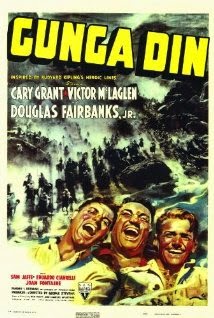
Gunga Din: based on the poem by Rudyard Kipling; written by Joel Sayre, Fred Guiol, Ben Hecht, Charles MacArthur, William Faulkner, Lester Cohen, John Colton, Vincent Lawrence, Dudley Nichols, and Anthony Veiller; starring Cary Grant (Cutter), Victor McLagen (MacChesney), Douglas Fairbanks Jr. (Ballantine), Sam Jaffe (Gunga Din), and Eduardo Ciannelli (Guru) (1939): Tremendously dated in its presentation of racial, cultural. and colonial values, Gunga Din nevertheless still has its moments of comedy, action, and drama. It's also one gigantic crib-note for Indiana Jones and the Temple of Doom.
Set in colonial India in the 1890's, Gunga Din is somewhat improbably based on a poem by Rudyard Kipling (who shows up as a character towards the end, along with a partial reading of the poem). Cary Grant, Victor McLagen, and Douglas Fairbanks Jr. play three sergeants tasked with investigating an uprising by the Thugee cult of murderous Kali worshipers.
Grant wisely took the best role in the film, that of the treasure-obsessed Cutter who's nonetheless the soldier who most treats water-carrier Gunga Din like a man and not an object. And Sam Jaffe manages to invest Din, who's about one step away from Stepin Fetchit, with a certain amount of dignity and heroism.
As the villainous cult leader with the oddly generic name of Guru, Eduardo Cianelli steals every scene he's in. At this point in history, his opposition to British colonialism seems perfectly legitimate. Maybe if he'd just have his followers stop strangling everybody! But he's the most articulate character in the movie, he has a self-sacrificing end that parallels that of Gunga Din, and he has one terrific speech about why he fights for Indian self-rule. He's like Gandhi, only with a lot more strangling and killing! Also, there's a lovable elephant, and enough historical inaccuracies in the types of weapons used by the British to keep any gun enthusiast up all night. Recommended.
Suspicion: adapted by Samson Raphaelson, Joan Harrison, and Alma Reville from the novel by Anthony Berkeley; directed by Alfred Hitchcock; starring Cary Grant (Johnnie) and Joan Fontaine (Lina) (1941): With the only Oscar-winning performance in a Hitchcock film -- Joan Fontaine for Best Actress -- one might imagine that this is first-rank Hitchcock. It isn't.
There's some question as to whether or not Hitchcock really was over-ruled by the studio about the ending. Whether or not he was, the movie makes absolutely no sense with the ending it has. The possibility that Hitchcock always intended the film to suggest that one character is delusional only makes sense within a framework in which either a number of events never actually occur, in which case the character is insane, or the events do occur but are coincidental, in which case the entire universe is insane.
Suspicion was a big financial success and gave Hitchcock a lot of creative control thereafter, as this was also the first film he produced as well as directed inside the Hollywood system. Regardless of the ending, the gender dynamics in Suspicion have dated so poorly that it's agonizing for repeated stretches, and not in a way that's enjoyable unless you're writing a paper on gender dynamics in Hitchcock films. Fontaine certainly gives some sort of performance, as she's on-screen for almost every minute of the movie. Grant is uncharacteristically menacing, which is interesting in and of itself.
There are the usual bravura Hitchcock touches, including a host of scenes in which shadows suggest spider-webs enveloping the characters, and the famous Glowing Glass of Milk Scene, which comes almost at the end of the picture if you're waiting for it. But for a 99-minute movie, this is awfully draggy, with almost schematically unlikeable characters made completely baffling by that godawful ending. But it's Hitchcock, so it's still lightly recommended.